
The monthly fee on a real estate website builder’s pricing page represents roughly half of what agents actually spend to produce a single lead through that platform. IDX fees, CRM add-ons, content labor, and conversion tool costs double or triple the advertised price before a single contact enters your pipeline. Comparing builders by their sticker price is comparing houses by their paint color.
TL;DR: Your real estate website builder ROI depends on total cost of ownership divided by qualified leads, not the monthly subscription alone. When you add IDX integration costs, CRM fees, plugin expenses, and labor hours, a $49/month platform can cost more per lead than a $299/month alternative that bundles those same tools and converts at a higher rate.
The Monthly Price Tells You Almost Nothing
IDX integration costs alone can double a budget before accounting for CRM connections, lead capture tools, or content production. According to Luxury Presence’s 2026 pricing breakdown, IDX setup fees range from $200 to $2,000 or more, with monthly service fees of $50 to $200. The CE Shop reports that standalone IDX services run $39 to $69 monthly per user, plus a one-time $99+ setup charge for credential validation.
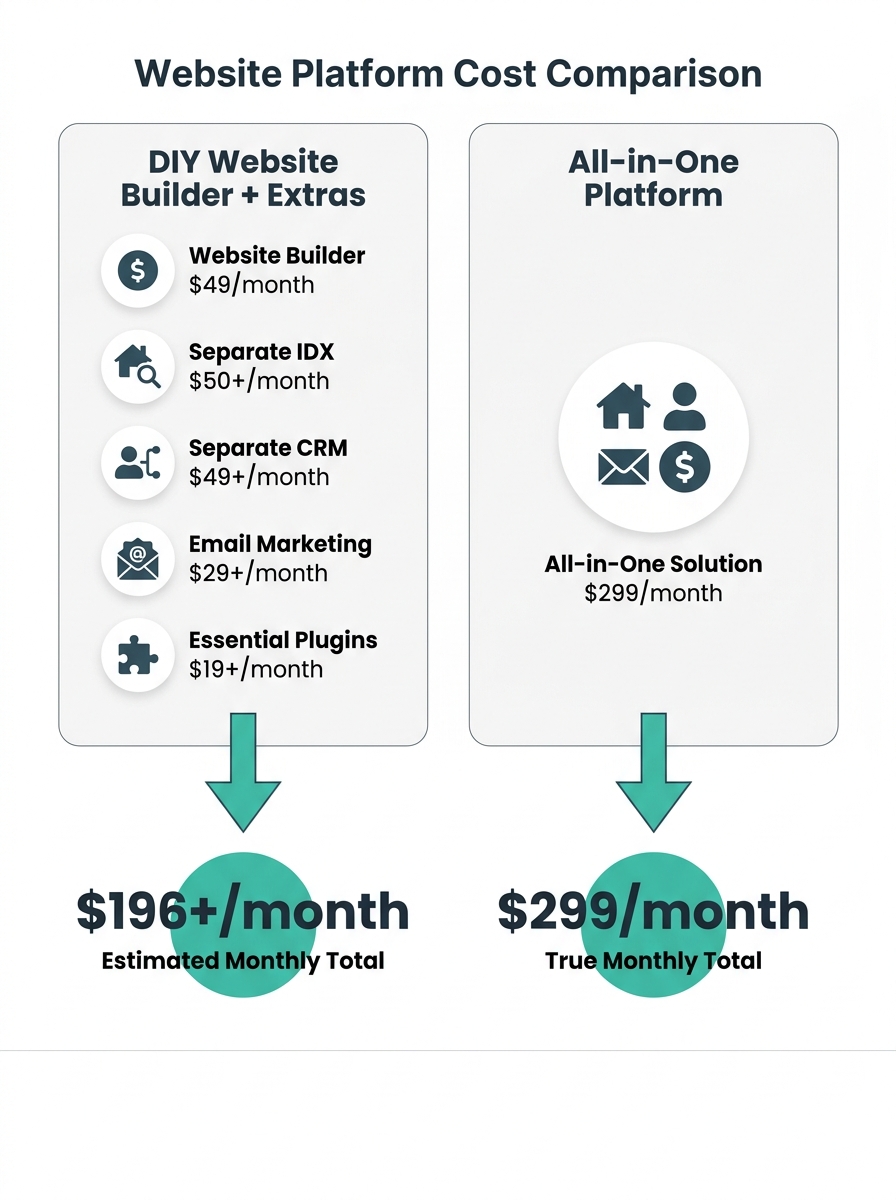
So a website builder advertising $49/month quickly becomes $49 + $69 (IDX) + $49 (CRM) + $29 (email automation) = $196/month before you’ve spent a dollar on content or ads. Compare that with an all-in-one platform at $299/month that bundles IDX search, CRM, and automated follow-up. CloseDaily’s integration guide puts the realistic monthly cost for a solo agent who wants IDX search, a CRM, and automated follow-up at $299 to $300 per month on an all-in-one platform, or $200 to $600 per month when assembling separate tools.
The math is clear: the “cheap” website is often the expensive one. Understanding your website builder total cost of ownership means listing every recurring charge, every setup fee, and every hour of your time spent managing integrations that a bundled platform would handle automatically.
The Five-Line Cost Sheet
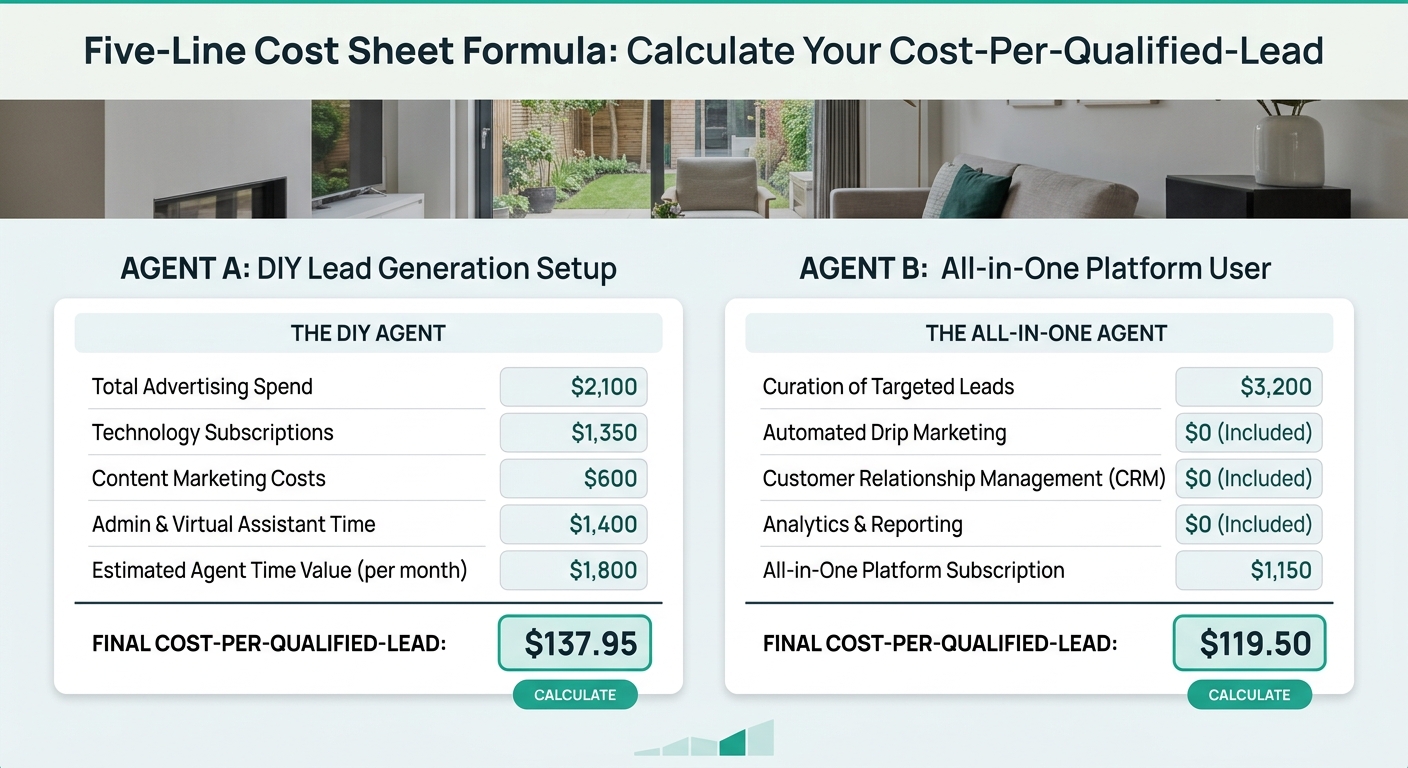
Why do agents consistently underestimate their website spending? Because the costs live in five separate buckets, and no one adds them together. Here’s a framework for calculating lead cost per acquisition by platform that forces an honest number.
Line 1: Platform fees. Monthly subscription plus any annual charges or premium tier upgrades. Include theme or template costs if they’re separate purchases. Range: $29 to $500/month depending on builder.
Line 2: IDX and MLS connectivity. Setup fees ($200 to $2,000) plus monthly IDX fees ($39 to $200). If your builder includes native MLS connectivity, this line may be $0. If it doesn’t, this is your largest hidden cost.
Line 3: Add-on tools. CRM subscription, email marketing platform, chatbot or live chat service, landing page builder, appointment scheduling software. Agents who chose platforms based on CRM integration as the primary selection criterion tend to avoid this line item ballooning.
Line 4: Content and maintenance labor. Blog posts, listing descriptions, photography optimization, SEO updates. If you’re hiring a VA or content writer, use their hourly rate times hours per month. If you’re doing it yourself, assign your time a value. A $449 WordPress package (the going rate for a professionally-built real estate WordPress site according to one developer’s published pricing) still needs $200 to $500/month in ongoing content and maintenance labor to stay competitive.
Line 5: Total monthly cost ÷ qualified leads. This is the number that matters. Add lines 1 through 4, then divide by the number of leads you received that month who were actually interested in buying or selling. Raw form submissions don’t count. Someone who fills out “Tell me about 123 Main Street” and never responds to follow-up is a data point, not a lead.
A $150 qualified lead that converts at 20% delivers better ROI than a $3 raw lead that converts at 0.5%.
That insight comes directly from 2026 CPL benchmark data, which documents the math: $150 ÷ 0.20 = $750 customer acquisition cost, while $3 ÷ 0.005 = $600 customer acquisition cost. The cheaper lead looks better on a dashboard but performs nearly the same when you factor in the conversion rate. And the $3 lead required you to sift through hundreds of unqualified contacts to find the few who closed.
Custom Builds vs. SaaS Platforms: Where the Money Actually Goes
The cost spectrum for real estate websites stretches wider than most agents realize. Custom builds from real estate-specific development agencies run $5,000 to $15,000 for a standard site, and established agents investing in brand identity can spend $5,000 to $25,000+ on fully custom architecture. According to Luxury Presence’s analysis of SaaS versus traditional website providers, the gap between agents running a modern SaaS platform and those relying on a one-time custom build has widened significantly in 2026.
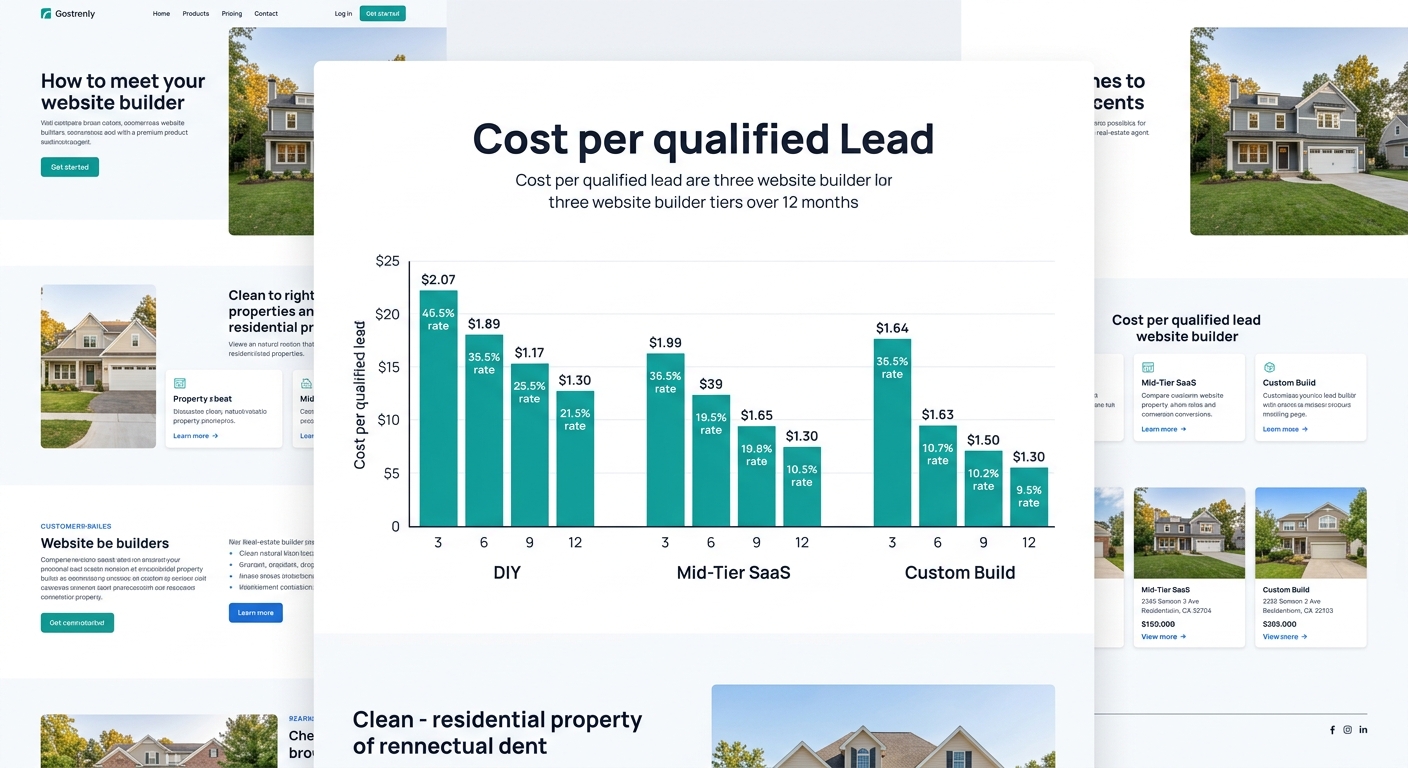
Here’s how the three main tiers compare when you factor in total cost of ownership across the first 12 months:
| Cost Category | DIY Builder + Plugins | Mid-Tier SaaS Platform | Custom Agency Build |
|---|---|---|---|
| Year 1 setup | $0–$200 | $0–$500 | $5,000–$25,000 |
| Monthly platform | $29–$79 | $199–$399 | $0–$150 (hosting/maintenance) |
| IDX integration costs | $139–$269/mo (separate) | $0 (bundled) | $50–$200/mo (separate) |
| CRM/email tools | $49–$149/mo | $0 (bundled) | $49–$149/mo |
| Year 1 total | $2,800–$8,600 | $2,400–$5,300 | $6,200–$31,000 |
| Typical leads/month | 3–10 | 10–30 | 8–25 |
| Cost per lead (Year 1) | $23–$239 | $7–$44 | $21–$323 |
The DIY builder’s low entry price creates an illusion of savings. But when IDX integration costs, CRM subscriptions, and plugin fees stack up, the annual bill rivals or exceeds the bundled SaaS option, and agents who struggle with CTA placement and conversion architecture on DIY platforms tend to generate fewer qualified leads from the same traffic volume.
Custom builds make sense for luxury agents and large teams where brand differentiation drives referral business. HousingWire’s 2026 analysis of website builders noted that luxury-focused platforms deliver the highest ROI through brand alignment and marketing features, specifically for agents whose clients expect a premium digital experience.
The Conversion Variable Most Agents Ignore
Your website builder choice doesn’t determine lead volume alone. It determines conversion rate, which is the multiplier that makes every other number in your cost sheet go up or down. A site with strong conversion-optimized CTAs and fast load times will produce 2x to 3x the qualified leads from the same traffic as a site with generic contact forms and 4-second page loads.
The 2026 CPL benchmarks published by Martal recommend maintaining at least a 3:1 ratio of customer lifetime value to customer acquisition cost. For a real estate agent whose average commission is $8,000, that means your cost to acquire a single closing client should stay below $2,667. If your website generates 10 qualified leads per month at a total cost of $400/month, and 1 in 10 leads eventually closes, your website’s acquisition cost per client is $4,000. You’re underwater on the 3:1 ratio.
Tip: Run the Five-Line Cost Sheet for three consecutive months before making any website platform switch. Single-month snapshots skew heavily based on seasonal traffic and listing inventory. A 90-day average gives you a defensible baseline for comparing your current real estate website builder ROI against alternatives.
The fix isn’t always switching platforms. Sometimes it’s improving the site you already have. Adjusting your site’s information architecture or fixing mobile navigation issues can double your qualified leads without adding a single dollar to your monthly platform spend. The Five-Line Cost Sheet helps you identify whether the problem is your platform’s cost or your site’s conversion rate, because the intervention for each is completely different.
What the Numbers Leave Out
Two factors resist clean spreadsheet math. First, your time. The hours spent troubleshooting a plugin conflict, manually importing listings, or cobbling together a Zapier automation between your website form and your CRM carry real cost. An agent billing $150/hour in opportunity cost who spends 5 hours per month on website maintenance is adding $750 to their monthly total, pushing a $49 platform’s true cost above $800.
Second, the leads you never see. Slow-loading pages, broken IDX search, and confusing navigation don’t show up as a line item. They show up as visitors who leave without converting, and you’ll never know how many there were. Comparing Pillar’s pricing and included features against your current stack using the Five-Line Cost Sheet gives you the cost side of the equation. The conversion side requires tracking what your site actually produces each month, then asking whether that number reflects the traffic you’re receiving or the traffic you’re losing.
The real estate website builder market wants you to compare $49 against $299 and feel like you’re saving $250. The audit forces a different comparison: cost per qualified lead on Platform A versus cost per qualified lead on Platform B. That number often inverts the obvious choice, and it’s the only number that connects your website investment to your actual commission income.