

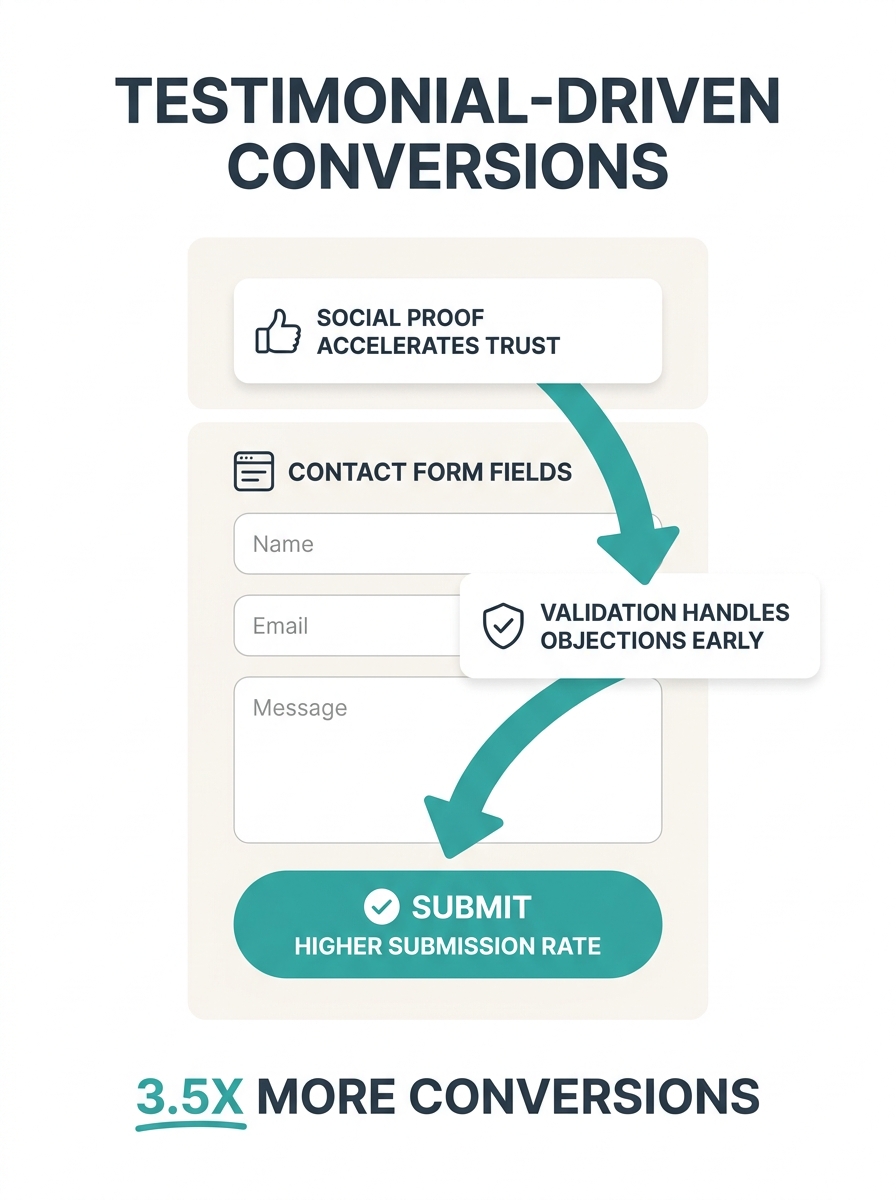
Testimonials placed within one scroll of a contact form convert at measurably higher rates than identical reviews buried on a standalone page. That positioning decision, proximity to the conversion point, explains most of the 34% lead lift that conversion analyses attribute to social proof on real estate websites.
TL;DR: Where you place testimonials matters more than how many you collect. Reviews near forms and CTAs drive a 34% conversion increase; the same reviews on a dedicated page that captures under 3% of site traffic accomplish almost nothing. These seven rules prioritize placement over volume.
Put reviews within scroll-distance of every contact form
88% of consumers trust online testimonials as much as personal recommendations, according to survey data cited across multiple lead generation platforms. That trust only converts when the testimonial appears at the moment a visitor hesitates, directly beside or above the form where they’re deciding whether to submit their information.
Carrot’s conversion analysis puts hard numbers on this: adding testimonials to a real estate site pushes conversion from 10% to 13.4%, generating 134 leads per 1,000 monthly visitors instead of 100. Trust signals on a real estate website function as friction reducers, not standalone content. A glowing five-star review sitting two clicks away from the contact form has zero measurable impact on the visitor who’s hovering over “Submit” right now.
The practical application: audit every page on your site that contains a form, a phone number, or a scheduling widget. If there isn’t at least one client testimonial visible without scrolling past the CTA, you’ve found a conversion gap. For more on positioning your conversion points effectively, our breakdown of where agents hide their most valuable CTA buttons covers the broader layout problem.
Stop sending traffic to a dedicated reviews page
Dedicated review pages feel organized. They also perform terribly. Analytics from real estate agent sites consistently show these standalone pages capture under 3% of total site sessions. The visitors who do land there arrived already convinced. They’re validating a decision they’ve already made, not being persuaded.
WiserNotify’s analysis of real estate conversion rates recommends displaying client testimonials on “the homepage, property pages, and call-to-action sections” rather than corralling them onto a single page. Social proof works as a psychological trigger when it meets visitors where they already are, during the decision-making moment.
If you’ve already built a reviews page as part of your site architecture for buyer intent, don’t delete it. It still serves an SEO function and provides a canonical URL for your review collection. But stop treating it as your primary testimonial placement strategy. Distribute those same reviews across every high-traffic page instead.
Match each testimonial to the page’s specific conversion goal
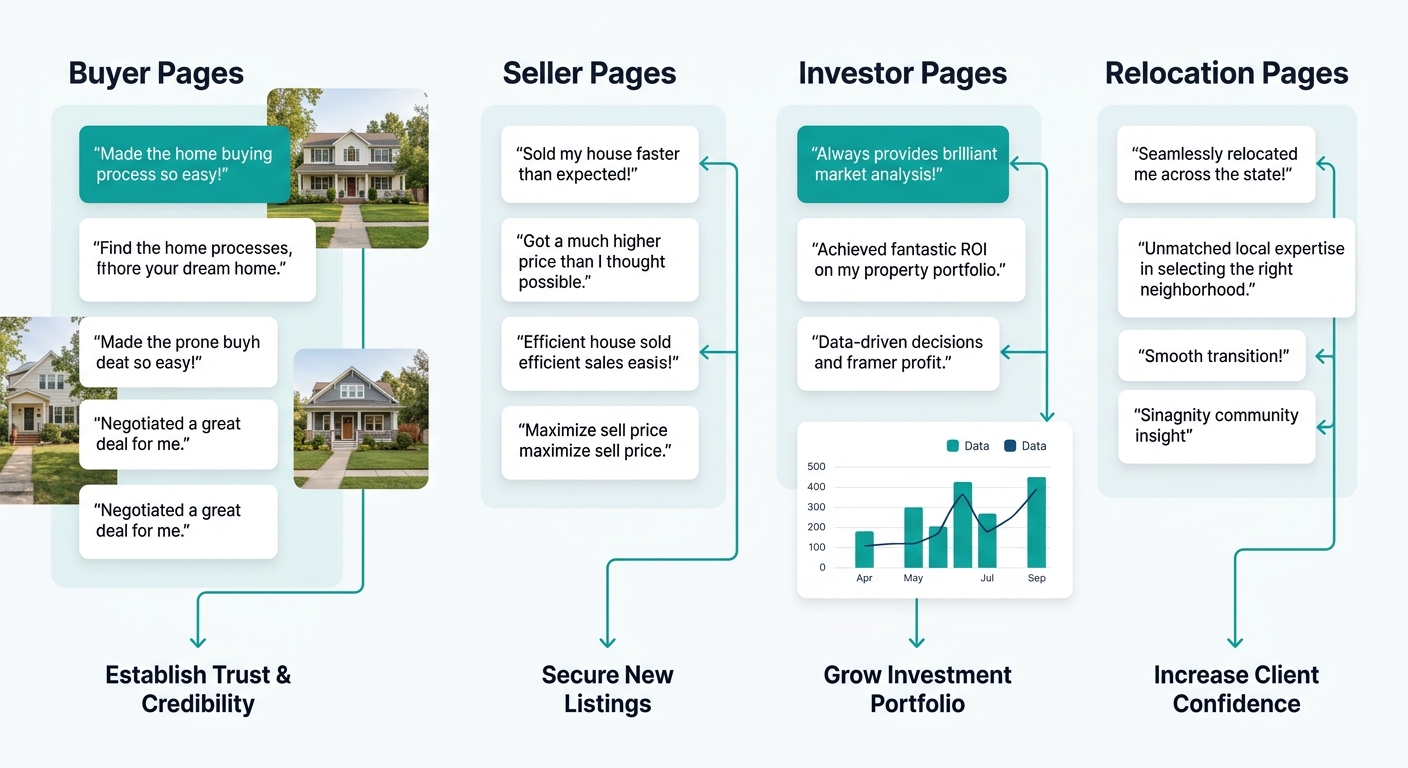
A first-time buyer testimonial on a luxury listing page creates cognitive dissonance. A seller testimonial on a buyer-focused neighborhood page wastes its persuasive power. The match between the review’s narrative and the visitor’s intent determines whether the testimonial accelerates real estate social proof conversion or gets scrolled past entirely.
Krofile’s guide to real estate review examples identifies the specific outcomes that carry the most weight: testimonials stating concrete results like “sold 10% above asking price” outperform generic praise by a wide margin on seller-focused pages. Quantitative details anchor trust in a way that “great agent, highly recommend” never will.
Here’s how to sort your existing reviews:
- Buyer testimonials → property search pages, neighborhood guides, buyer resource pages
- Seller testimonials → home valuation pages, listing presentation pages, seller CTA sections
- Investor testimonials → investment property pages, market analysis content
- Relocation testimonials → area guides, out-of-state buyer landing pages
This approach to review page optimization turns a scattered collection of praise into targeted persuasion that speaks directly to each visitor’s situation. One review in the right context outperforms twelve reviews in the wrong one.
Refresh testimonials every 90 days or watch credibility erode
A testimonial dated 2022 on a 2026 website signals neglect. Visitors notice timestamps, and stale reviews raise an immediate question: has this agent closed a deal recently? Luxury Presence’s social proof guide for real estate professionals states that “authenticity and relatability often matter more than experience alone,” and nothing undercuts authenticity faster than a review collection that hasn’t been updated in two years.
The 90-day refresh cycle works because it aligns with typical real estate transaction timelines. An agent closing 12 to 20 transactions per year generates enough new material to rotate fresh reviews quarterly. If you’re using a tool like MyReviewDashboard’s ReviewStream, which pulls your most recent reviews onto your site automatically via a code snippet compatible with WordPress and Placester, the process requires almost no manual effort after initial setup.
Tip: Set a calendar reminder for the first of every quarter. Spend 15 minutes swapping your three most recent reviews across your homepage, about page, and top-performing listing pages. Delete any testimonial older than 18 months unless it contains unusually specific transaction details worth preserving.
Pull third-party reviews onto your site instead of linking away
Every outbound link to Zillow, Google Business, or Realtor.com sends a potential lead to a platform filled with competing agents. Customer testimonial lead generation depends on keeping visitors on your domain long enough to convert, and linking out to review platforms does the opposite.
RealEstateBees’ 2026 comparison of realtor review sites found that agents can create free profiles across multiple platforms where verified customer reviews display publicly. The smart play is pulling those verified reviews back onto your own site, embedding them directly into your pages, rather than sending visitors to read reviews in an environment where competitor profiles sit one click away. Zillow, Realtor.com, Google, Yelp, and Facebook all serve as source platforms for reviews you should be displaying on your own domain.
Tools like ReviewStream aggregate reviews from Google, Yelp, and Facebook into a single embeddable widget. The result: your visitors see the credibility of third-party verification without ever leaving your site. This approach pairs especially well with a mobile navigation structure that keeps imported reviews visible alongside your primary contact options.
A testimonial two clicks away from the contact form has zero impact on the visitor hovering over “Submit” right now.
Format testimonials for mobile screens first
Mobile usage for real estate browsing crossed 55.1% in 2021 and has continued climbing since. If your testimonials display as long paragraph blocks that require scrolling through walls of text on a phone screen, they’re actively creating friction rather than reducing it.
Effective mobile testimonial formatting follows three constraints:
- Cap display length at 2 to 3 sentences on mobile view, with a “read more” expansion toggle for longer reviews
- Use tappable elements of at least 44×44 pixels for any interactive review components, including star ratings, expansion toggles, and profile photos
- Stack testimonials vertically in a swipeable carousel rather than side-by-side layouts that force pinch-zooming
The real estate social proof conversion rate on mobile depends on these formatting details. A testimonial that requires effort to read creates friction at the exact moment you need to eliminate it. Every extra pinch, zoom, or horizontal scroll gives the visitor a reason to tap the back button instead of the contact form.
Ask for testimonials that name specific numbers and neighborhoods
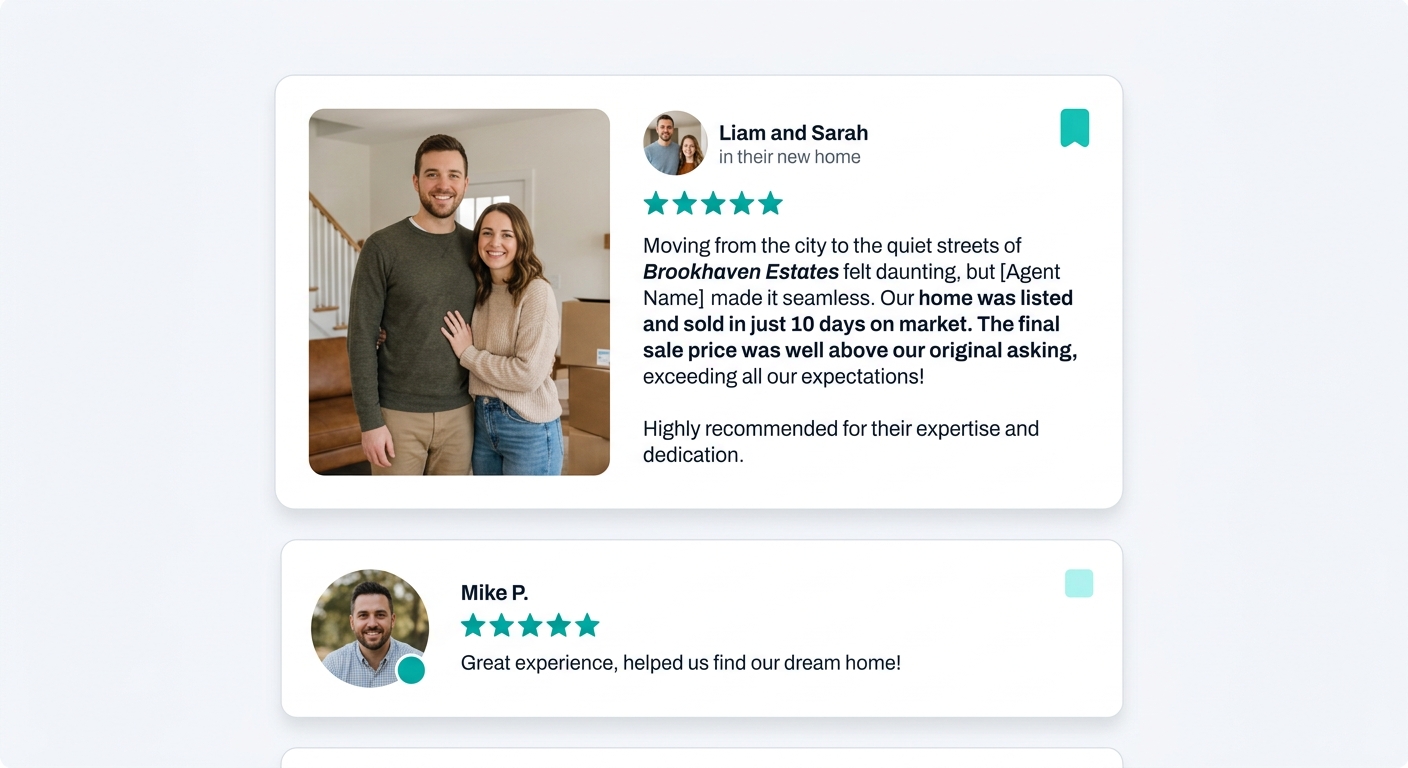
Generic praise converts poorly. “John was amazing, 10/10 would recommend” reads as genuine but gives the prospective client nothing concrete to anchor their trust. The testimonials that move leads toward conversion include specific transaction details: sale prices relative to asking, days on market, neighborhood names, dollar figures.
Luxury Presence’s social proof guide emphasizes that even new agents can build credible social proof by collecting testimonials from past collaborators and former colleagues, provided those testimonials contain concrete, verifiable details. Specificity and relatability carry more persuasive weight than sheer volume of five-star ratings.
When requesting reviews from past clients, provide a prompt that steers them toward numbers: “Would you mind mentioning the neighborhood, the approximate timeline from listing to closing, and whether the final price met your expectations?” The resulting testimonial, something like “Sold our Riverside bungalow in 14 days, $22,000 over asking,” functions as both social proof and a local SEO signal when published on your site. That kind of specificity does double work that vague praise never will.
When These Rules Break Down
These seven rules assume you have a website that already generates steady traffic and contains functioning conversion points. If your site gets fewer than 200 monthly visitors, testimonial placement won’t move the needle because the underlying traffic problem needs solving first. Addressing your site’s information architecture will deliver a larger return on effort at that stage.
The rules also assume you’re collecting reviews consistently. An agent with three total testimonials shouldn’t distribute them across six pages. Concentrate thin review inventory on your homepage and primary CTA page until you’ve built enough volume, aim for 8 to 12 reviews minimum, to begin distributing across property pages and neighborhood guides. And if your reviews skew heavily toward one transaction type (all buyer clients, for example), the matching rule in section three becomes impossible to follow until your review portfolio diversifies. Placement strategy becomes powerful once the raw material exists to support it. Until then, focus on asking every closing client for a testimonial with specific details, and position the few you have where the math says they’ll matter most: right next to the form.