

The dominant real estate homepage pattern for the past decade, a hero image with a centered search bar, no longer matches documented buyer behavior. 98% of homebuyers search for listings online, but the path from landing to lead now runs through visual browsing, neighborhood context, and AI-driven personalization rather than a zip-code field.
The Search Bar as Homepage Centerpiece
For years, the standard real estate homepage followed a predictable formula: full-bleed hero image of a skyline or staged living room, a prominent search bar dead center, and maybe a row of featured listings below the fold. The logic was straightforward. Buyers want to search, so give them a search box immediately.
And that logic wasn’t wrong, at least when desktop traffic dominated. A buyer sitting at a laptop could comfortably type “3 bed, 2 bath, 78704” into a search field and filter from there. The search bar acted as the gateway to the entire site. IDX feeds pulled listings directly, and agents measured success by how many visitors initiated a search.
By 2023, most real estate website templates, from WordPress themes to platform-specific builders, still centered their homepage layout conversion strategy around this single interaction. The hero search bar was so ubiquitous that deviating from it felt risky, as if removing the search bar meant hiding the product.
But the data on how buyers actually used these homepages was already diverging from the design assumption.
When Mobile Traffic Broke the Original Model
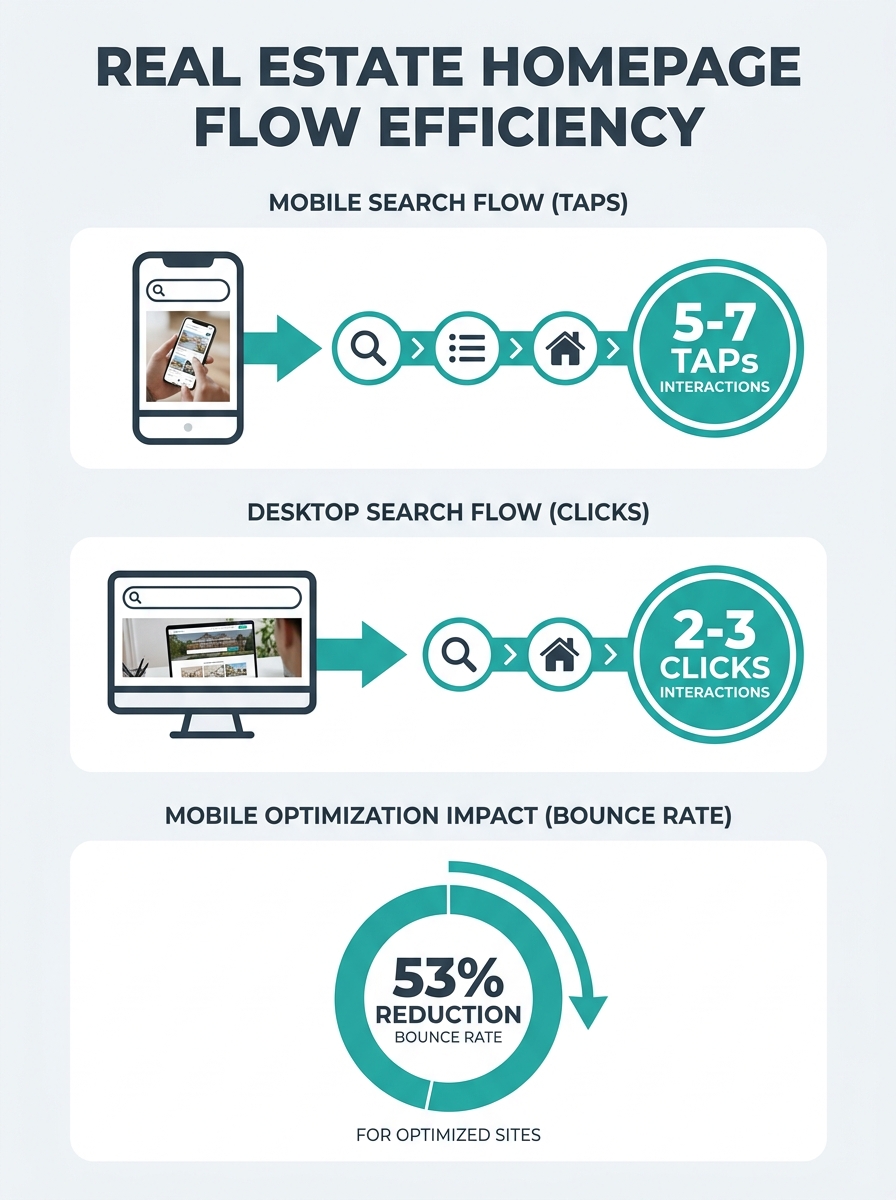
The shift didn’t happen overnight. It accumulated. By 2024, mobile devices accounted for 76% of home search activity, according to NAR buyer behavior data. And on a 6-inch screen, the hero search bar presented real usability problems.
Think about what typing into a search field on mobile actually involves: tap the field, wait for the keyboard to slide up (now covering half the screen), type a location, hit search, then navigate through filters designed for desktop sidebars. The friction at each step was measurable. Sites built around mobile-first navigation principles saw bounce rates drop by up to 53%, while legacy desktop-first layouts hemorrhaged visitors who couldn’t complete basic tasks within three seconds of landing.
The research from Paired Inc.’s analysis of buyer behavior on agent websites captured the core tension: buyers still want property search as their first interaction, but when that search functionality isn’t visible within the first scroll or requires too many taps, a large portion of visitors will leave and find a site where it is.
The problem wasn’t that search stopped mattering. The problem was that the input method changed, and over 75% of real estate web traffic was now coming from devices where the old input method created friction at every step.
Visual Browsing Replaces Keyword Entry
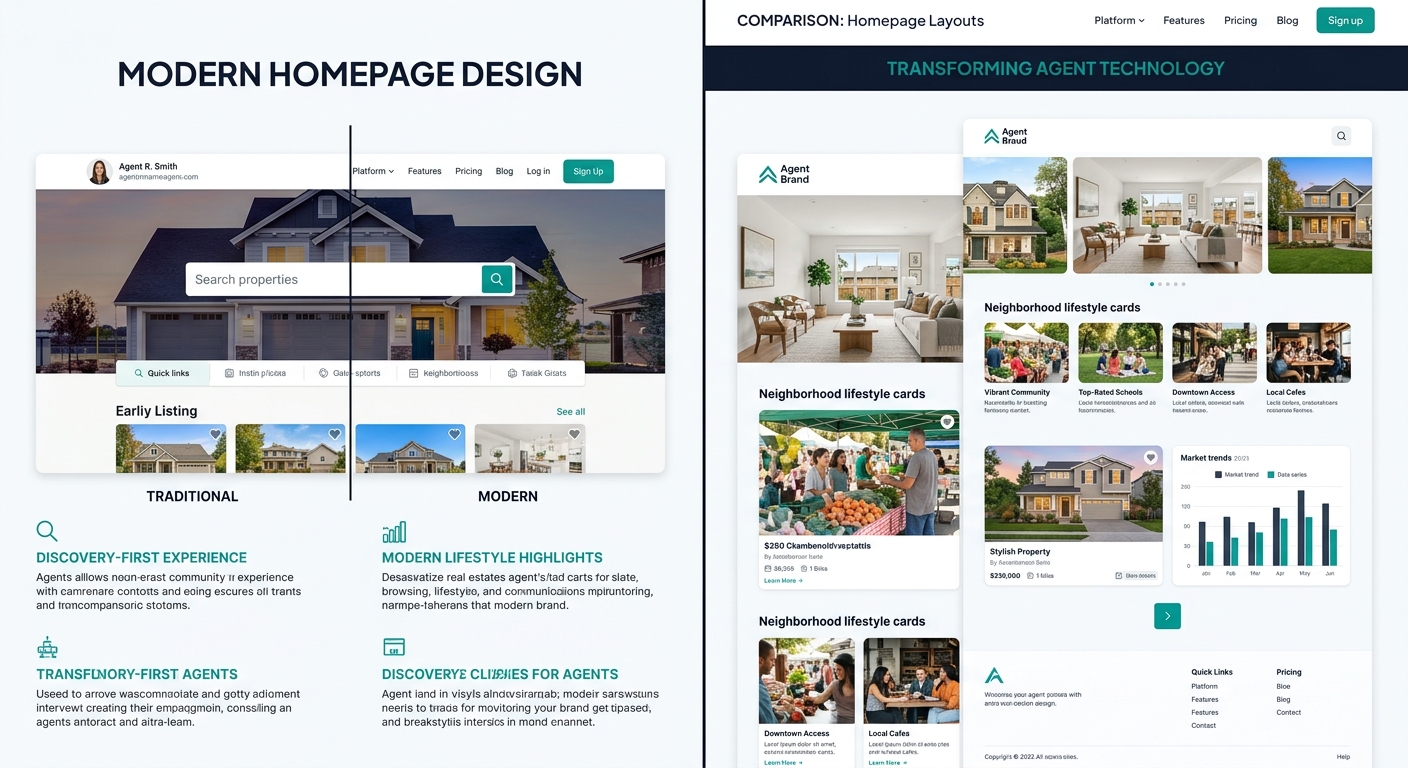
Between 2024 and 2025, the highest-converting real estate sites started making a structural change to their property search UX patterns. Instead of centering the homepage on a search input, they centered it on curated visual content: neighborhood photo collections, featured listing cards with large images, and area-specific landing pages that let buyers browse by lifestyle rather than filter by bedroom count.
This wasn’t random experimentation. It followed documented principles of visual hierarchy and emotional design in how users actually scan web pages. Research on web design psychology confirmed that Z-pattern layouts work better for visual content, while F-patterns suit text-heavy pages. Real estate homepages, which are inherently visual products, had been forcing buyers into text-input behavior that contradicted how eyes naturally move across a screen.
The numbers backed up the shift. High-quality property visuals and virtual tours increased listing views by 61%, and cinematic point-of-view photography boosted inquiries by 403%. Color choices played a measurable role too: blue tones built trust, green suggested growth, and red or orange elements created urgency around CTAs.
Here’s the stat that reframed the entire real estate homepage redesign conversation: 75% of users judge a website’s credibility based on its design, and that judgment forms in roughly 0.05 seconds. A homepage that opens with a beautiful neighborhood image, a one-line value proposition, and tap-friendly listing cards communicates credibility faster than a text input field ever could.
75% of users judge a website’s credibility based on its design, and that judgment forms in 0.05 seconds. A text input field doesn’t win that race.
Agents who made this shift found that their search functionality didn’t disappear. Search moved to a dedicated page or a sticky navigation element, always accessible but no longer the homepage’s sole reason for existing. The homepage became a curation layer, a first impression designed around buyer intent rather than database access.
AI Personalization Enters the Layout
The next phase started gaining traction in early 2025 and accelerated through 2026. AI-driven personalization tools began reshaping what buyers see on a homepage based on their behavior, location, and search history. The impact on buyer intent design 2026 strategies is quantifiable: sites using AI personalization to recommend properties based on user behavior report conversion rate increases of 30%. AI chatbots handling initial buyer inquiries have driven lead capture rates up by 40% by qualifying high-intent visitors around the clock.
A/B testing, which can improve conversions by 49% when applied to headlines, CTAs, and layouts, became significantly more powerful when paired with AI. Instead of running a single split test across all visitors, agents could test different homepage variants for different buyer segments: first-time buyers seeing affordability-focused content, move-up buyers seeing school district data, investors seeing rental yield calculations.
With 93% of homebuyers using local search to find properties, the most effective strategies combined AI personalization with hyper-local content. Neighborhood pages featuring local amenities, recent sales data, and original media became the connective tissue between the homepage and specific listings. When a buyer lands on your homepage after searching “homes near Barton Springs,” your site should already surface relevant area content without requiring them to start from scratch.
This is where strong information architecture matters more than any single design element. A beautiful homepage that dumps every visitor into the same generic experience wastes the behavioral data you’re already collecting through analytics, cookies, and referral parameters.
What The Data Looks Like Today
The real estate homepage redesign conversation in 2026 sits at a clear inflection point. The search bar isn’t dead, but its role has fundamentally changed. It’s a utility, like a site’s navigation menu: present and functional, but no longer the centerpiece of the homepage experience.
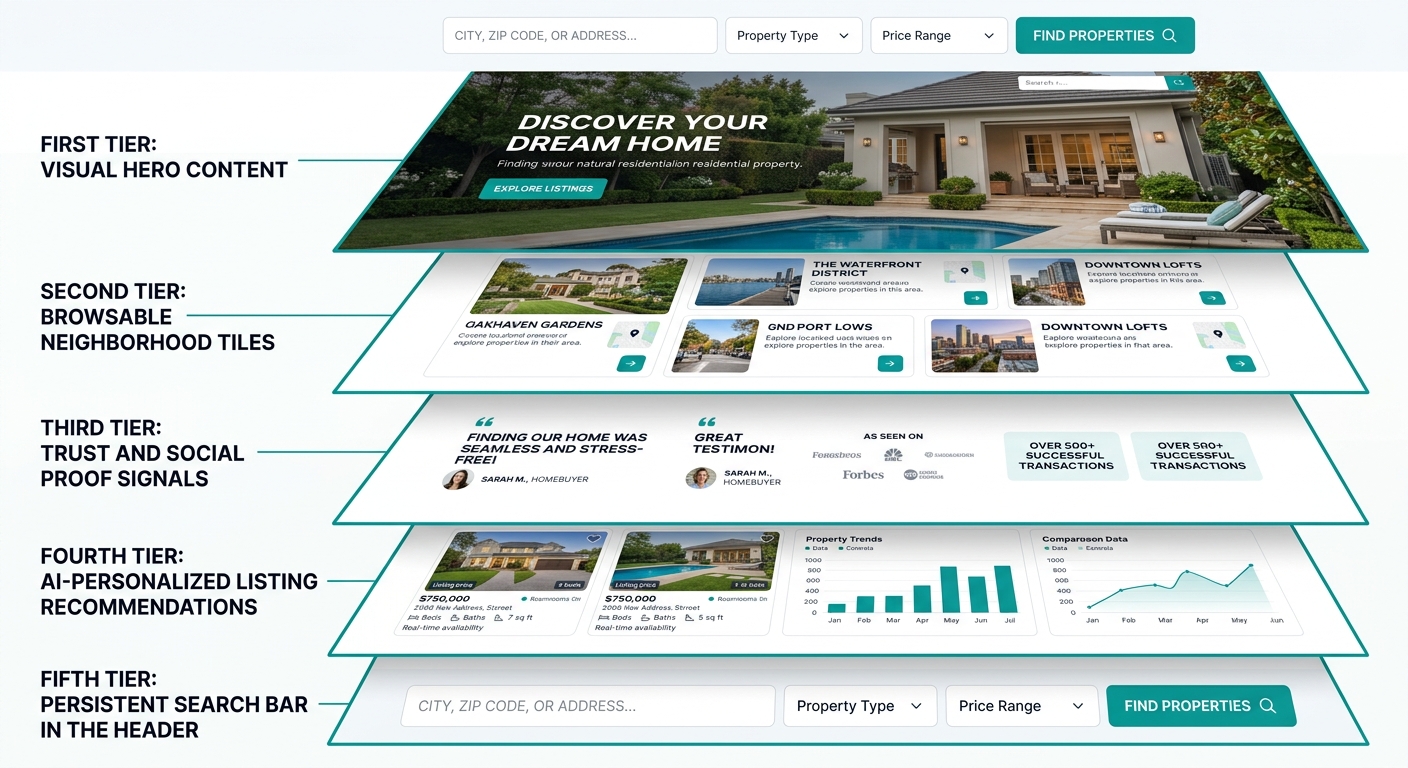
The pattern that converts, based on behavior research and conversion data across the industry, follows a specific hierarchy:
- Visual-first hero content — a curated image or short video of the local area, paired with a single-line value proposition. Not a generic skyline. Your neighborhood.
- Tap-friendly browsing tiles — neighborhood cards, price-range selections, or lifestyle categories that let mobile users (76% of your traffic) browse without typing a single character.
- Social proof and trust signals — 93% of consumers say online reviews impact their decisions, and 67% abandon a site if something feels off. Verified badges, recent testimonials, and agent credentials belong above the fold.
- AI-driven recommended listings — personalized content blocks that adjust based on visitor behavior, location, and return-visit history.
- Persistent but secondary search — a search function accessible from a sticky header or dedicated tab, available for the buyer who knows exactly what they want.
Agents building or rebuilding sites on platforms like Pillar already have access to property page structures designed around visual-first presentation. The challenge is less about the technology available and more about letting go of the assumption that a search bar equals a lead funnel.
The buyers visiting your homepage in 2026 are actively researching, comparing, and expecting something that feels personal, as the Association of Realtors research documented. They’ve already searched on Google, scrolled through Zillow, and asked an AI assistant about neighborhoods before they ever hit your site. Your homepage’s job isn’t to be their search engine. It’s to prove you know the area, surface relevant listings fast, and make the next step (saving a property, scheduling a showing, starting a conversation) feel effortless on any device.
That shift, from search gateway to curated experience, is where homepage layout conversion rates have actually moved over the past two years. The agents who recognized it earliest are the ones whose sites now convert at the top of that 1–3% industry range, while everyone else is still wondering why a perfectly good search bar isn’t generating leads like it used to.