
Responding to a web lead within five minutes makes an agent 21 times more likely to qualify that prospect. The industry average response time is over 15 hours. According to Florida Realtors reporting, leads don’t go cold because they’re inherently bad. They go cold because the gap between capture and real conversation is too long, too inconsistent, or too irrelevant to hold a buyer’s attention. Agents trying to close that gap typically reach for one of three fixes: manual high-touch outreach, fully automated drip sequences, or AI-driven qualification with selective human follow-up. Each approach has a real track record, and each one breaks in a specific, predictable way depending on team size, deal volume, and tolerance for letting software talk to your prospects.
If your website captures leads that vanish before becoming clients, the problem almost certainly lives in one of these three categories. Here’s what each looks like when it works, and where each one falls apart.
Picking Up the Phone 40 Times a Day
The oldest approach to lead nurturing workflows is also the most direct: assign a person (or hire an Inside Sales Agent) to call every new lead as fast as humanly possible, qualify them over the phone, and hand warm prospects to a licensed agent for showing appointments.
Teams that run dedicated ISAs report conversion rates between 5% and 7%, compared to the industry average of 0.4% to 1.2%. The math behind these numbers is straightforward. An ISA making 40 contacts a day, booking two appointments per day and 40 per month, creates a pipeline volume that no passive system can match. Robert Slack, founder of Robert Slack Real Estate, has been blunt about this: “People complain about online leads all the time. They buy them, but they have no system for converting them.”
The conversion ceiling on manual outreach is genuinely high. Michael Urbanski reportedly closes 8-10% of online leads by maintaining contact for five straight days on every new inquiry. That’s four to five times the industry average.
But here’s where manual breaks down. It demands consistent human energy at a level most solo agents and small teams can’t sustain. The protocol that produces those numbers looks something like this: three call attempts on Day 1, an email on Day 2, a text on Day 3, another call plus voicemail on Day 5. Combine text, call, email, and text again within the first 24 hours and you can hit a 55-65% response rate. Drop to one or two attempts (which is what the average agent actually does) and that response rate craters to 15-20%.
If your website architecture is already filtering for quality leads, manual outreach gets more efficient because you’re calling people who demonstrated real intent. Without that filter, you burn hours dialing tire-kickers.
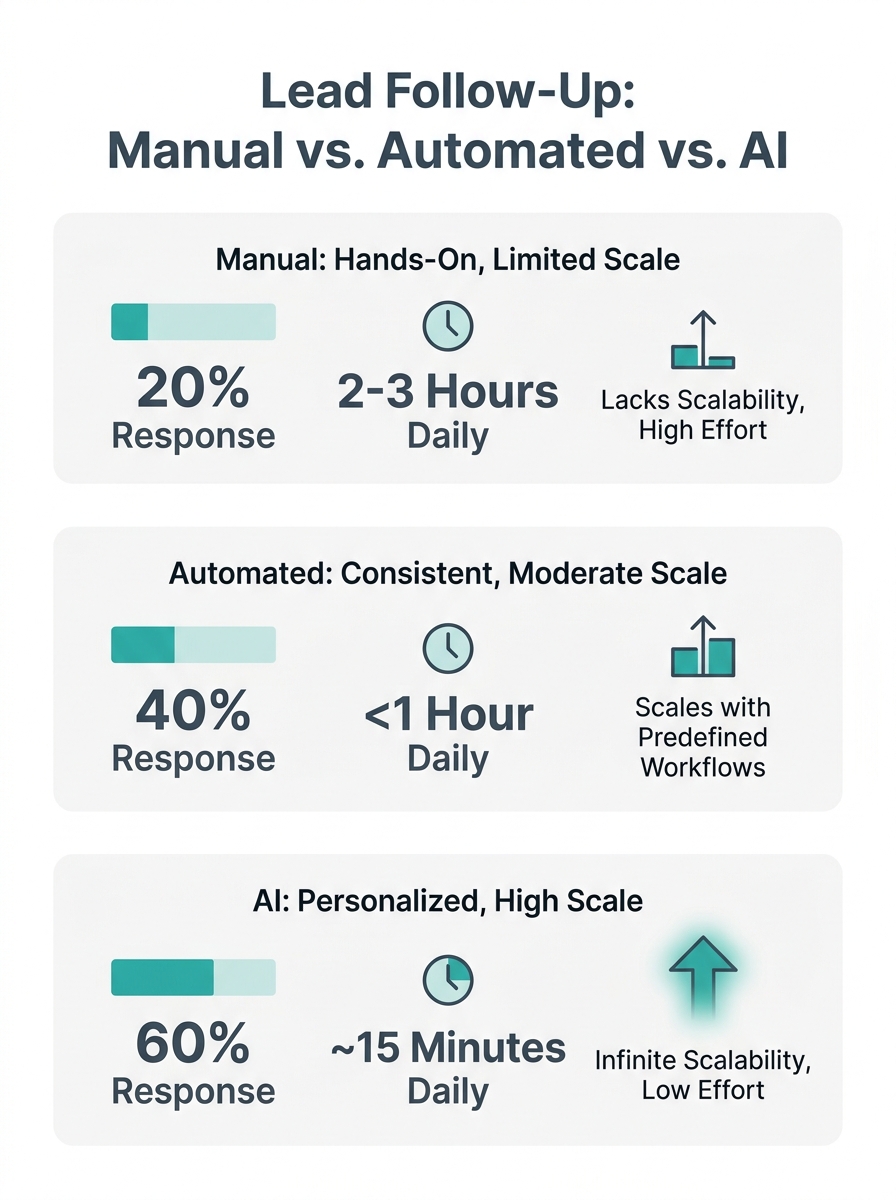
The tradeoff is clear: manual follow-up has the highest conversion ceiling and the lowest scalability ceiling. It works brilliantly until your lead volume exceeds what your team can physically handle, at which point leads start slipping through — and you’re right back where you started.
What Happens When You Automate Everything
Drip campaigns are the most popular response to the scalability problem. Set up a sequence once in Follow Up Boss, iHomefinder, or whatever CRM you’re running, define triggers (form fill, email open, listing view), and let automated messages run on a schedule for weeks or months.
The case for automation is backed by solid numbers. Nurtured leads show 119% higher email click rates and 50% higher conversion rates than non-nurtured leads. Drip sequences also keep your database alive during the 6-to-18-month timeline that most online buyers operate on. One widely cited case: a lead nurtured for 13 months via automated drip ultimately purchased a $925K home and later listed a property for $613K, generating $1.54M in combined transaction volume.
Real estate follow-up automation excels at the long game. It maintains presence with C and D leads (3-12+ months out) without requiring daily agent effort. You can build a 12-month sequence — welcome email on Day 1, educational content in Weeks 1-2, market data by Week 4, listing alerts in Month 2, re-engagement offers in Month 3 — and let it run across hundreds of contacts simultaneously.
Managing a growing database while delivering personalized attention to each lead feels impossible for most agents. The result is what the industry calls the “dead-a-base” — a graveyard of contacts representing massive unrealized commissions.
The failure mode of pure automation is equally well-documented, though. Generic “just checking in” messages produce generic results. Behavioral trigger emails generate 8x more revenue and 3x higher open rates than broadcast emails, which means a drip campaign that sends the same content to every lead regardless of behavior is leaving most of its potential on the table. If someone has viewed the same listing four times this week and your system sends them a generic market update, you’ve wasted the highest-intent signal in your pipeline.
And if your site’s property search filters aren’t refined enough to capture meaningful preference data, your automation has nothing useful to personalize around. The drip just… drips.
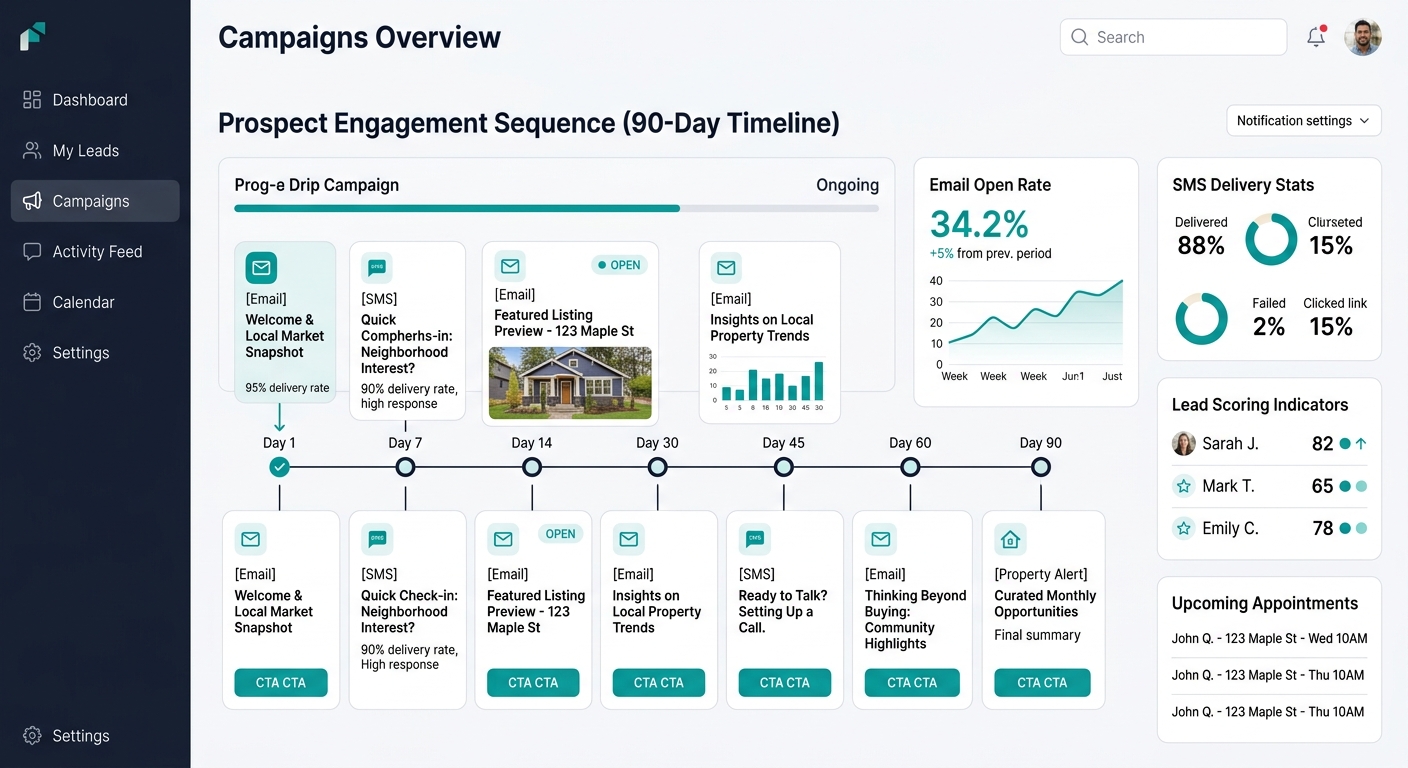
The tradeoff: automation scales infinitely and costs almost nothing per lead after setup. But it has a conversion ceiling that’s lower than skilled human outreach, and it can actively damage your brand if the messaging feels robotic to a lead who’s ready to talk to a real person right now.
AI Qualification Changes the Math
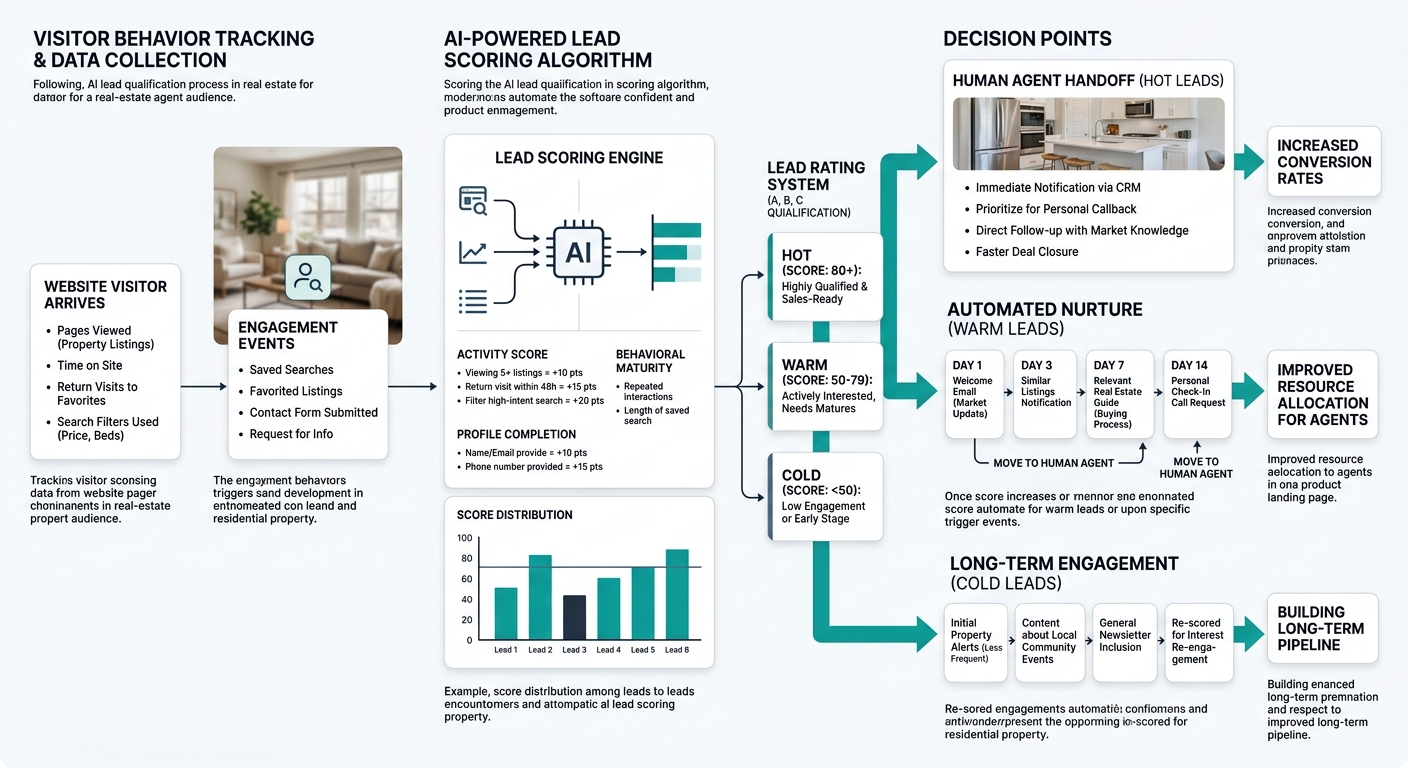
The third approach uses AI-powered tools to score, sort, and engage leads based on behavioral signals — then routes only the highest-intent prospects to human agents. This is the lead qualification process that’s gained the most traction since 2024, and the performance data is hard to ignore.
A major real estate franchise reported improving its predictive lead-scoring accuracy from 71% to 89% after implementing AI-driven scoring, according to MindStudio’s analysis of AI qualification tools. That accuracy improvement translated directly into higher conversion because agents spent time on leads most likely to close. Across the broader data, AI-assisted qualification has shown a 64% increase in qualified leads compared to manual methods.
The practical version of this looks like a system (Ylopo’s AI², Structurely, or similar) that monitors your leads’ digital behavior — repeated property views, saved searches, return visits after a long absence — and sends personalized messages referencing the exact properties a lead engaged with. When a lead’s score crosses a threshold, the system alerts a human agent or ISA for direct outreach. Forbes recently covered how GenAI models are being used to personalize sales pitches and follow-up messages across the full CRM workflow.
If you’ve already explored how AI-powered lead qualification reshapes follow-up priorities, the progression here makes sense: the AI handles the ABCD segmentation that agents struggle to maintain manually. A leads (buying in 0-90 days) get daily attention. D leads (12+ months) get monthly automated touches. And when a D lead suddenly views five listings in a week, the system reclassifies them as an A lead and triggers immediate human contact.
Warning: AI qualification tools require clean, structured data in your CRM to work well. If your lead records are incomplete, inconsistently tagged, or spread across multiple disconnected systems, the scoring algorithms will produce unreliable results. Clean up your database before investing in an AI layer.
The tradeoff: AI qualification offers the best efficiency ratio — high conversion rates at relatively low per-lead cost once the system is running. The downsides are real, though. Setup costs and learning curves are steeper than either manual or basic automation. You need enough lead volume to make the scoring algorithms meaningful (a solo agent getting 10 leads a month won’t benefit much from predictive scoring). And there’s an uncomfortable dependency: when the AI mislabels a hot lead as cold, you lose a deal you would have caught with a simple phone call.
How to Choose Between These Three
The honest answer is that most agents don’t need to pick one approach and ignore the others. The winning configuration depends on where your operation sits right now.
Solo agents handling fewer than 30 leads per month should default to manual outreach with a simple CRM sequence as backup. Your lead volume doesn’t justify AI tooling costs, and your personal touch is your competitive advantage. Set up a basic 5-day contact protocol and a 90-day drip for leads that don’t convert immediately. Focus your energy on conversion optimization for agents at your scale, which means speed and consistency, not technology.
Small teams (2-5 agents) processing 30-100 leads per month get the most lift from well-built automation. Invest time in creating behavior-triggered sequences rather than calendar-based drips. Make sure your CTA placements are generating qualified leads rather than casual clicks, because automation amplifies whatever quality of lead enters the system. Bad leads in, wasted sequences out.
Larger teams and brokerages handling 100+ leads per month are where AI qualification starts paying for itself. The volume justifies the setup cost, the scoring accuracy improves with more data, and the efficiency gain of routing only hot leads to agents can meaningfully change your cost-per-closed-deal math. Pair AI scoring with a trained ISA team for maximum conversion, and keep automated drips running underneath for the long-tail database.
Whatever you choose, the underlying problem stays the same: the gap between lead capture and meaningful human contact is where deals die. The 78% of buyers who choose the first agent to respond aren’t making a careful evaluation. They’re rewarding whoever showed up. The fix is whichever approach gets you showing up faster and more consistently than you do today, given the resources you actually have.