
Ylopo’s lead scoring engine assigns a conversion-likelihood number to every website visitor by analyzing their property preferences and engagement patterns before an agent picks up the phone. That capability sounds like table stakes in 2026, but the average real estate team still takes over fifteen hours to respond to an online inquiry. The gap between what AI lead qualification technology can do and how most brokerages actually operate is where this story starts.
Only about 22% of real estate companies have adopted AI for lead qualification so far. Yet the early adopters are reporting conversion rate jumps from roughly 14% to 39% at some brokerages, with cost per qualified lead dropping by 35%. What follows is a dissection of how that shift actually works in practice, from the initial speed-to-lead crisis through scoring, handoff, and the surprising revival of leads most agents had written off as dead.
The Fifteen-Hour Response Gap
The foundational problem is embarrassingly simple: agents are too slow. Research consistently shows that 78% of buyers choose the first agent who responds to their inquiry. Speed matters more than experience, more than brand, more than the listing itself. And yet the industry average for responding to an online lead sits above fifteen hours.
That number should alarm anyone running a team. A lead contacted within one minute has a 95%-plus contact rate. Wait five minutes, and your odds of qualifying that lead drop by a factor of 21 compared to waiting 30 minutes. Wait an hour, and you’re essentially cold-calling someone who’s already talking to your competitor. The data on this is unambiguous: teams responding within one minute see 391% more conversions than those responding in five.
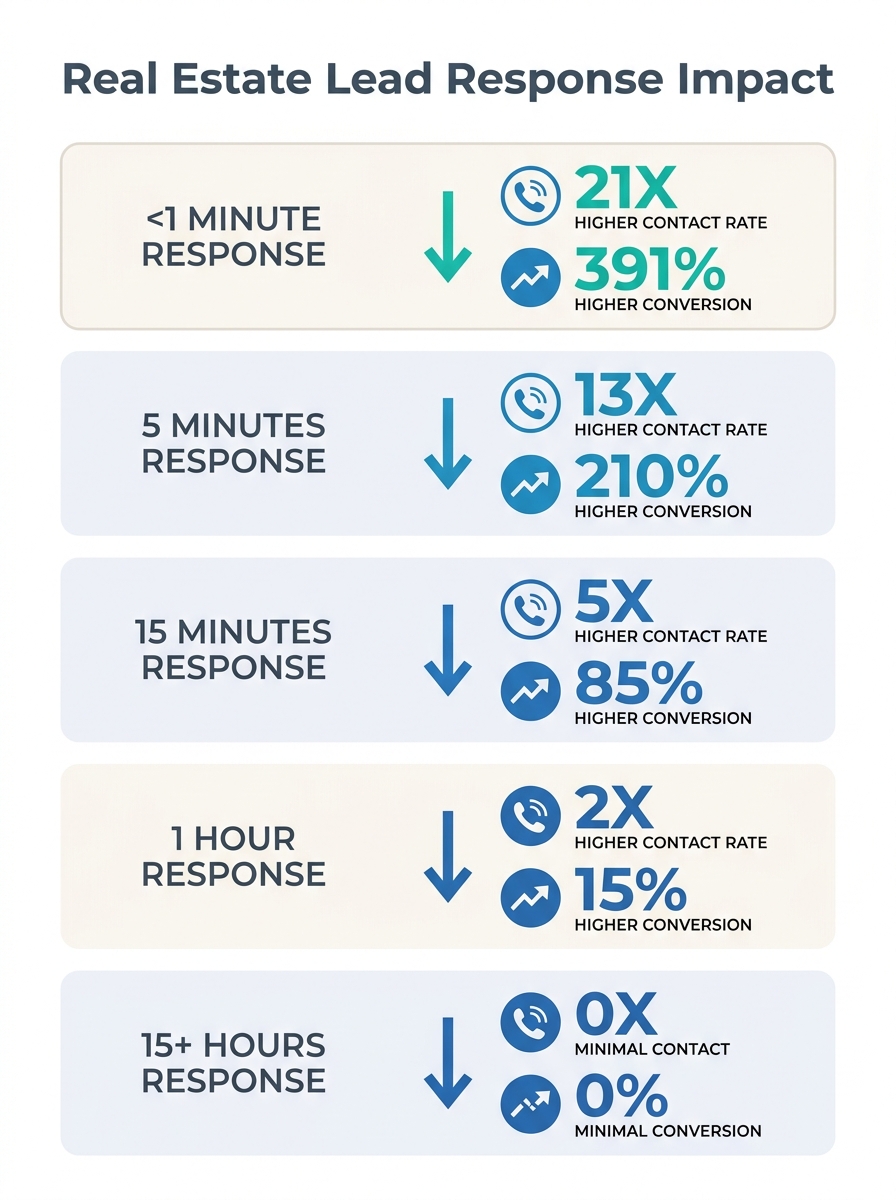
AI chatbots and voice agents collapse that fifteen-hour gap to seconds. They operate around the clock across websites, SMS, Instagram DMs, and social ad landing pages. The bot doesn’t take lunch. It doesn’t prioritize the leads it “likes.” It responds instantly, every time, which is why this is the entry point for most brokerages adopting AI lead qualification in real estate.
But responding fast is the easy part. The hard part is figuring out which of those fast responses deserve a human follow-up.
How Lead Scoring Engines Read the Room
AI lead scoring uses machine learning to rank leads by their likelihood of converting. It pulls from behavioral data, CRM history, and marketing engagement to generate a dynamic score for each prospect. The score changes in real time as the lead’s behavior changes.
Here’s what that looks like in practice. A visitor lands on your site from a Facebook ad, clicks through three listings in the same ZIP code, returns the next day and views one of them again, then asks the chatbot about showing availability. That visitor gets a very high score. Compare that to someone who clicks one listing, asks the price, and bounces. Low score. The AI engine distinguishes between these two visitors automatically, and it routes them differently.
The conversational layer matters here too. Modern chatbots use progressive profiling rather than dumping a lead form on someone’s screen. Instead of asking for budget, timeline, financing status, and contact info all at once, the bot gathers data naturally over the course of the conversation. It’s applying something close to the BANT framework (Budget, Authority, Need, Timeline) without making the lead feel interrogated.
The bot doesn’t prioritize the leads it “likes.” It responds instantly, every time, and it scores every response against actual behavioral signals.
Platforms like MindStudio take this further by letting agents build custom AI workflows without writing code, so the qualification criteria can be tailored to a specific market or niche. A luxury agent in Manhattan and a first-time-buyer specialist in suburban Phoenix shouldn’t be scoring leads the same way. The flexibility to define what “qualified” means for your business is what separates useful lead scoring systems for agents from generic off-the-shelf chatbots.
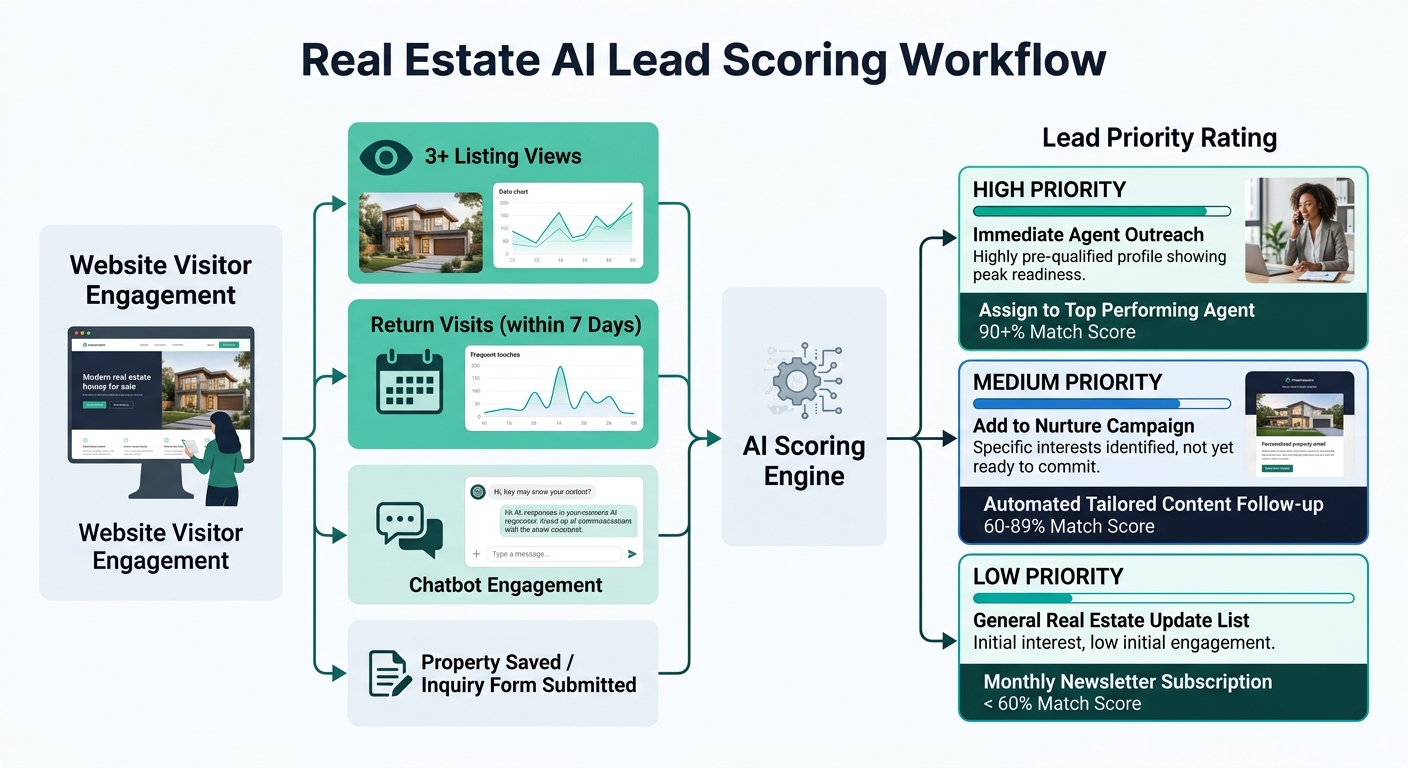
If you’re already investing in strategies to generate leads at scale, the scoring layer is what prevents that volume from becoming noise. Without it, more leads often means more wasted time.
The Handoff That Makes or Breaks Conversion
Scoring a lead means nothing if the handoff to a human agent is clumsy. This is where CRM lead management in 2026 has evolved significantly. The best implementations create a full dossier for the agent before they ever make a call: the lead’s conversation transcript, their property preferences, their engagement history, their score, and sometimes even their likely timeline.
Intelligent routing platforms like MaverickRE go further by matching leads to agents based on specialty, market expertise, availability, and personality fit. The goal is to make the agent’s first human touchpoint feel warm and informed rather than cold and scripted. When an agent calls and says, “I saw you were looking at the three-bedroom on Oak Street, and you mentioned wanting to be in the district for Lincoln Elementary,” the lead knows they’re talking to someone who’s paying attention.
Tip: If your CRM doesn’t automatically create a contact record with full conversation context when a chatbot qualifies a lead, you’re losing data between the bot and the agent. That gap is where deals die.
Task triggers are another critical piece. When a lead crosses a score threshold, the CRM can automatically prompt the assigned agent to call within an hour, send a personalized video message, or schedule a showing. This kind of real estate lead nurturing automation means the system is doing the remembering and prompting, and the agent is doing what agents are actually good at: building trust, reading emotional cues, and negotiating.
The numbers support the approach. Lead-to-appointment rates increase by 10-30% with automated scheduling, and deal closure rates improve by around 18% through consistent AI-driven follow-up. Agents using these systems report saving 15-27 hours per week on qualification and initial contact alone.
Reactivating a Dead Database
Here’s the part most agents haven’t thought about yet. AI lead qualification doesn’t only work on fresh inbound leads. Predictive models can re-rank your existing CRM database daily, flagging contacts who show renewed interest.
Someone who inquired eight months ago, went silent, and then clicked on a listing alert last Tuesday? That’s a signal. Behavior-triggered campaigns can automatically send them a personalized follow-up: “Still looking? Here are three new homes in your preferred ZIP.” The message goes out within minutes of the behavioral trigger, not days later when an agent happens to check their cold lead list.
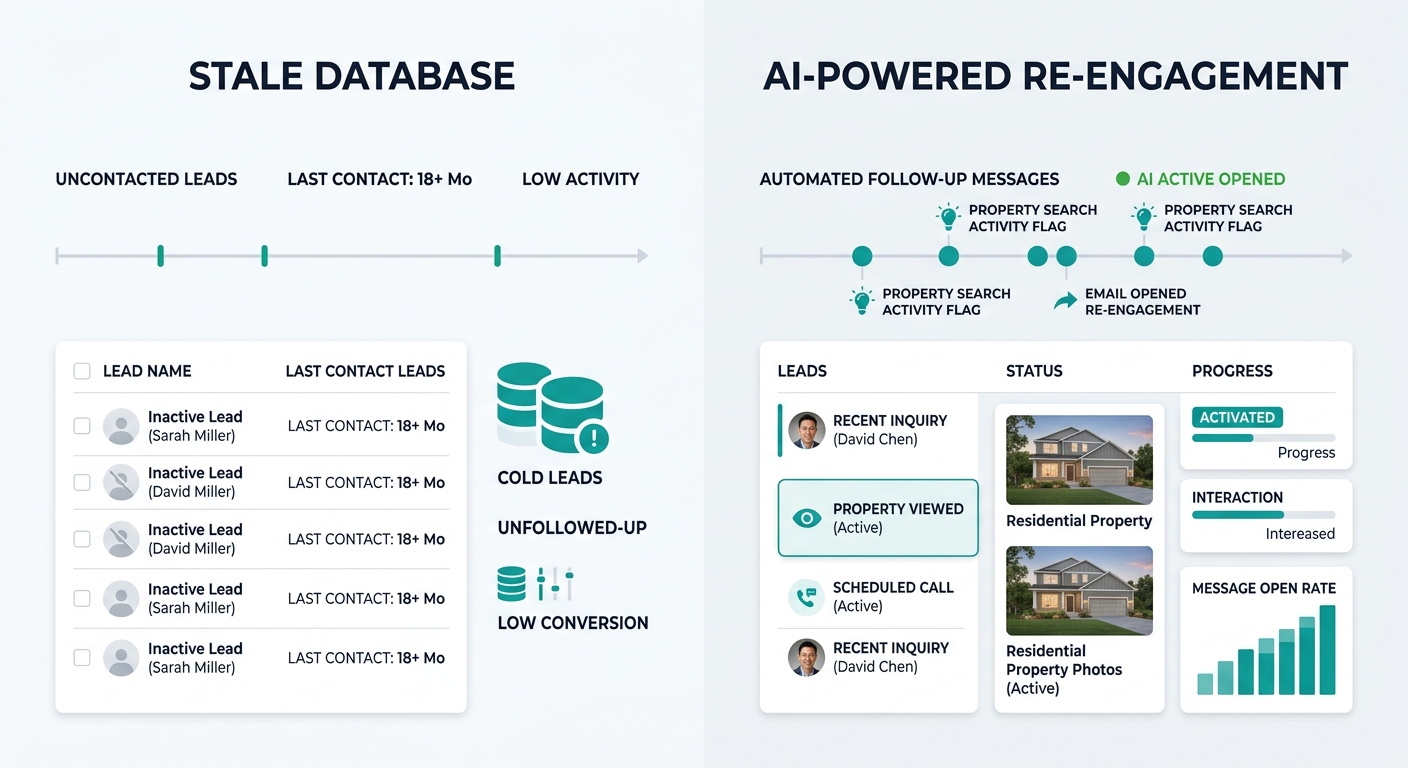
Predictive analytics can also surface likely sellers months before they list by analyzing behavioral and demographic signals. For listing agents, this turns AI from a reactive tool into a prospecting engine. And AI-powered deal stage forecasting can predict which transactions are likely to close, which may fall through, and what your revenue pipeline looks like for the quarter ahead.
The combination of lead scoring, automated nurturing, and predictive reactivation is what makes the system compound over time. Your database doesn’t just grow; it gets smarter. Every interaction trains the model, and every re-engaged lead represents revenue that would have otherwise evaporated.
If you’re building out your marketing software stack this year, the CRM-to-AI integration layer should be at the top of the priority list, because it’s the piece that connects everything else.
The 22% Who Moved First
The brokerages that adopted AI lead qualification early aren’t just working more efficiently. They’re structurally advantaged. They respond faster. They score more accurately. They lose fewer leads in the handoff. And they’re reactivating dormant contacts that their competitors have completely forgotten about.
The remaining 78% of the industry is still operating with manual follow-up, gut-feel prioritization, and response times measured in hours rather than seconds. Some of those teams have great agents who close well once they get on the phone. The problem is that they’re getting on the phone with fewer qualified prospects every month, because the speed-to-lead race is already over by the time they dial.
The conversion data tells a clear story. Predictive lead scoring achieves 75-89% accuracy in predicting conversion probability, compared to 45-60% accuracy for manual methods. When you pair that with instant response, intelligent routing, and automated nurturing, the math gets hard to argue with.
None of this replaces the agent. AI handles the repetitive early-stage work: responding, qualifying, scoring, scheduling. The agent steps in with context, warmth, and the judgment that still closes deals. The division of labor is straightforward, and the brokerages that figured it out first are the ones pulling away.
If you’re ready to build a website that actually captures and converts the traffic you’re paying for, you can get started with Pillar for free and see how a well-structured property site supports everything downstream of the first click.