

WordPress gives real estate agents more design and functionality control than any other CMS, but that flexibility directly slows page load times, degrades Core Web Vitals, and reduces lead conversion rates. Agents face a three-way trade-off between customization depth, conversion speed, and ongoing maintenance cost.
TL;DR: WordPress real estate websites suffer from plugin bloat, JavaScript-heavy IDX filters, and security overhead that hurt lead conversion. Dedicated real estate platforms convert faster out of the box but limit design control. Headless CMS setups deliver the best raw performance but cost $15,000+ to build and maintain. Your choice should follow your primary lead source: organic search favors WordPress, paid campaigns favor dedicated or custom platforms.
Industry data shows most real estate websites convert between 1% and 3% of visitors into leads. The gap between the bottom and top of that range often comes down to page speed, form placement, and how much technical overhead your CMS demands. On a site with 2,000 monthly visitors, a single percentage point of conversion improvement means 20 more leads per month. That math makes your CMS choice one of the most consequential decisions in your business.
The three approaches agents typically weigh are WordPress with real estate themes, dedicated platforms like Real Geeks or kvCORE, and headless or custom-built solutions. Each handles the real estate website customization vs conversion tension differently, and the performance trade-offs are measurable.
WordPress Real Estate Themes: Full Control, Full Friction
WordPress dominates the agent website market for good reasons. A real estate-focused theme like WPResidence costs roughly the price of a nice dinner, compared to thousands for a custom build. You get drag-and-drop page builders, hundreds of plugins, and full ownership of your domain and data. Self-hosted WordPress solutions keep everything on your server, giving you complete data control and CRM flexibility.
But every layer of customization adds performance cost. JavaScript-heavy IDX search filters and property sliders are the primary causes of poor Interaction to Next Paint (INP) scores. Google requires INP under 200ms for a “good” rating, and most WordPress real estate sites with active IDX plugins blow past that threshold. Autoplay video heroes on mobile pages specifically damage Largest Contentful Paint (LCP) performance, which Google tightened to a 2.0-second threshold in its March 2026 core update. Sites still loading above that cutoff have dropped 2 to 4 ranking positions on competitive local searches.
The plugin dependency creates a second, less visible problem. WordPress sites face up to 500 brute-force login attempts per month, requiring hardened hosting, security plugins, and regular manual updates to themes and plugins. Each update risks breaking your IDX integration, contact forms, or CRM connection. The WPRETS development team put it directly: “Good real estate website development is not about the listings and displaying them in WordPress. It really is all about how you are making an agent’s job easier, how effective your application is at producing leads, [and] what the conversion rates of those leads are.”
Jakob Nielsen’s research at NN/g found that 52% of homepage screen space on real estate sites goes to filler content, with one documented A/B test showing a simplified homepage layout lifted conversions from 259 to 398. That’s a 54% increase from removing clutter. WordPress makes filling space easy because the tools encourage adding widgets, sliders, and featured sections. The platform’s greatest strength becomes its conversion weakness: when you can add anything, you usually add too much.
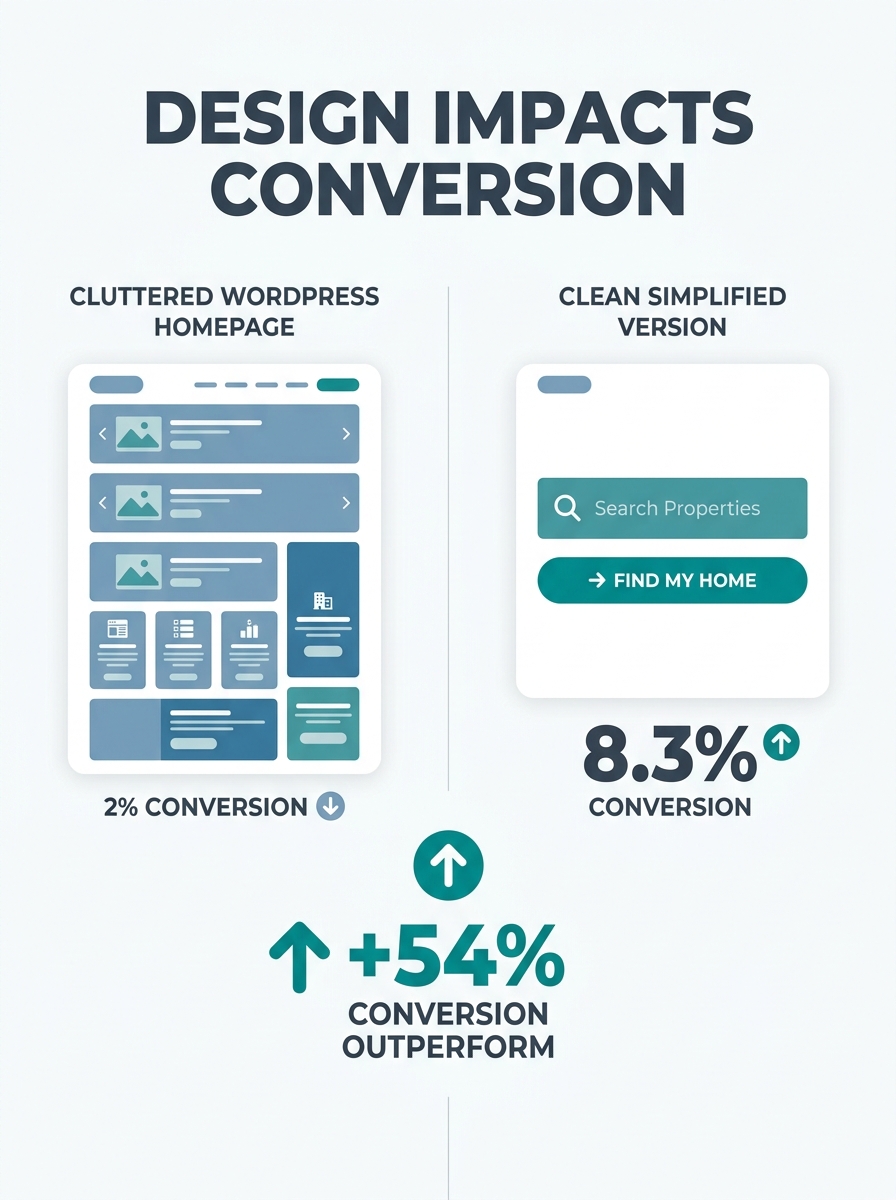
Warning: If your WordPress real estate site runs more than 15 active plugins, audit each one against your Google PageSpeed Insights score. Deactivate them one at a time and measure the impact. Many agents discover 3 to 5 plugins that add seconds of load time while delivering zero measurable lead value.
Where WordPress Still Wins
WordPress earns its place when you need deep customization that dedicated platforms can’t match. Custom neighborhood landing pages, content strategies for local SEO, and complex blog architectures all benefit from the open ecosystem. The SEO ceiling is genuinely higher because you control URL structures, schema markup, internal linking, and page templates. Implementing RealEstateListing and SingleFamilyResidence JSON-LD schema can improve click-through rates by 15% to 30% by enabling rich snippets in search results.
Dedicated Real Estate Platforms: Fast Conversions, Rigid Design
Platforms like Real Geeks, Placester, kvCORE, and Sierra Interactive exist precisely because WordPress real estate websites are hard to optimize. They ship with native IDX integration, built-in CRM tools, and pre-tested lead capture forms. There’s no plugin management because the features are baked into the platform code.
The conversion speed advantage is measurable. Native IDX imports listings as posts on your domain, meaning search engines index your property pages and assign SEO authority to your site. Compare that to iFrame IDX on many WordPress setups, where listings live on the vendor’s server and earn your site zero search value while adding load time. The half-map search layout common on these platforms (listings left, map right) helps users find properties 30% faster than list-only views.
A 2026 platform comparison guide described Real Geeks as built for agents “whose business model revolves around paid lead generation,” providing infrastructure to maximize ROI on purchased leads. The trade-off: “the design templates can feel a bit dated and offer limited creative flexibility.”
That limited flexibility is the core constraint. You can’t build custom content hubs, create unique neighborhood microsites, or implement advanced schema markup beyond what the platform allows. When you consider how information architecture drives conversion outcomes, dedicated platforms force you into their navigation structure. Your site looks and functions like every other agent on the same platform, making brand differentiation harder.
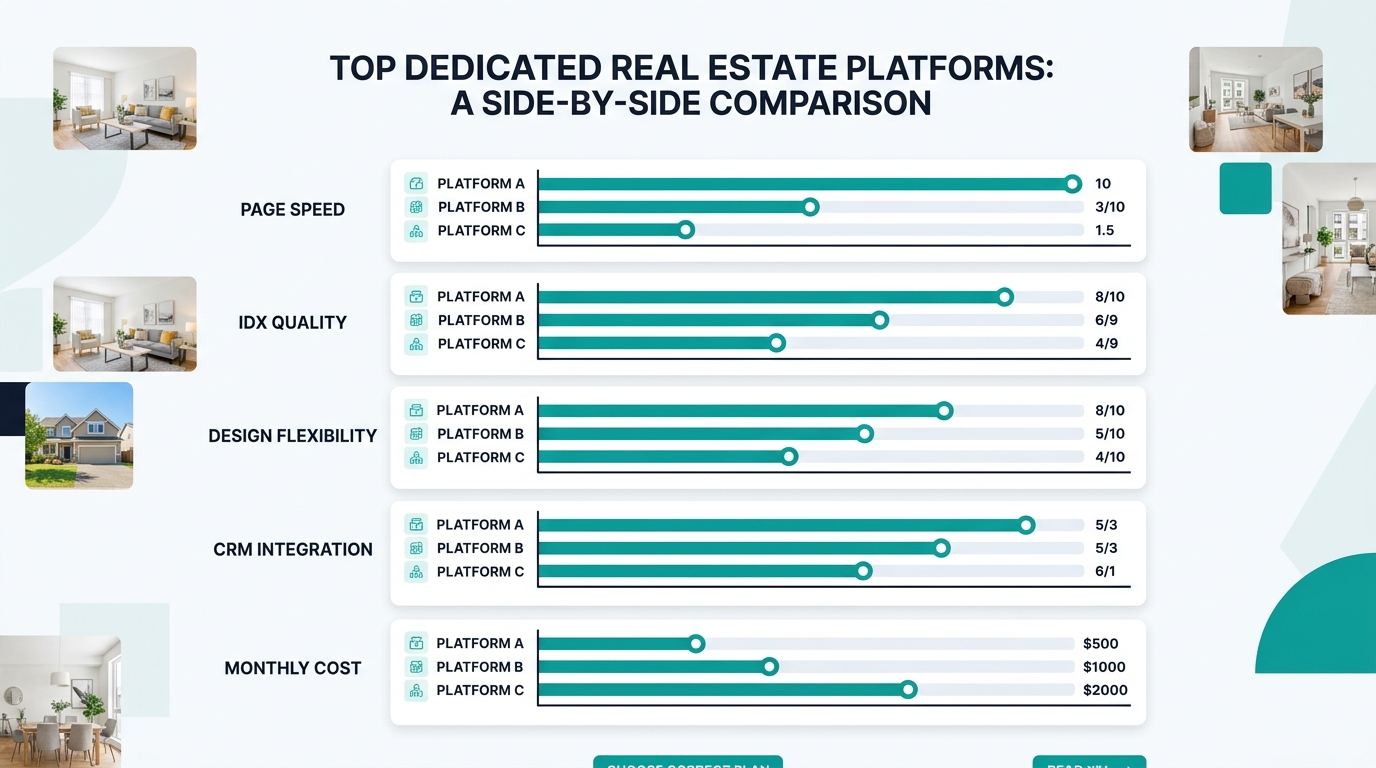
Maintenance costs are lower and more predictable. You pay a monthly subscription, typically $200 to $500 for a solo agent, and the platform handles hosting, security, updates, and IDX connectivity. There’s no scenario where a theme update breaks your contact forms at 11 PM on a Friday.
Where Dedicated Platforms Fall Short
The SEO ceiling is lower. You can’t control URL structures, add custom schema types, or build deep content architecture that ranks for informational queries. If your lead generation depends on organic traffic from blog posts, neighborhood guides, and market reports, a dedicated platform will cap your growth faster than you expect.
Headless CMS and Custom Builds: Peak Performance, Peak Cost
A headless CMS (Strapi, Contentful, BCMS) decouples your content management from your front-end presentation. Content lives in one system. Your website pulls that content through an API and renders it independently using a modern framework. The result is faster data retrieval and better site performance because the front end doesn’t carry the weight of a traditional CMS.
For real estate, this means property search interfaces, interactive maps, and virtual tours can be built as standalone components that load only when a visitor needs them. A well-built headless real estate site can hit LCP under 1.0 seconds and INP under 100ms. That’s roughly twice as fast as an optimized WordPress installation and three times faster than a bloated one. Those speed differences translate directly into conversion rates.
On a site with 2,000 monthly visitors, a single percentage point of conversion improvement means 20 more leads per month. Your CMS choice determines where in that range you land.
The cost is substantial. Custom real estate sites typically start at $15,000 to $50,000 for initial development, with ongoing maintenance running $500 to $2,000 per month for a developer. As one CMS selection guide explained, this approach “is mainly used by large agencies or developers with unique functionality requirements that go beyond what traditional CMS platforms offer.”
You also lose the casual editing experience. Adding a blog post or updating a listing description requires working through an admin panel without the visual, what-you-see-is-what-you-get editing that WordPress provides. For a solo agent publishing weekly market updates, that friction adds up.
Where Custom Builds Earn Their Price
Teams running heavy paid ad campaigns benefit most. When you’re spending $5,000 or more per month on Google Ads or Facebook campaigns, the difference between a 1.5% and 3.0% landing page conversion rate means the custom build pays for itself within months. If you’ve been wrestling with which website features actually drive leads versus drain your budget, a custom build lets you ship only what converts.
Side-by-Side Comparison
| Feature | WordPress + RE Theme | Dedicated Platform | Headless / Custom |
|---|---|---|---|
| Upfront cost | $50–$500 (theme + plugins) | $0–$500 setup fee | $15,000–$50,000+ |
| Monthly cost | $30–$150 (hosting + plugins) | $200–$500 | $500–$2,000 (developer) |
| Typical LCP | 2.5–4.5 seconds | 1.5–2.5 seconds | 0.8–1.5 seconds |
| IDX integration | Plugin-based (iFrame or native) | Native, built-in | Custom API integration |
| Design flexibility | Very high | Low to moderate | Unlimited |
| SEO ceiling | Very high | Moderate | Very high |
| Maintenance burden | High (updates, security, backups) | Low (managed) | Moderate (developer-dependent) |
| Content editing ease | High (visual editors) | Moderate (template-based) | Low (admin panels) |
| Best for | Content-driven lead gen | Paid lead conversion | High-volume teams, ad-heavy models |
Who Should Pick Which
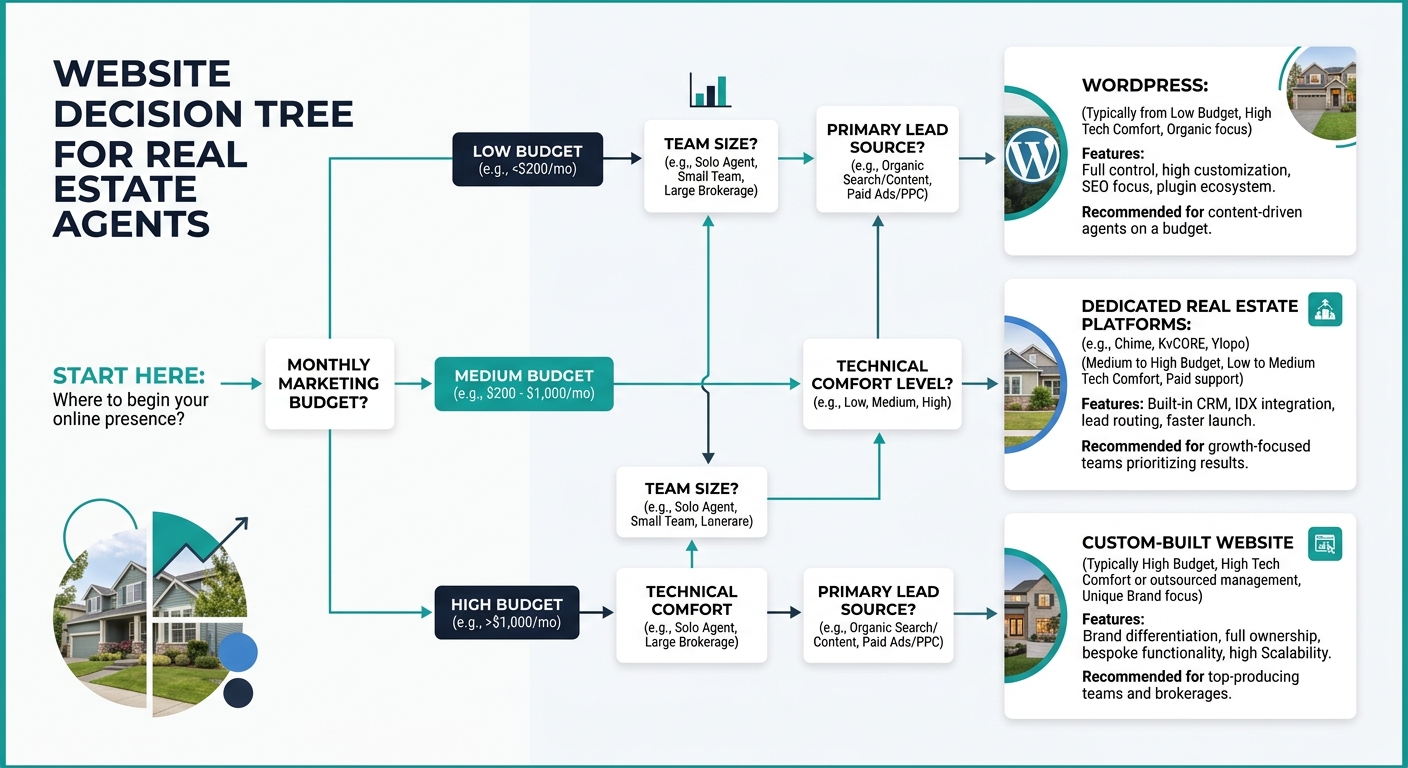
WordPress with a real estate theme fits agents and small teams who plan to generate leads through content marketing, local SEO, and organic search. You need a comfort level with plugin management and either a basic technical background or a web developer on retainer. If you’re building neighborhood guides, publishing market reports, and creating property website designs that reflect your personal brand, WordPress gives you room to grow. Budget 2 to 4 hours per month on updates, speed audits, and plugin checks.
A dedicated real estate platform fits agents who buy leads from Zillow, run paid search campaigns, and want their website to convert those purchased leads as fast as possible. You’re trading design control and SEO depth for reliability, speed, and simplicity. If you don’t plan to blog regularly or build content hubs, the lower SEO ceiling won’t hold you back. Check platform reviews on G2, Capterra, or TrustRadius before signing a contract, and talk to agents in your market who already use the platform you’re considering.
A headless or custom-built solution fits teams and brokerages processing thousands of listings with complex search needs and high ad budgets. The performance advantage is real, but so is the cost. If your monthly marketing spend is under $3,000, the ROI math rarely justifies a custom build. Above $10,000, the conversion gains from sub-second load times can make the investment look small.
The honest answer in this agent CMS platform comparison is that most solo agents and small teams should start with a dedicated platform if their primary lead source is paid, or WordPress if their primary lead source is organic search. The real estate website performance trade-offs favor different platforms depending on which side of that equation drives your closings. Upgrade to a custom build only when your lead volume and ad spend clearly justify it, and when you’ve already audited your current site’s conversion bottlenecks to confirm the CMS is actually the constraint holding you back.