

Three design philosophies compete for your real estate homepage: lifestyle storytelling, trust-signal architecture, and behavioral trigger layouts. Each one drives buyer intent differently, converts at different rates, and fails in ways the others don’t.
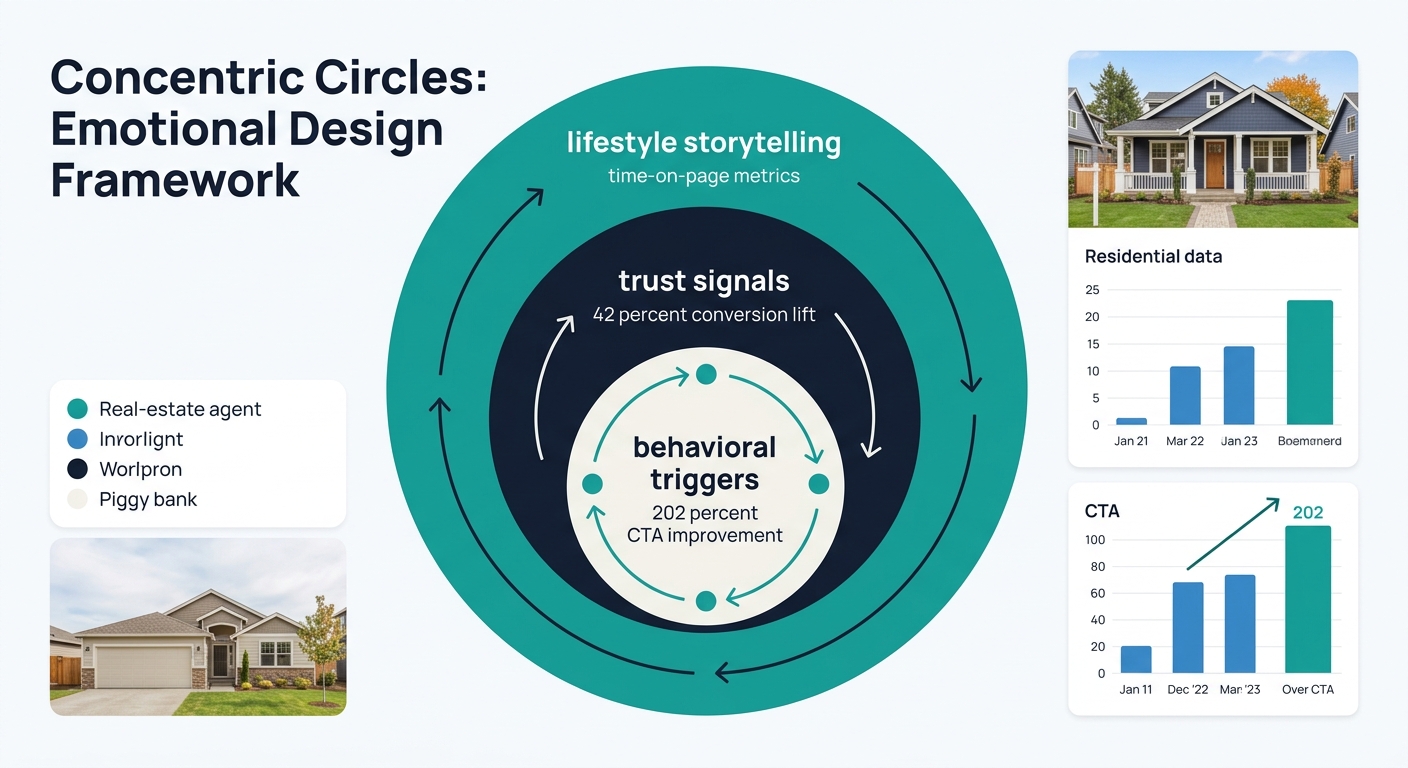
TL;DR: Lifestyle storytelling wins attention and time on page. Trust-signal design wins credibility and form completions (+42% lift). Behavioral triggers win urgency and speed to inquiry (+202% for personalized CTAs). The best-converting sites layer all three in a specific order based on your price point and traffic source.
The core question behind real estate website design psychology is simple: what should a visitor feel before they ever type an address into your search bar? The answer shapes which framework deserves top billing. Buyers form a credibility judgment about your site in 0.05 seconds, and 75% of that judgment comes from design alone. The framework you lead with determines everything that follows.
Lifestyle Storytelling Shapes the First Scroll
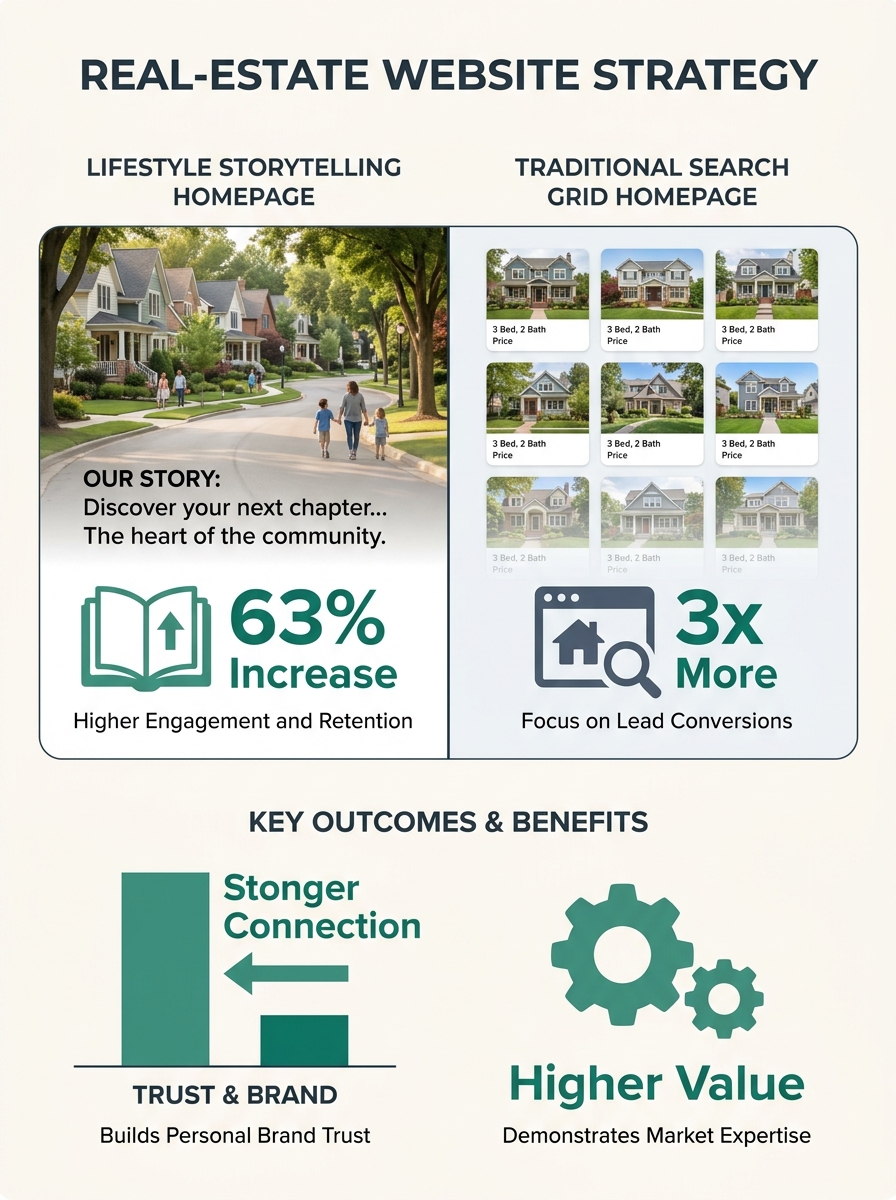
This approach treats your homepage like a magazine cover. Instead of opening with an IDX search bar and a grid of listings, the page leads with full-bleed photography, neighborhood narratives, and language that puts the buyer inside a life they want. Think “weekend farmers markets two blocks away” rather than “3 bed / 2 bath / 1,450 sq ft.”
The psychology backing this is clear. Homebuyer research from Contempo Themes found that “emotions—such as identity, security, and aspiration—drive decisions,” often overriding square footage and price comparisons. Lifestyle storytelling targets those exact emotions. It asks the buyer to imagine a morning routine, a commute, a Saturday afternoon—before they see a single listing.
Real estate agent and author Stephen Husted reinforces this point: “Fear, excitement, urgency, and nostalgia influence real estate decisions.” A lifestyle-first homepage activates excitement and nostalgia within the first scroll.
If you’ve explored why aspiration-first design outperforms property-focused homepages, this framework builds directly on that principle.
Where it excels: Time on page, emotional engagement on property websites, brand differentiation in luxury markets. Gold, black, and white color palettes raise perceived property value by nearly 30% in luxury listings, according to 2026 design audits. This is the framework that makes someone want to live somewhere before checking if they can afford it.
Where it falls short: Storytelling alone doesn’t convert price-sensitive buyers or investors scanning for ROI data. It can increase bounce rates among visitors with high purchase urgency who want to search right away. Real estate websites typically convert between 0.4% and 3% of visitors, per Contempo Themes’ metrics analysis. A storytelling-heavy page pushes you toward the low end if it buries search functionality.
Trust-Signal Architecture Converts the Skeptic
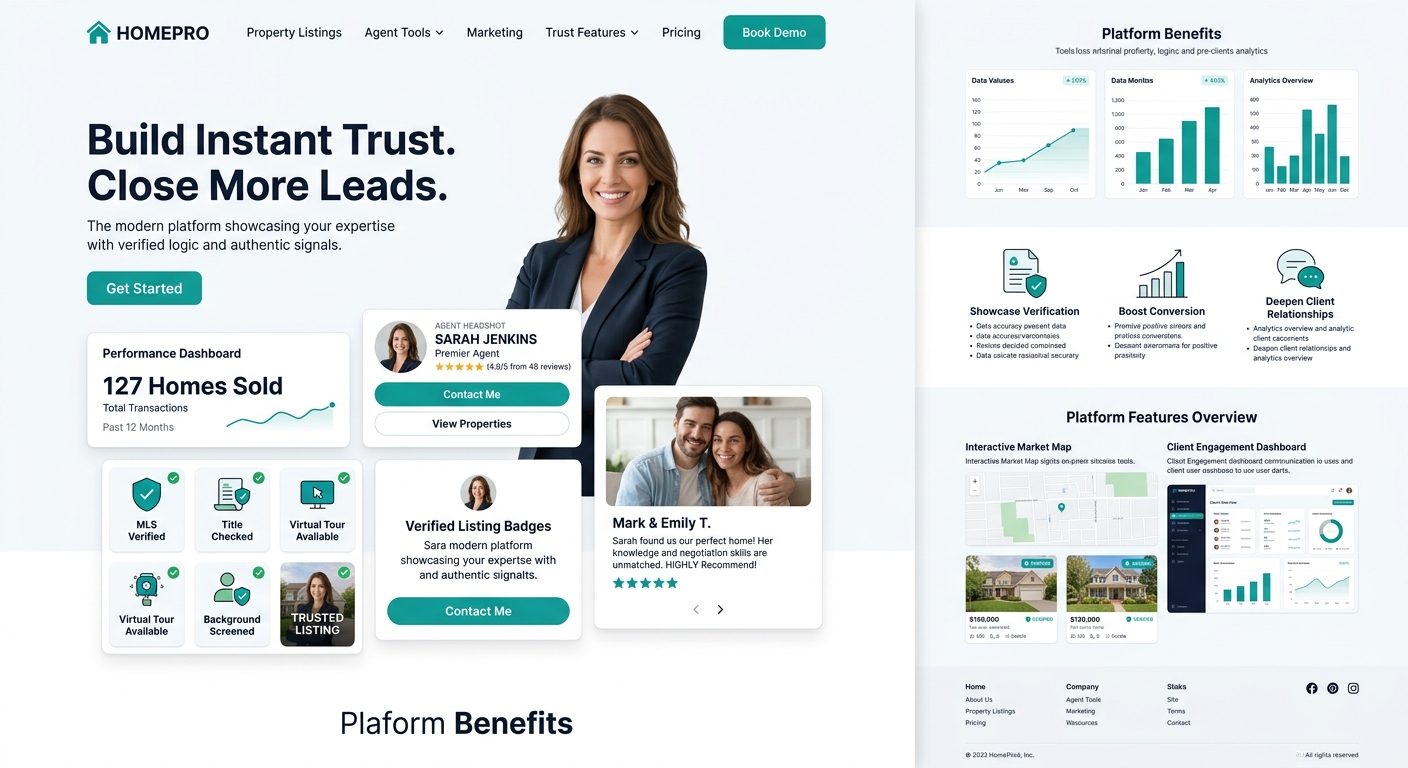
Why does a buyer who spent 40 minutes browsing your site still leave without filling out a contact form? Often, credibility is the gap. Trust-signal architecture prioritizes testimonials, agent credentials, transaction counts, and verified listing badges as the dominant visual elements on the page.
The data here is hard to ignore. Conversion rates increase by up to 42% after adding visible trust signals to a real estate site. Agent photos and badges placed prominently on listing pages produce 23% more contact form completions. For an agent getting 2,000 monthly visitors at a 1.5% baseline conversion rate (30 leads per month), a 42% lift means roughly 13 additional leads from the same traffic. No extra ad spend.
This framework works because 84% of buyers research online before contacting an agent. They’re comparing you against three or four other sites at the same time. The site that answers “why should I trust this person?” fastest wins the inquiry. A testimonial carousel above the fold, a transaction counter (“127 homes sold in Scottsdale since 2019”), and a clear headshot with credentials all reduce the cognitive work of that trust evaluation.
Marketing Butler’s research on real estate website psychology backs this up: “A strategic use of psychological principles—from emotional storytelling to the targeted placement of call-to-actions—can significantly increase interaction with potential buyers.” Trust signals are the principle most agents underinvest in.
If your site lacks reviews and testimonials, you’re likely losing qualified leads at the credibility stage.
Where it excels: Mid-funnel conversion, repeat visitors, referral traffic. Buyers who arrive via recommendation already carry some intent. Trust signals confirm the recommendation and push them toward contact.
Where it falls short: Trust-signal architecture alone feels clinical. A homepage plastered with badges, awards, and testimonial sliders but no emotional warmth reads like a LinkedIn profile. It doesn’t create desire. Buyers who haven’t yet decided what they want won’t stay long enough to care about who you are.
Behavioral Triggers and the Urgency Equation
Behavioral trigger layouts use scarcity cues, personalized CTAs, countdown timers, and dynamic content to accelerate decision-making. This is the buyer intent design pattern most borrowed from e-commerce: “Only 3 days until open house,” “12 buyers viewed this listing today,” “Price reduced 48 hours ago.”
The conversion math is striking. Personalized CTAs perform 202% better than generic ones. Buttons with high contrast and rounded edges increase conversions by up to 84%. Zillow listings featuring virtual tours and interactive floor plans get 81% more page views, 75% more saves, and 85% more shares. Each of these numbers reflects a behavioral trigger doing its job: scarcity, social proof, or reduced friction.
The conversion-focused layout hierarchy matters here. With over 60% of real estate searches happening on mobile, CTAs need to be thumb-friendly and positioned at the bottom of screens. Sticky navigation bars that keep search, favorites, and contact options visible during scrolling cut the friction between interest and action. If your site captures leads but struggles to close them through the funnel, the behavioral layer is usually what’s missing.
Digital engagement patterns and social media interactions often indicate stronger intent than casual recommendations, according to Ylopo’s 2026 conversion analysis. Behavioral triggers are designed to capture and accelerate that intent.
Warning: Overusing urgency cues backfires. Showing “17 people are viewing this listing!” on a property that’s sat on market for 90 days destroys credibility. Countdown timers on open houses that get rescheduled feel manipulative. And listing hundreds of properties without filtering or recommendation paths overwhelms buyers, as noted by [RexTheme’s engagement research](https://rextheme.com/real-estate-buyer-engagement/).
Where it excels: Bottom-of-funnel conversion, high-urgency markets, investor-oriented sites. Buyers who already know their neighborhood and price range respond strongly to urgency cues.
Where it falls short: Anxiety. Behavioral triggers applied carelessly erode the trust you spent the rest of your site building.
The framework that wins is the one matched to where your buyer sits emotionally when they land on your site.
Three Frameworks Side by Side
| Attribute | Lifestyle Storytelling | Trust-Signal Architecture | Behavioral Triggers |
|---|---|---|---|
| Primary emotion | Aspiration, nostalgia | Security, confidence | Urgency, fear of missing out |
| Best market fit | Luxury, lifestyle ($750K+) | Referral-heavy agents, teams | High-inventory, fast-moving ($250K–$500K) |
| Biggest conversion lift | Time on page, brand recall | Form completions (+42%) | CTA clicks (+84% with optimized design) |
| Biggest risk | Burying search function | Feeling impersonal | Eroding trust through overuse |
| Lead with it on | Homepage hero, neighborhood pages | About page, listing detail pages | Search results, listing CTAs |
| Mobile effectiveness | Strong (visual-first) | Moderate (text-heavy elements shrink) | Strong (thumb-friendly CTAs) |
How to Choose Between These Three
You don’t pick one. You layer them. But the order determines your results, and it depends on two variables: your price point and your traffic source.
If you sell homes above $750,000 and most traffic comes from brand searches or referrals, lead with lifestyle storytelling on your homepage and build design consistency around that emotional tone. Place trust signals on your about page and listing detail pages. Add behavioral triggers only at the bottom of the funnel—on scheduling forms and specific listing pages where urgency is real.
If you work in the $250,000–$500,000 range with traffic from paid ads, flip the hierarchy. Lead with behavioral triggers: clear CTAs, personalized recommendations, and honest urgency cues on the homepage. Back them with trust signals on every page. Save lifestyle storytelling for neighborhood content and blog posts.
And if you’re a team or brokerage handling both segments, build separate landing page flows for each audience. The emotional engagement path for a first-time buyer browsing neighborhoods on a Sunday morning looks nothing like the path for a relocating executive with a preapproval letter already in hand.
Someone dreaming needs storytelling. Someone comparing needs trust. Someone ready to act needs a clear, confident push to schedule the showing. Match the layer to the moment, and you’ll convert visitors who never made it past your search bar before.