

Free real estate website builders route every visitor through identical capture forms, thank-you pages, and autoresponder emails regardless of intent. This one-size-fits-all architecture collects contacts at a healthy clip while producing a lead-to-close conversion rate of just 2% to 3%, because capture and conversion require fundamentally different page designs.
The disconnect is structural. A platform optimized to make agents sign up for subscriptions has no incentive to build the kind of post-capture logic that turns a downloaded market report into a listing appointment. The builder gets paid when the agent launches the site. Whether leads from that site ever close is someone else’s problem. One agency’s documented rebuild of this exact funnel illustrates where the leak starts, what it costs, and what it takes to seal it.
The Default Funnel: High Capture, Hollow Pipeline
Website builders marketed to real estate agents advertise lead capture as a core feature. Drag in a form widget, connect it to a CRM, run some ads, and watch the contacts accumulate. The average real estate website converts at 1% to 3% of visitors to form submissions, which sounds reasonable until you trace what happens to those submissions downstream.
The standard free-tier setup looks like this: a homepage with IDX search, a “Contact Me” form on every page, a pop-up offering a generic home valuation or buyer’s guide PDF, and an automated email that says some version of “Thanks for reaching out! I’ll be in touch soon.” That automated email is often the last structured touchpoint the platform provides. Everything after it depends on the agent manually following up, usually within a window that’s already closed by the time they notice the notification.
As multiple agents on Reddit’s r/realtors thread on lead magnets have noted, automating nurture emails or SMS after someone downloads a lead magnet is the difference between casual clicks and real conversations. But the default free builder funnel doesn’t include that automation. It captures the click. Then it stops.

The real estate landing page conversion problem compounds over weeks. An agent running Facebook ads to a free builder homepage might add 40 to 60 leads per month to their CRM. When 97% of those leads never respond to the single follow-up email, the agent concludes that online leads are low quality. The leads aren’t low quality. They entered a funnel that ended at the capture step.
One Form Serving Three Audiences
The deepest architectural flaw in free builder landing pages is intent mismatch. A seller who clicks an ad promising “Find Out What Your Home Is Worth” expects an instant valuation tool, a specific number, and a clear next step. Instead, she lands on a generic homepage with an IDX search bar, a headshot, and a contact form asking for name, email, phone, and “How can I help you?” She bounces. The ad spend is gone.
This scenario repeats across every lead type. First-time buyers want filtered listings and neighborhood data. Investors want cap rates and rental yield estimates. Relocating families want school ratings and commute maps. A single contact form treats all of these people identically and answers none of their actual questions.
The research is clear on why this matters. Luxury Presence’s analysis of lead magnets found that landing pages give lead magnets the clarity and focus they need to convert, and pairing them with thoughtful follow-up turns casual visitors into real clients. Agents who’ve already encountered the template trap recognize this pattern: a pre-built design that looks professional enough but wasn’t built to match ad messaging to page content for any specific audience.

Over 60% of real estate leads now arrive from mobile devices. Google’s Interaction to Next Paint metric penalizes pages slower than 200 milliseconds, and 57% of users say they wouldn’t recommend a business with a poorly designed mobile page. Free builders often pass basic mobile responsiveness tests, but their template layouts still force mobile users through desktop-designed form experiences. Five fields on a phone screen, no sticky CTA button, no click-to-call option. Each friction point bleeds real estate lead leakage that never shows up in the platform’s dashboard, because the dashboard only tracks form submissions, not the visitors who almost submitted but didn’t.
The Thank-You Page Where Nurturing Dies
Assume a lead does complete the form. On a purpose-built conversion page, the thank-you page is the start of the relationship. As Storydoc’s landing page analysis explains, a thank-you page has the power to move a lead further down the sales funnel or set up a repeat customer. It can offer a second resource, schedule a showing, embed a video introduction, or trigger a CRM workflow that segments the lead by intent and starts a drip sequence calibrated to their behavior.
On a free builder, the thank-you page is a dead end. “Thanks! We’ll be in touch.” No second offer. No scheduling link. No segmentation logic. The lead sits in a CRM table, undifferentiated from every other contact, waiting for the agent to manually sort through them. If you’ve read about why form conversion audits matter, you know this is the exact step where most leads evaporate from the pipeline.
The builder gets paid when the agent launches the site. Whether leads from that site ever close is someone else’s problem.
The timing dimension makes this worse. Data on follow-up response windows shows that the gap between a five-minute response and a thirty-minute response can crater contact rates by orders of magnitude. Free builders don’t include speed-to-lead automation. The form submission sits in an inbox until the agent checks it, which might be hours later if they’re at a showing or an open house.
Sixty Days, Three Deals, and 7.8%
Agency MNKY documented a client rebuild in September 2025 that illustrates what happens when you replace a free builder’s generic funnel with purpose-built landing pages. After iterative A/B testing of headlines, CTA copy, and form length across dedicated pages for different audience segments, the client’s conversion rate jumped to 7.8%, and they closed three deals within 60 days.
That 7.8% figure deserves context. The average real estate landing page converts at about 7.4%, with a median of 2.6%. The median is what most agents experience. The average is skewed upward by teams running dedicated, tested pages with post-capture automation. The gap between 2.6% median and 7.8% optimized represents a roughly 3x improvement in conversion, achieved through changes that had nothing to do with ad spend or traffic volume.
The rebuild followed a pattern that ContempoThemes documented in their landing page audit: creating landing pages that convert well requires ongoing tracking and smart adjustments based on data. Without monitoring performance, you miss valuable leads and watch ROI erode.
What the rebuild changed, specifically:
- Separate pages for each ad campaign. Seller ads pointed to a seller valuation page. Buyer ads pointed to a neighborhood search page. Each page had one CTA, one form, and copy that matched the ad’s promise word for word.
- Staged form fields. The first step collected name and email only. A second step, shown after submission, asked for timeline, budget range, and property type. Initial completion rates climbed because the first step required minimal commitment.
- Automated SMS within 90 seconds of submission. The text message included the agent’s name, a reference to the specific resource the lead requested, and a link to schedule a call. This replaced the generic autoresponder email.
- CRM tagging by source page. Leads from the seller valuation page entered a seller nurture sequence. Leads from the buyer search page entered a buyer sequence. No manual sorting required.
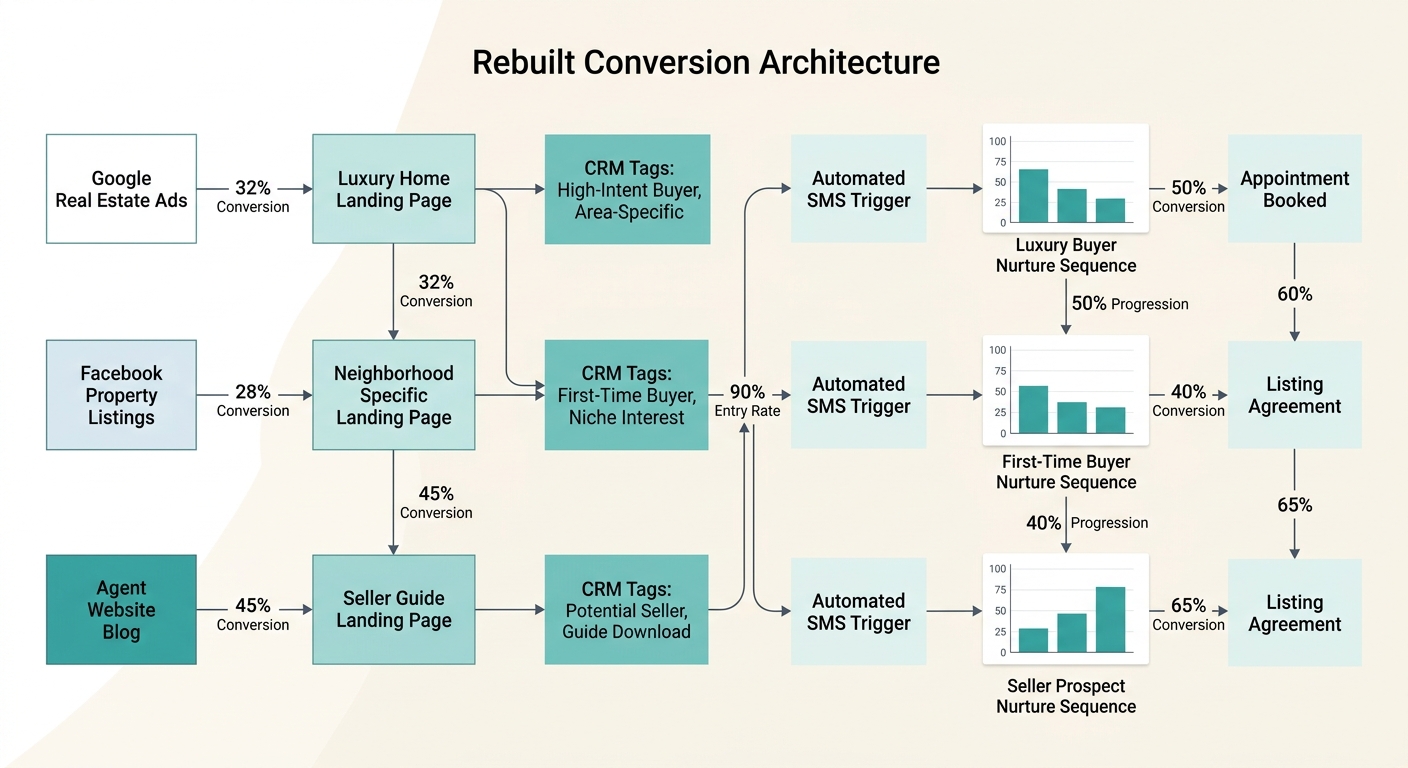
The core insight from this rebuild is that lead capture vs lead conversion are separate engineering problems. The free builder solved the first one. The agent had to build the second one from scratch, outside the platform, using a CRM, an SMS tool, and a landing page builder that allowed A/B testing. The lead nurture breakdown was never a traffic problem. It was a plumbing problem.
Why the Platform Economics Keep the Leak Open
Free and low-cost website builders make money by acquiring agent subscribers, not by closing real estate deals. Their product roadmap is optimized for the metrics that drive subscriptions: template variety, ease of setup, IDX integration, and mobile responsiveness. These are all real features. They’re also all pre-conversion features.
Building post-capture conversion tools costs engineering resources that don’t show up in subscriber acquisition numbers. A staged form builder, CRM segmentation logic, SMS automation triggers, A/B testing infrastructure for landing pages, and a thank-you page editor with conditional routing based on lead source all require significant development investment. And the agents who would benefit most from these tools are often the same agents who chose a free builder because they didn’t want to pay for a more capable platform.
The result is a market where website builder lead magnets attract agents with the promise of easy lead generation, deliver on the capture half of that promise, and leave the conversion half as an exercise for the agent. Agents who don’t realize conversion requires separate tooling assume their leads are bad. Agents who do realize it end up cobbling together three or four additional services to fill the gaps their builder leaves open. Either way, the platform’s churn metrics look fine because new agents keep signing up, attracted by the same capture-focused marketing that attracted the last cohort.
The conversion leak isn’t a bug in these platforms. It’s a predictable outcome of their business model. Understanding that distinction is the first step toward building a pipeline that actually closes.