

Eighty-four percent of consumers trust online reviews as much as personal recommendations from friends, according to aggregated survey data cited by AgentFire and BrightLocal. That number climbs to 95% among consumers aged 18–34. In an industry where a single transaction can represent the largest financial commitment of a buyer’s life, those figures carry real weight. Yet a scan of independent agent websites reveals a persistent blind spot: the majority feature no client reviews, no testimonials, and no verifiable evidence that anyone has ever successfully worked with the agent. The listing photos are polished, the headshot is professional, the contact form is prominently placed. But the site is asking visitors to initiate a six-figure relationship based on nothing but self-reported credentials.
This disconnect between what buyers expect and what agent websites deliver is what marketers call the social proof gap. And the data suggests it’s one of the most expensive, least-discussed conversion problems on real estate websites today.
Where the Conversion Funnel Springs a Leak
The logic is straightforward: a prospect finds your site through a Google search, a paid ad, or a referral link. They spend 30 to 90 seconds scanning the homepage. They’re evaluating whether you’re credible enough to contact. If they see no evidence from past clients, a significant percentage will leave and find an agent whose site provides that evidence.
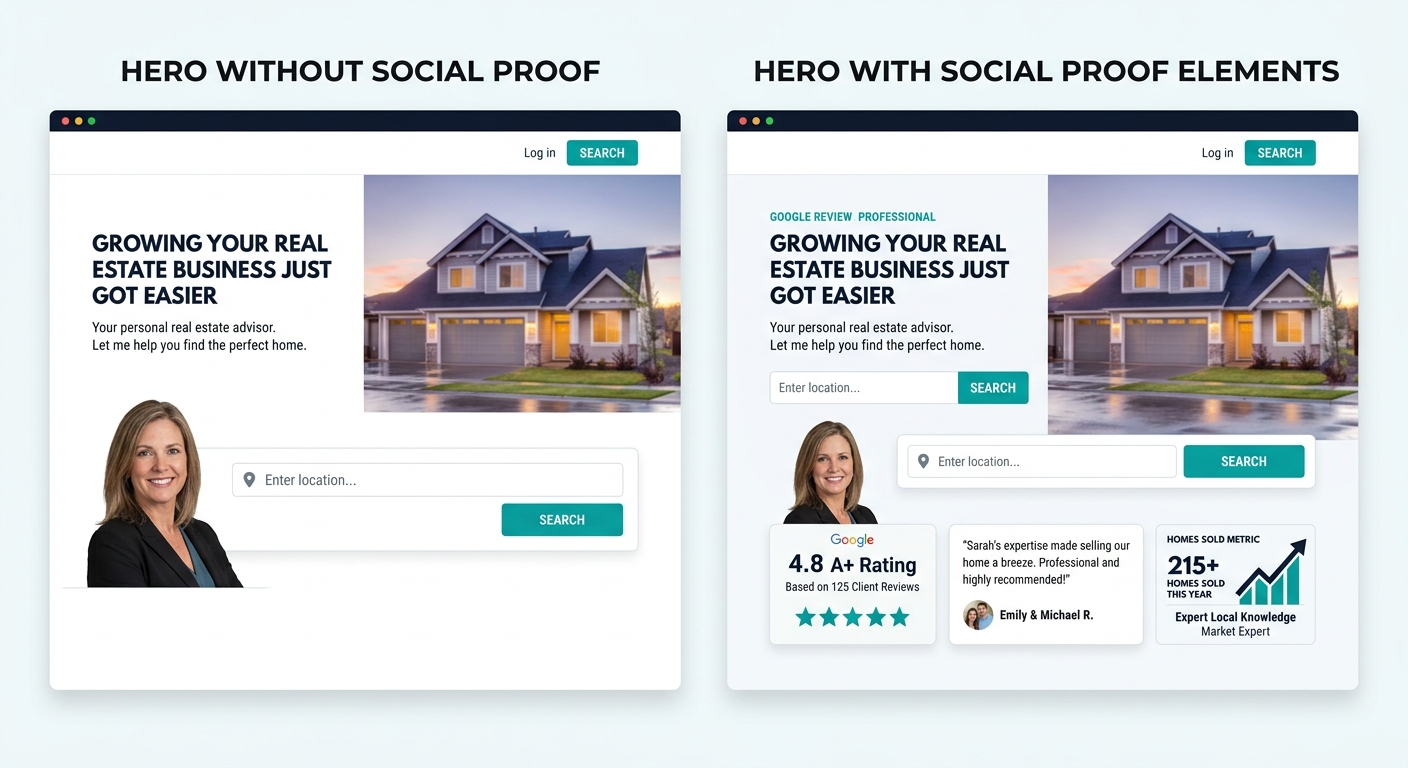
Nilead’s analysis of real estate website bounce rates recommends swapping hero banners with versions that include a trust stat or testimonial as one of the first fixes for high drop-off. The reasoning is simple: the hero section is where most visitors make their stay-or-leave decision, and a review snippet placed there acts as a speed bump against the bounce instinct.
Juicer.io’s research supports this further, reporting that integrating live social media feeds showcasing client engagement and reviews can boost website conversion rates by 20–30%. That’s not a marginal improvement. For an agent generating 200 monthly site visitors, even a 20% bump in conversion could mean the difference between 4 and 8 qualified contacts per month.
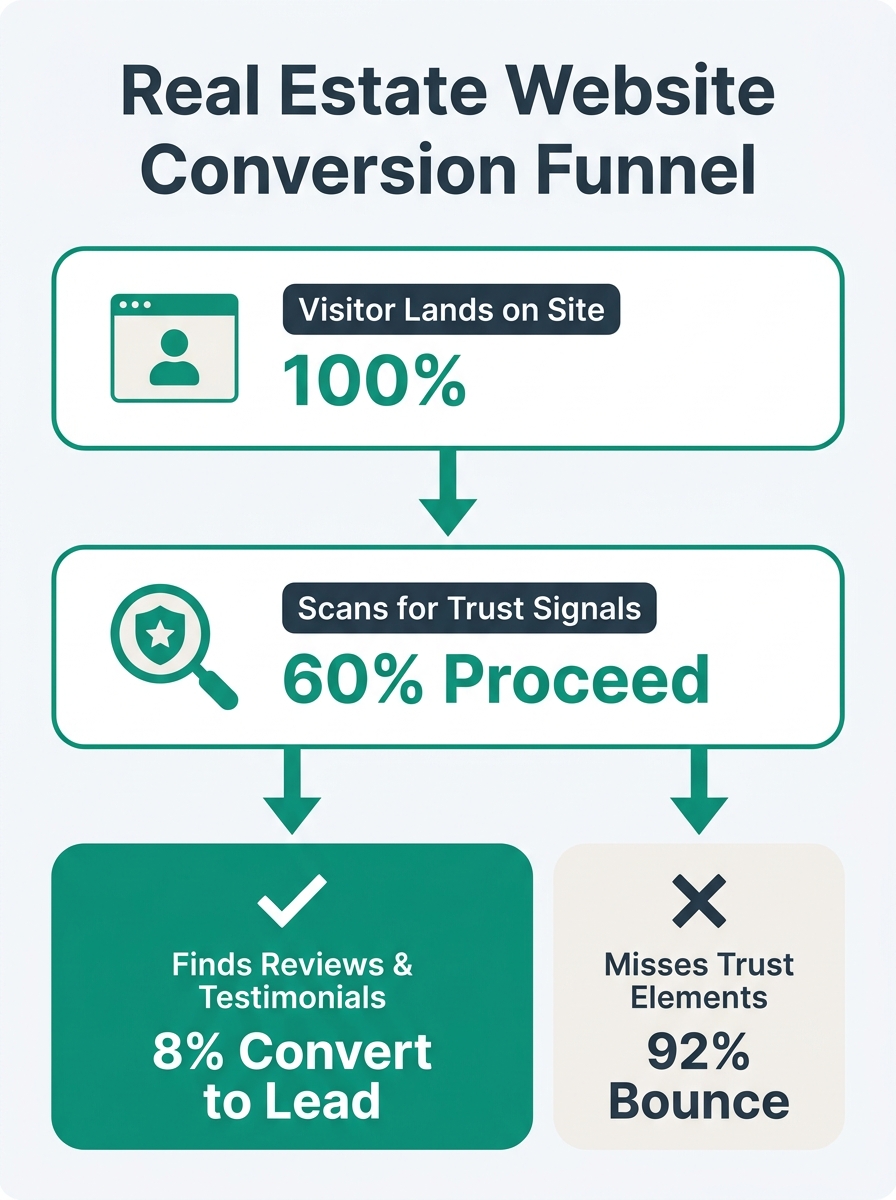
The leak compounds because the visitors you lose are often your most qualified ones. As Ylopo’s lead conversion research notes, lead quality varies dramatically by source, and organic search visitors tend to be higher-intent than cold social media traffic. These are people who typed something like “best real estate agent in [your city]” into Google. They arrived ready to evaluate. Your site gave them nothing to evaluate against.
The Three Pages That Need Social Proof Most
Social proof on real estate websites isn’t a single widget you install on the homepage and forget. Different pages serve different buyer intents, and the type of proof that works on each one varies.
The homepage is your first impression, and it needs at least one visible review or trust metric above the fold. A rotating testimonial carousel buried at the bottom of a long scroll doesn’t count. By the time someone scrolls that far, they’ve already formed their opinion. Place a short client quote, a star rating badge from Google or Zillow, or a concrete metric (“127 homes sold in Metro Denver”) where it’s visible within 2 seconds of page load.
Individual property listings are where customer testimonials on property listings pages create an unexpected advantage. Buyers browsing a listing are in evaluation mode, and a brief testimonial from a past buyer about the agent’s negotiation skills or responsiveness adds context that listing photos can’t provide. This is especially true on pages where you’re competing for visibility in search results against portal listings that already aggregate agent reviews.
The contact or “about me” page is where the highest-intent visitors land. They’ve already decided they might want to work with you and are looking for final confirmation. This page should carry your strongest proof: video testimonials, detailed case studies, or screenshots of Google reviews with names and dates visible. If your contact page is sparse, you’re losing leads at the exact moment they were ready to convert, a problem we’ve explored in our analysis of form conversion drop-offs.
What Counts as Social Proof for Real Estate
Not all trust signals carry equal weight. A vague quote attributed to “J.S. — Happy Client” does almost nothing for credibility. Specific, verifiable, and diverse social proof moves the needle.
Third-party platform reviews from Google Business Profile, Zillow, or Realtor.com are the gold standard because visitors can verify them independently. Display these with an automated feed or embed rather than manually copying quotes, which can feel curated and therefore less trustworthy.
Video testimonials punch above their weight. A 60-second clip of a real couple standing in front of their new home, talking about the experience, communicates authenticity in a way that text alone struggles to match. NAR’s guidance on the power of testimonials emphasizes that these should be a top-of-mind marketing tool for every agent, not an afterthought.
Quantifiable results give context to subjective praise. “She was amazing!” tells a prospect very little. “Sold our home in 9 days, $23,000 above asking” tells them everything. Pair the qualitative with the quantitative wherever possible.
A testimonial without a specific outcome is just a compliment. A testimonial with a number attached becomes evidence.
Social media activity also functions as proof, though indirectly. Reddit discussions about how agents use social media consistently point to three benefits: staying top-of-mind with past clients, building trust with people who are already considering you, and creating a body of content that prospects check before making contact. An active Instagram or Facebook presence, where real clients tag the agent and leave comments, reinforces the credibility established on the website.
And there’s an important warning here about shortcuts. Some services promote purchasing fake reviews to quickly build a profile. This is a trap. Platforms like Google and Zillow actively detect inauthentic reviews, and getting flagged can damage your profile ranking and your reputation more than having a small number of genuine reviews ever would. The consumer trust gap in real estate is real, but the solution involves earning trust, not manufacturing it.
Building a Review Collection System That Actually Works
The biggest barrier to social proof on real estate websites isn’t technical. It’s behavioral. Agents close a deal, celebrate, and move to the next one without asking the client for a review while the positive experience is still fresh.
Samantha Odo at PreCondo described the results of systematizing this process in an interview with Trustmary: collecting testimonials from existing customers improved their service quality (by surfacing issues mentioned in reviews) and increased client inquiries and referrals. The compounding effect matters. Each new review makes the next prospect slightly more likely to convert, which generates another happy client, which generates another review.
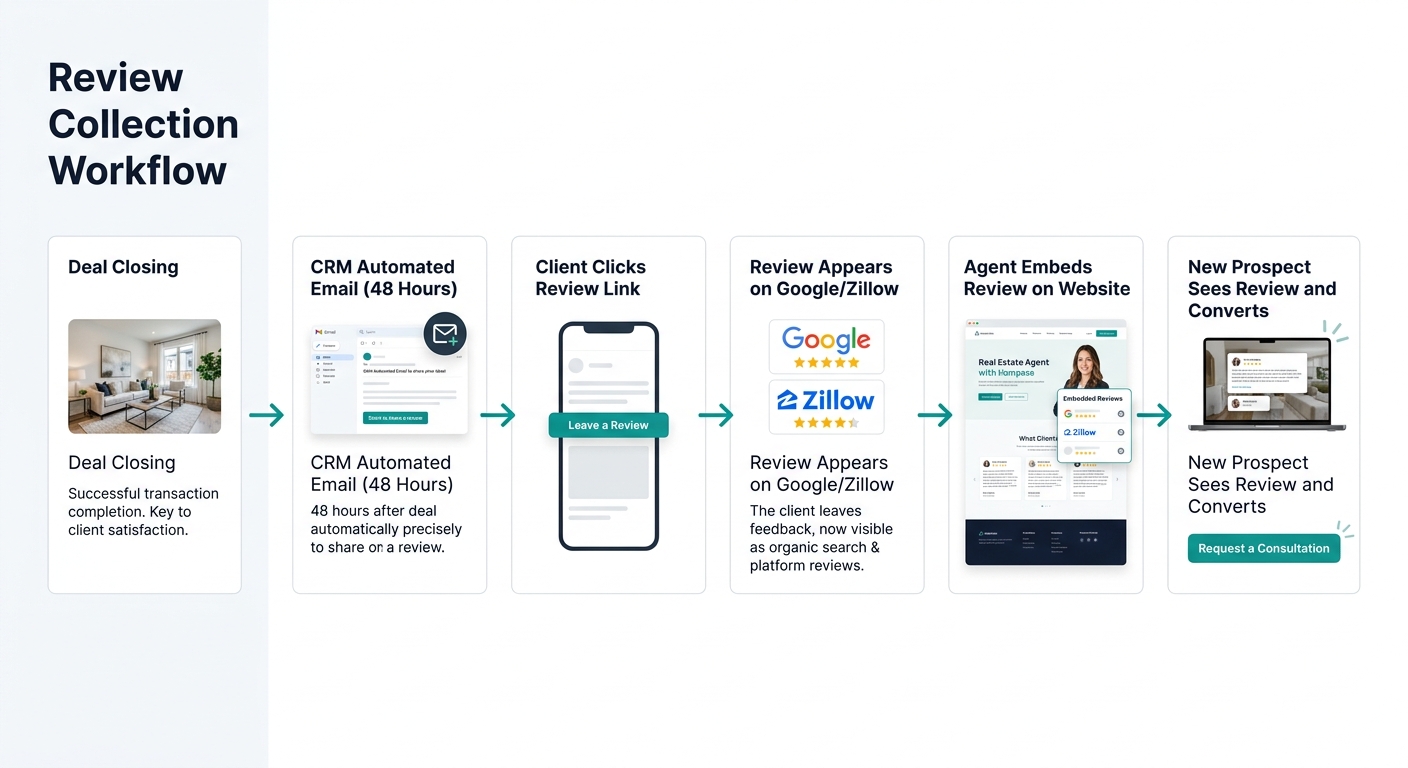
Here’s what a practical collection system looks like:
- Set a CRM trigger for 48 hours after closing. Send an automated email with direct links to your Google Business Profile and Zillow review page. Two platforms max per request — more than that creates decision fatigue.
- Provide a prompt, not just a link. “Would you mind sharing what the home search process was like and how we worked together?” generates more useful testimonials than “Please leave a review.”
- Ask for video at the final walkthrough. The client is excited, the house is right there, and a phone camera is all you need. Even 30 seconds of genuine enthusiasm outperforms a paragraph of polished text.
- Rotate fresh reviews onto your site monthly. A testimonial dated 2022 on a 2026 website signals stale activity. Use your CRM or a widget like Grade.us or BirdEye to automate the refresh cycle.
If your site already captures leads effectively but struggles to convert them into conversations, the issue might extend beyond social proof into your lead nurture workflow. But trust signals on the site are usually the first domino. Fix them, and downstream conversion often improves without changing anything else.
Tip: The Close’s lead conversion guide highlights that [social proof can skyrocket conversion rates](https://theclose.com/real-estate-lead-conversion/) by borrowing the same psychology that drives Amazon purchase decisions. When a prospect is on the fence, one specific review from a similar buyer profile can be the deciding factor.
What the Data Doesn’t Capture
The 84% trust figure and the 20–30% conversion lift are compelling, but they come with caveats worth acknowledging. These are aggregate numbers drawn from cross-industry studies and real estate-specific surveys that vary in methodology, sample size, and recency. The actual impact on your site depends on your market, your traffic volume, your current conversion baseline, and the quality of the rest of your online presence.
There’s also no reliable dataset measuring how many qualified leads are lost specifically because a real estate site lacks reviews, as opposed to all the other reasons a visitor might bounce (slow load times, poor mobile experience, confusing navigation). The social proof gap is real, but it exists alongside a constellation of other trust and usability factors that all interact.
What the data does tell us, consistently across multiple sources and years of research, is that buyers look for social proof before they reach out, and agents who make that proof visible on their own websites reduce friction at the most critical decision point in the funnel. The sites that treat reviews as decorative afterthoughts — a small testimonial block buried in the footer — are leaving money on the table in a way that no amount of ad spend or SEO optimization can fully compensate for.
The numbers point clearly in one direction. The specific ROI for your site remains something you’ll have to measure yourself, one review at a time.