

Seventy-seven percent of consumers who watched a brand’s video testimonial said it directly influenced their purchase decision, according to data compiled by Teleprompter.com. For real estate agents, this makes video testimonials the single highest-converting trust signal available on a website, assuming they’re placed where visitors actually encounter them.
TL;DR: Video testimonials outperform text reviews and raw data displays for social proof conversion, but placement determines whether they work. Put your strongest proof at friction points — homepage hero area, property pages above the contact form, listing presentations — and stop burying reviews on a standalone testimonials page most visitors never click.
Homepage Placement Produces the Highest-Value First Impressions
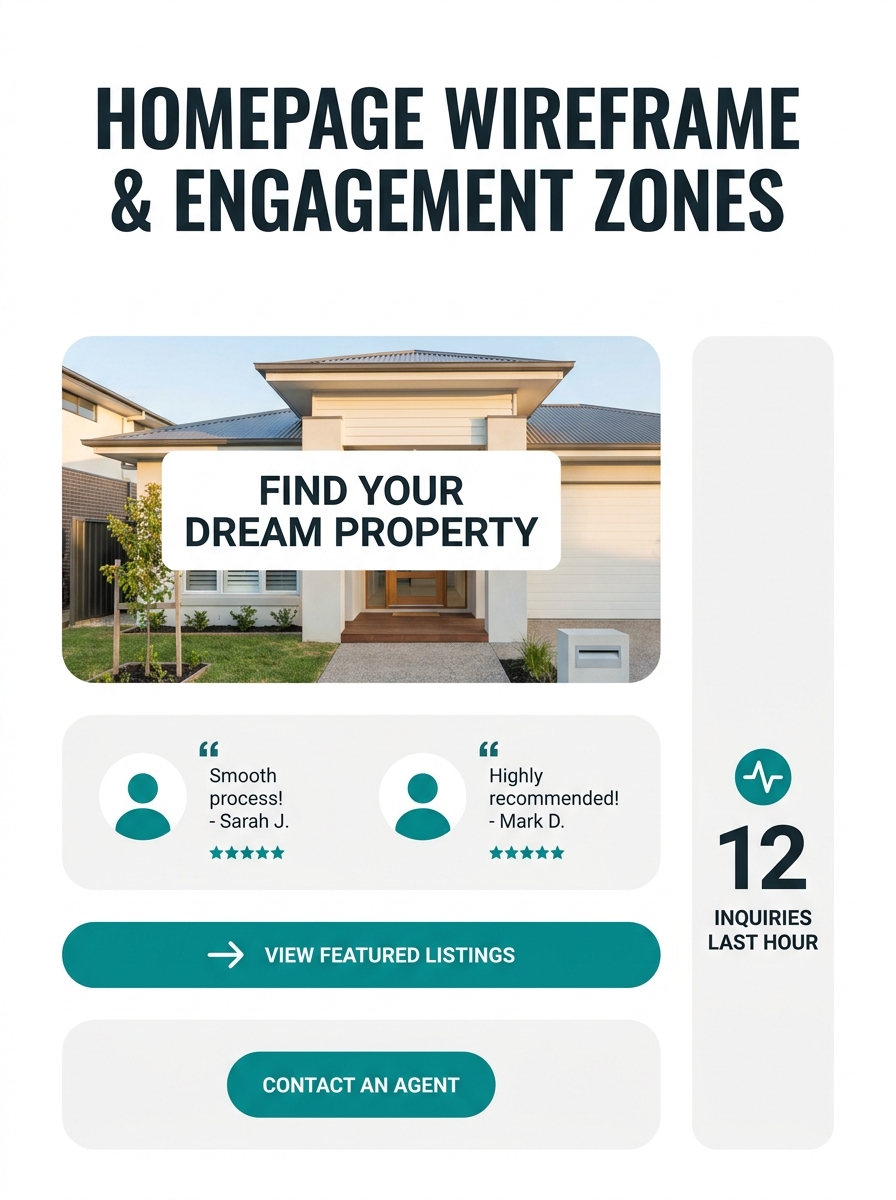
The homepage is where trust signals matter most because it’s where the majority of new visitors form their first credibility judgment. Agents who position two to three short testimonials in the top 40% of their homepage give cold traffic an immediate reason to keep browsing instead of bouncing to a competitor.
A real estate testimonial strategy that works treats the homepage as a credibility checkpoint, not a gallery. You don’t need 15 reviews scrolling in a carousel. You need two or three specific, outcome-focused quotes placed between your value proposition and your first call-to-action. The structure matters: client name, neighborhood or property type, and a concrete result (“sold in 9 days, $22,000 over asking”).
This pairs with what we’ve covered in our breakdown of where testimonials actually drive lead conversion. The trust signals homepage section should interrupt the visitor’s decision process before they’ve decided to leave, not reward them for scrolling to the footer.
Real-time activity indicators add a second layer. Updater’s research on property marketing recommends using live data like “14 people inquired about this property today” or “1,344 people reached out to our brokerage in the past week.” These bandwagon-effect signals have been shown to increase conversion rates by 10–15% when displayed as live activity notifications.
Video Testimonials Outperform Text by a Wide Margin
Why does video dominate? Because seeing a real person speak on camera creates a credibility gap that written reviews can’t close. Lemonlight’s analysis of testimonial formats found that testimonial videos function best as bottom-of-funnel assets, deployed when prospective buyers are making their final purchase decision and need to eliminate last doubts.
The 77% figure from Teleprompter.com’s research deserves context: that’s consumers who specifically attributed part of their buying decision to a video testimonial they watched. The number for text-only reviews falls significantly lower because text lacks the nonverbal trust cues (facial expressions, tone of voice, body language) that trigger mirror neuron responses in the viewer’s brain.
For real estate agents specifically, video testimonials lead generation works best when the videos are short (60–90 seconds), filmed in the actual home the client purchased, and structured around a single concern the viewer likely shares. A first-time buyer talking about their fear of the process. A relocating family describing how the agent handled the remote search. Each video should answer one objection, not offer a vague endorsement of how “great” you are.
| Format | Conversion Strength | Best Placement | Production Effort |
|---|---|---|---|
| Video testimonial (60–90 sec) | Highest: 77% purchase influence | Homepage hero, property pages, email nurtures | Medium: requires client coordination |
| Text + photo review | Moderate: adds credibility, lacks emotional depth | Homepage mid-section, dedicated reviews page | Low: pull from Google/Zillow |
| Data-driven social proof (“14 inquiries today”) | Strong for urgency: 10–15% conversion lift | Property listing pages, search results | Low: automated from CRM/analytics |
| Case study with before/after | High for luxury/complex transactions | Blog, listing presentations, retargeting ads | High: requires narrative + data |
Each video testimonial should answer one specific objection a prospective client likely shares, not offer a general endorsement.
The Psychology That Makes Social Proof Convert
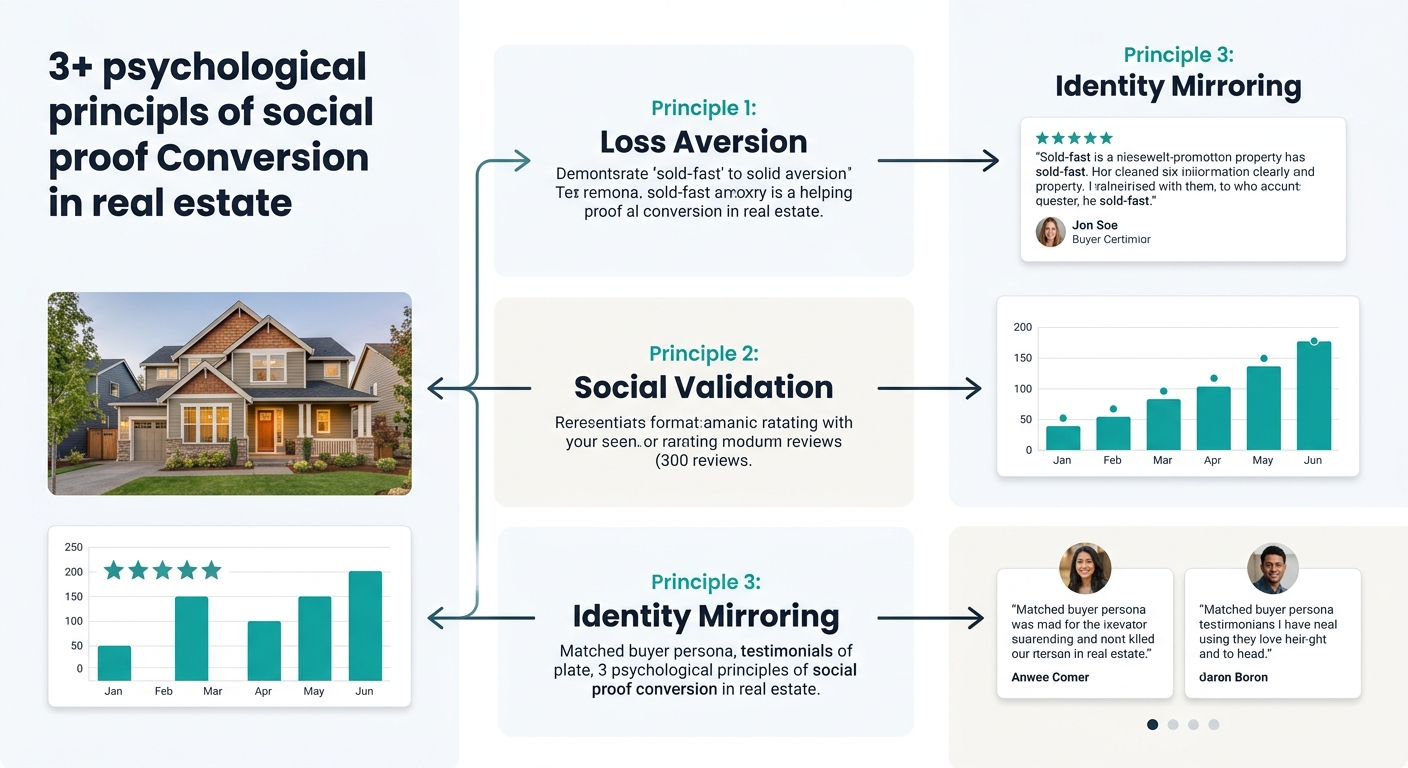
The mechanism behind social proof conversion in real estate operates on three distinct psychological principles, and understanding them changes how you deploy testimonials.
Loss aversion is the most powerful. Tversky and Kahneman’s foundational research established that people fear missing out more than they value acquiring gains. In real estate marketing, H5 Property’s analysis of psychological triggers documents this with examples like “Only one penthouse suite remaining with a panoramic skyline view.” Testimonials that reference speed of sale or competitive offer situations activate this same fear, pushing prospects to act before they lose access.
Social validation is the second driver. People follow proven paths set by others, and the more positive testimonials you display, the easier it becomes to convince the next prospect, as REnd’s breakdown of sales psychology outlines. When a visitor sees 47 five-star reviews and three video testimonials, the implicit message is that choosing you is the safe, validated decision. This is the bandwagon effect working in your favor.
Identity mirroring is the third and most underused. Prospects convert at higher rates when the testimonial comes from someone they identify with. A young couple buying their first condo responds to a testimonial from another young couple, not from a retiree downsizing a 4,000-square-foot colonial. Segmenting your testimonials by buyer type and displaying the most relevant ones based on the page context produces measurably better results than a generic rotation.
The neighborhood trust map concept shows the localized version of these principles in action. Displaying a map of completed transactions by area has produced a 34% increase in contact form submissions from visitors who viewed it, according to research on local service businesses. That’s social proof tied to geographic relevance, which matters enormously in a business built on local expertise.
How to Build a Testimonial Collection Pipeline
Collecting testimonials requires a system, not occasional requests. The agents who generate the most social proof content are also the ones who generate the most leads from their websites, according to Carrot’s analysis of member engagement patterns.
Build the ask into your closing process at three specific points:
- At the closing table, ask for a 30-second video reaction while emotions run high. Provide a single prompt: “What were you most worried about before we started, and how did it turn out?” This produces the best raw footage because clients are genuinely emotional and unscripted.
- Seven days post-close, send a text (not email) asking for a Google review. Include the direct link to your Google Business Profile review page. Text messages get read within 3 minutes on average; emails sit for hours. Keep the text personal: “Hey [name], we loved working with you on [address]. Would you mind leaving a quick review? Here’s the link.”
- Thirty days post-close, request a more detailed testimonial for your website. By this point, the client has had time to settle in and reflect. Offer to write a draft based on your conversation that they can edit and approve. Most clients will accept the draft with minor changes, which dramatically increases your completion rate.
Tip: If your website architecture is already costing you leads, fixing testimonial collection won’t matter until you [fix the structural problems first](/blog/conversion-tax-real-estate-website-architecture). Testimonials strengthen a working funnel; they don’t rescue a broken one.
Property Page Placement Changes the Conversion Math
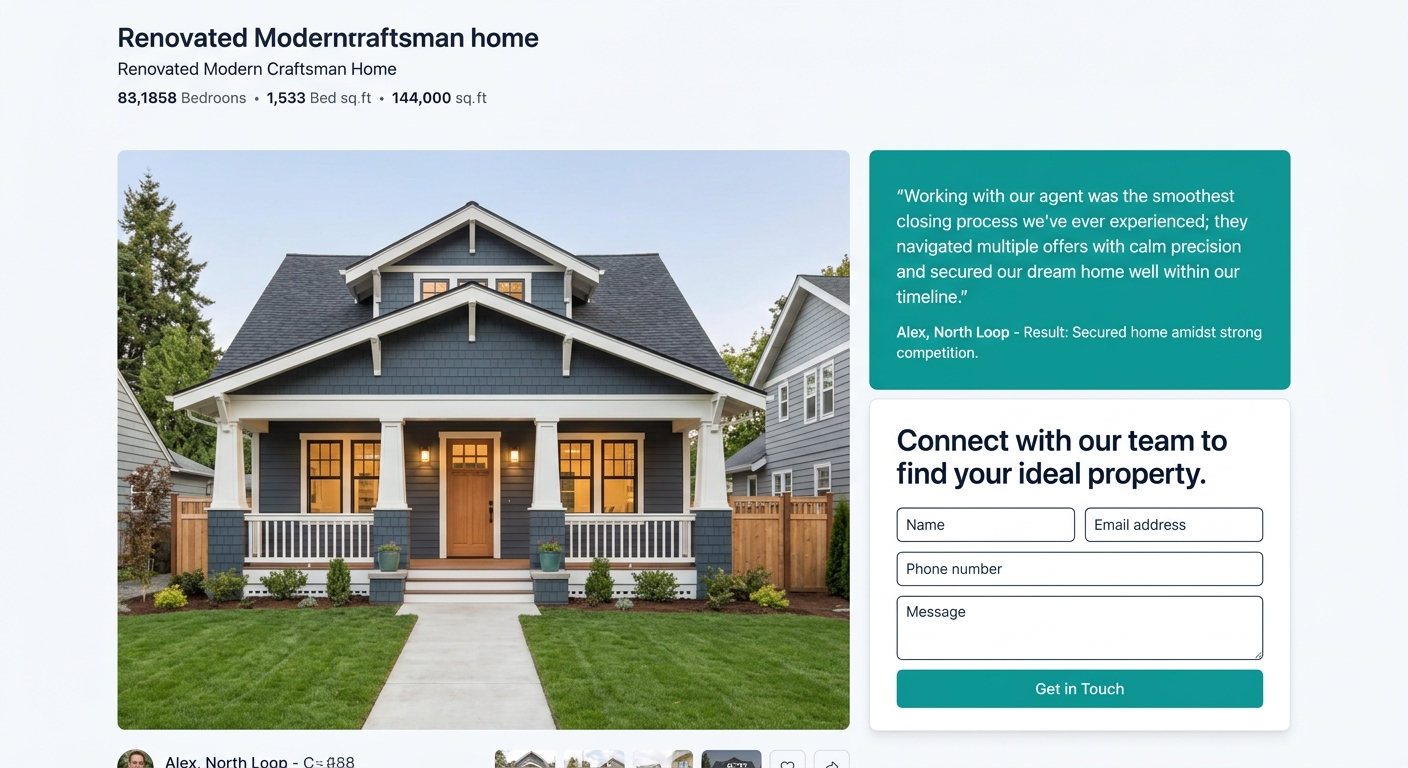
Testimonials on individual property pages serve a different purpose than homepage testimonials. On a property page, the visitor has already expressed interest in a specific listing. The testimonial’s job here is to reduce the friction between “this looks interesting” and “I should contact this agent.”
Place one or two short testimonials directly above the contact form or scheduling widget on each property page. The testimonials should reference the type of transaction (buying, selling, first-time, luxury) that matches the listing. An agent selling a $1.2M waterfront property should display a testimonial from a previous luxury buyer, not from a first-time buyer who purchased a $280K starter home.
We’ve covered the hierarchy of elements on property pages in detail before. Testimonials belong in the conversion zone: the area between the last meaningful listing detail and the lead capture form. They act as the final trust checkpoint before a visitor decides whether to fill out the form or close the tab.
For agents running paid campaigns, featuring specific client success stories in ad creative (including the outcome: “sold in 6 days above asking”) improves click-through rates in luxury markets. The testimonial becomes the ad copy, which is far more persuasive than self-promotional messaging about your years of experience or number of transactions.
What Still Isn’t Settled
The data on social proof conversion is strong in aggregate, but several questions remain open for agents building a testimonial strategy in 2026.
No large-scale study has isolated the conversion impact of testimonial placement on real estate websites specifically. The 77% video influence figure comes from general consumer behavior research, not from homebuyers evaluating agents. The 34% lift from neighborhood trust maps comes from local service businesses broadly. Real estate-specific controlled studies would sharpen these recommendations considerably, but the industry hasn’t produced them yet.
The optimal number of testimonials per page is also unresolved. Too few and you lack proof; too many and you overwhelm the visitor or create suspicion that the reviews are curated. Anecdotal evidence from high-producing agents suggests three to five per key page, but nobody has tested this rigorously against two or against eight in a real estate context.
And video length remains debated. The 60–90 second recommendation is a general best practice from marketing research. Some agents report that 30-second clips perform better on mobile, while longer 2–3 minute stories convert better in email sequences where the viewer has already opted in and is further down the funnel. Until agents start A/B testing their own testimonial formats systematically and sharing the data, the “right” approach will remain an educated guess informed by adjacent industries rather than from within real estate itself.