
Fifty-four percent of Realtors now rank social media as their best source of high-quality leads, ahead of MLS portals and paid search. But that statistic hides a critical split: the agents pulling buyer leads from Pinterest and the agents pulling them from TikTok are reaching entirely different people at entirely different points in the purchase timeline. Choosing between these two platforms without understanding that gap means burning hours on content that reaches the wrong audience at the wrong moment.
The distinction matters because home buyer behavior has fractured along generational and intent lines. According to the NextGen Homebuyer Report, 40% of Gen Z and 30% of Millennials use social media for at least part of their home buying research. But “social media” is doing a lot of heavy lifting in that sentence. A buyer saving a pin of a mid-century kitchen remodel to a “Dream Home” board is doing something fundamentally different from a buyer watching a 30-second walkthrough on TikTok during a lunch break. One is building a wish list. The other is being entertained into curiosity. Both paths lead to real transactions, but they demand different content, different CTAs, and different follow-up timing.
Where Each Platform Sits in the Buyer Funnel
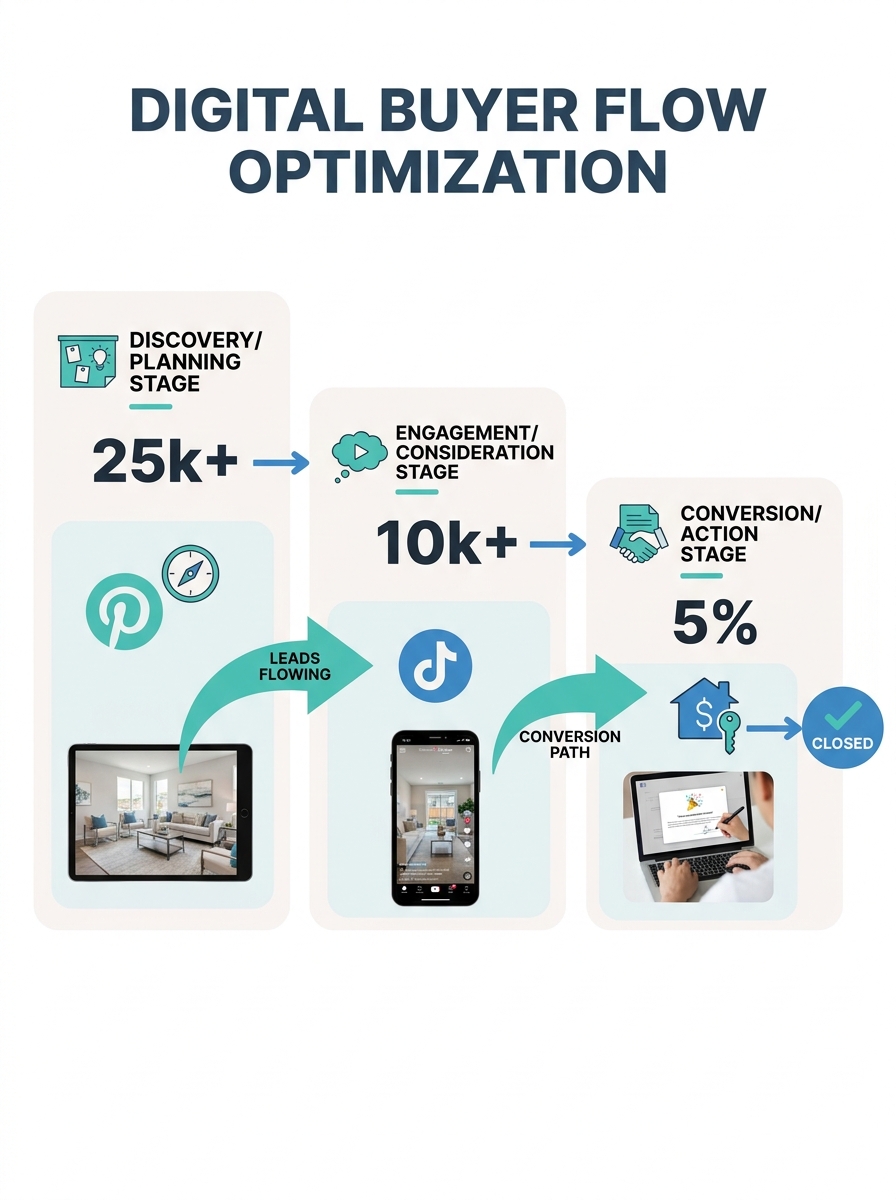
Pinterest functions as a visual search engine. Ninety-seven percent of its top searches are unbranded, which means users aren’t typing in agent names or brokerage brands. They’re searching “modern farmhouse exterior paint colors” or “walkable neighborhoods near Denver.” That search-first behavior places Pinterest squarely in the discovery and planning phase. A buyer might save pins for six months before they ever contact an agent. The upside is that when they do reach out, their intent is high. They’ve already filtered their preferences.
TikTok operates on a different mechanism entirely. Its algorithm serves content to users based on engagement patterns, not explicit searches. A first-time buyer who watches two property tour videos will get fed a steady stream of real estate content within hours, whether they asked for it or not. This creates what you might call accidental lead generation: buyers who didn’t know they were in the market until your video made them realize their rent payment could cover a mortgage in a different zip code.
The practical implication for agents: Pinterest captures demand that already exists. TikTok creates demand that didn’t exist five minutes ago.
Pinterest Pins Keep Working While You Sleep
The most underappreciated advantage of Pinterest real estate marketing is content longevity. A TikTok video peaks within 48 to 72 hours of posting. A Pinterest pin, optimized with the right keywords, can drive traffic to your website for months or even years. That’s a meaningful difference when you’re an agent juggling showings, negotiations, and open houses without a dedicated marketing team.
To make pins work as a lead generation tool, each one needs to link somewhere useful. A pin of a staged living room that links to your Instagram profile is a dead end. A pin of that same living room that links to a neighborhood guide with an embedded lead capture form is a funnel. The Close recommends encouraging visitors to save your pins, follow your boards, and click through to your real estate website, which turns passive browsing into active engagement.
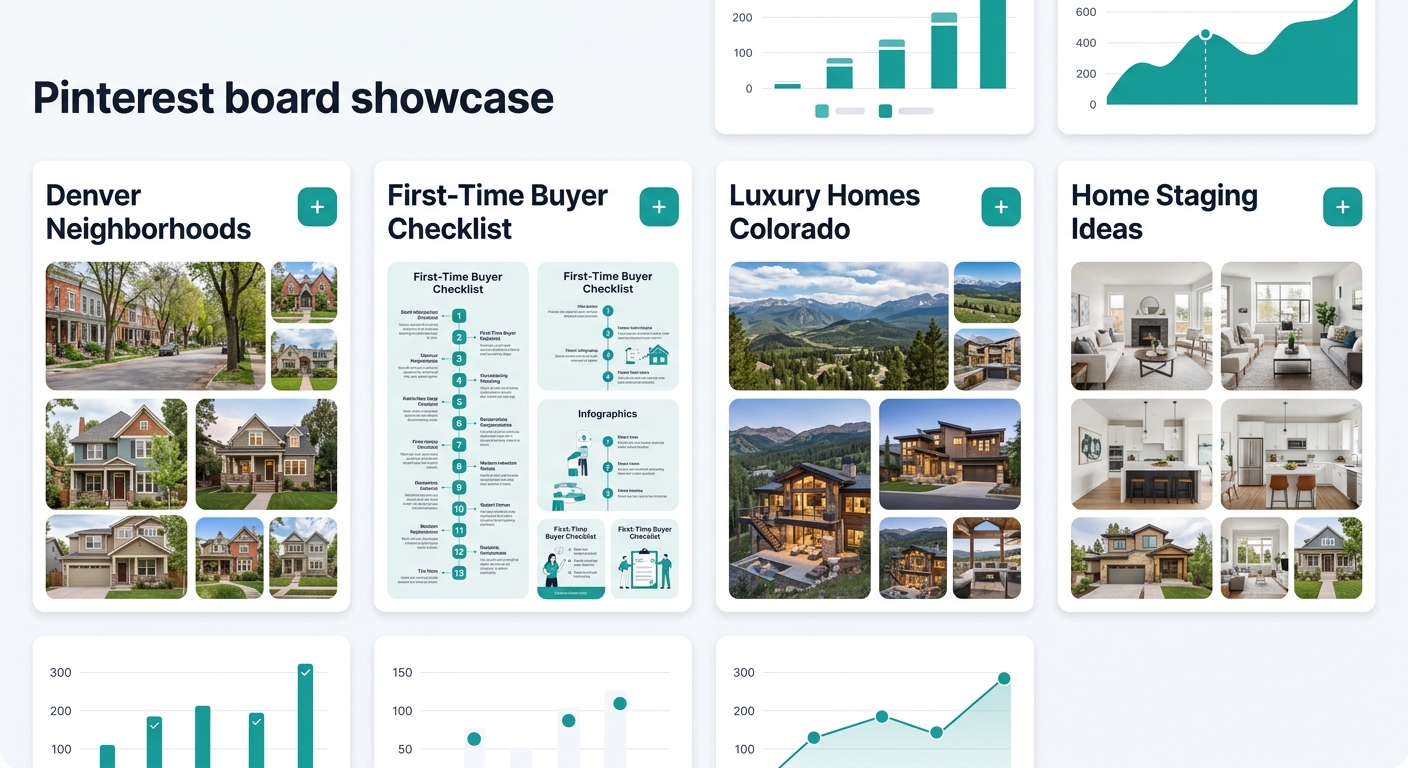
Tip: Build 5 to 7 core Pinterest boards organized by buyer intent: neighborhood guides, home style inspiration, first-time buyer tips, local market data, and renovation ideas. Post 3 to 5 original pins per week using vertical images in 2:3 ratio with keyword-rich descriptions that include location, price range, and home style.
Pinterest pins also appear in Google Image Search results, which means your visual content strategy on Pinterest reinforces your SEO work. If your website architecture is already built for lead capture, Pinterest becomes an additional traffic source feeding into the same conversion system you’ve already optimized.
The audience skews toward women aged 25 to 54 with middle-to-upper household incomes. If you’re farming luxury listings or family-oriented neighborhoods, that demographic overlap is significant.
TikTok’s Cost-Per-Lead Advantage
Where TikTok wins is speed and cost. Agents running paid campaigns on TikTok report cost-per-lead figures between $15 and $45 for standard residential properties, roughly 40 to 60 percent lower than comparable Facebook and Instagram campaigns. Luxury properties see higher CPL ($75 to $150 range), but the lead quality tends to justify the spend because the audience targeting on TikTok allows tight geographic and interest-based filtering.
TikTok’s Instant Forms are the key mechanism here. When a user taps on a lead generation ad, the form populates within TikTok itself rather than redirecting to an external landing page. That reduction in friction matters enormously on mobile, where every extra page load loses a percentage of potential leads. Agents using Instant Forms report CPLs in the $15 to $35 range, compared to $35 to $75 for campaigns that send users to external pages.
The organic side of TikTok works differently but still produces results. Agents who post consistently with face-to-camera content—market updates, myth-busting videos, “what you get for $400K in this city” comparisons—build personal brands that convert followers into clients over time. Top-performing real estate brokers see conversion rates above 12%, compared to the industry average of 4.7%, and much of that gap comes from agents who’ve built audience trust through regular short-form video.
Pinterest captures demand that already exists. TikTok creates demand that didn’t exist five minutes ago.
The challenge with TikTok is sustainability. Content production is relentless. You need to post 3 to 5 times per week to maintain algorithmic visibility, and each video requires planning, filming, and editing. If you’re already blocking dedicated prospecting time before administrative tasks, adding TikTok content creation to your schedule requires honest accounting of where those hours come from.
How to Run Both Without Burning Out
Running a social media platform comparison in your head is useful, but the real question is execution. Agents who try to maintain separate content strategies for Pinterest and TikTok from scratch will burn out within two months. The agents who sustain both platforms long-term build from a single content production session.
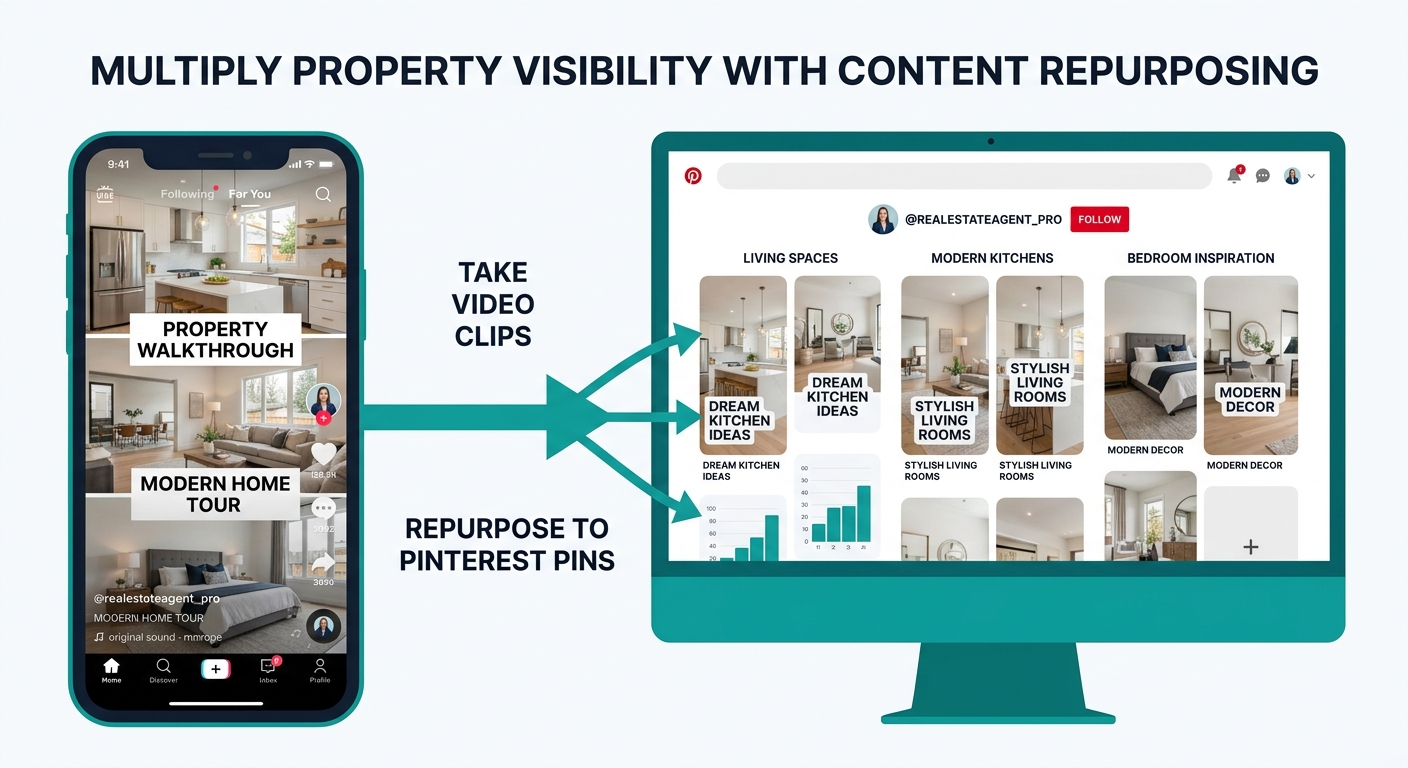
Here’s what that looks like in practice: you film a 60-second property walkthrough for TikTok. From that one video, you pull 3 to 4 still frames for Pinterest pins. The TikTok video gets posted with a CTA to DM you for showing details. Each Pinterest pin links to the listing page on your website, where your CTA placement is already optimized to capture leads. One filming session, two platforms, five or more pieces of content.
The visual content strategy extends beyond property tours. Neighborhood spotlights work well on both platforms. A 45-second TikTok walking through a popular coffee district or waterfront park converts directly into Pinterest-friendly location photography. Market data visualizations—median price trends, days-on-market comparisons—perform strongly on Pinterest as infographics and on TikTok as quick “did you know” talking-head clips.
Agents who master social media marketing across platforms tend to batch their content: one afternoon per week dedicated to filming and pin creation, with everything scheduled through a tool like Tailwind for Pinterest and TikTok’s native scheduler. Virtuance’s 2026 data confirms this approach works: agents who publish consistent visual content across multiple platforms see significantly higher inbound lead rates than those relying on a single channel.
Which Platform Wins for Your Market
The answer depends on who you’re trying to reach and how patient you are.
If you work with first-time buyers under 35 in urban or suburban markets, TikTok delivers faster results. The algorithmic reach means a single viral video can generate more leads in a weekend than a month of Pinterest activity. The TikTok real estate leads pipeline works especially well when you combine organic posting with modest ad spend ($500 to $1,000/month) targeting your farm area.
If you work with move-up buyers, relocating families, or luxury clients, Pinterest’s search-driven model aligns better with how those buyers research. They’re comparison shopping neighborhoods, saving renovation ideas, and building vision boards for their next home. The leads arrive more slowly, but they tend to arrive warmer and with clearer intent. And because your pins keep generating impressions indefinitely, the compound return on Pinterest content grows over time in a way that TikTok content does not.
The strongest approach, and the one the data supports, is treating Pinterest as your long-term organic engine and TikTok as your short-term engagement and brand-building channel. Neither platform replaces the need for a well-built website with proper lead generation infrastructure, but both can feed qualified traffic into that system.
The Open Threads
Several questions around this social media platform comparison remain unresolved heading into the second half of 2026. TikTok’s regulatory status in the U.S. continues to create uncertainty for agents who’ve invested heavily in the platform. Building your entire lead pipeline on a single app that could face restrictions is a real risk worth monitoring.
Pinterest’s advertising tools for real estate remain less developed than Meta’s or TikTok’s. The organic opportunity is strong, but agents looking for paid lead generation on Pinterest will find fewer targeting options and less granular analytics than they’re used to from other platforms.
And the biggest unknown: how buyer behavior on both platforms shifts as Gen Z ages into peak homebuying years. The 40% of Gen Z currently using social media for home research will only grow, and the platforms they prefer will shape where smart agents invest their time. Whether that favors Pinterest’s methodical planning style or TikTok’s impulse-driven discovery will depend on economic conditions, housing inventory, and how both platforms evolve their real estate-specific features. Agents who build presence on both platforms now give themselves optionality regardless of which direction the market moves.