
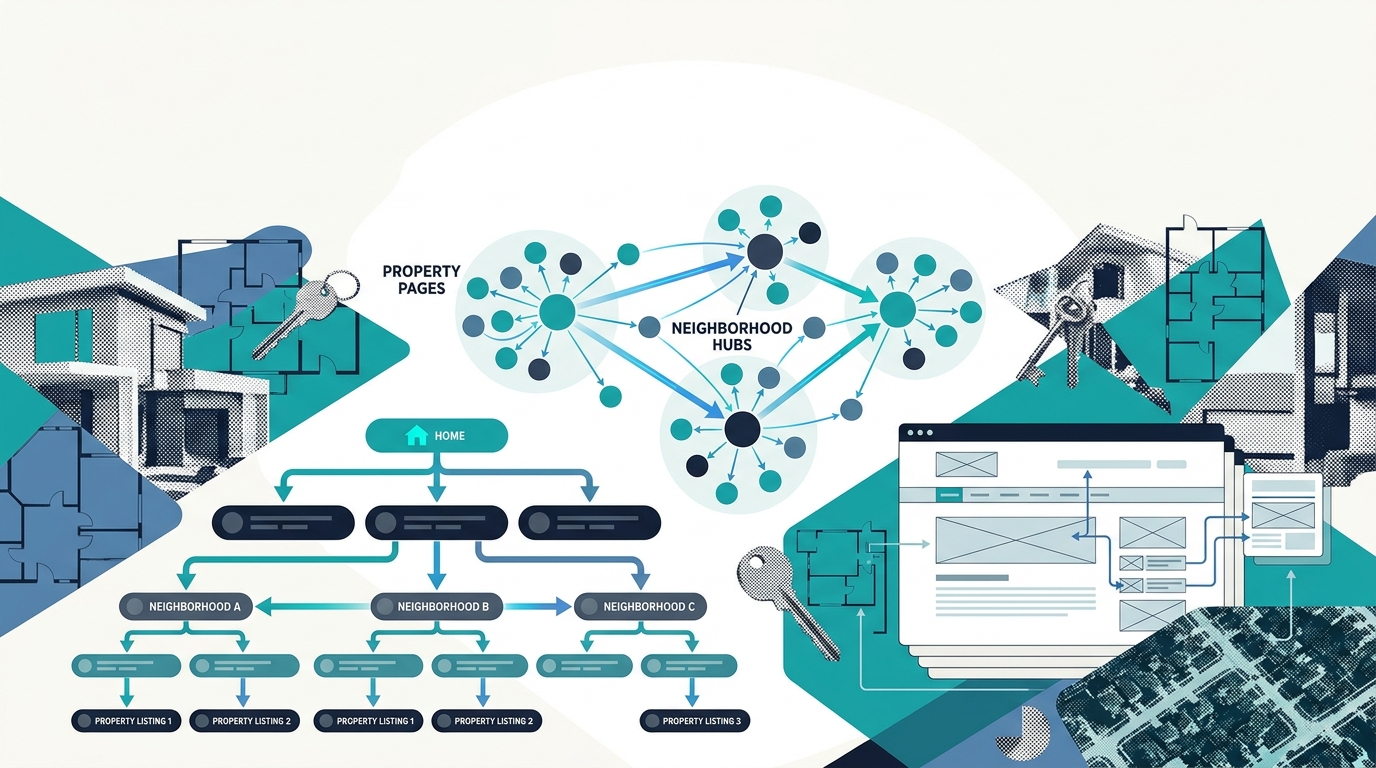
One documented site restructuring produced a 30% increase in organic traffic and a 19% lift in conversions within 90 days after the site moved from flat city-level pages to a pillar-cluster neighborhood model with bidirectional internal links. The mechanism was property page linking architecture, not new content creation.
The Flat-Map Problem: A City Page With Nowhere to Go
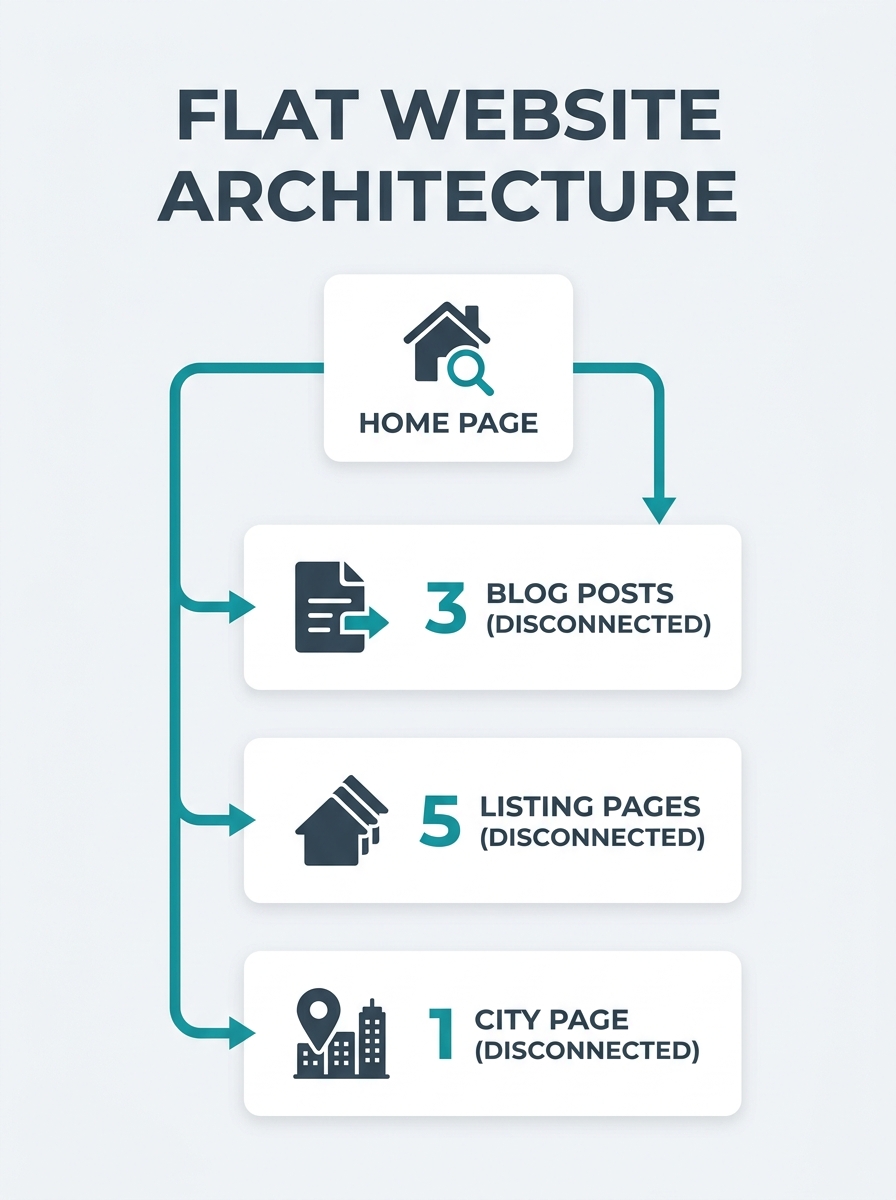
The Austin real estate site that LinkerFlow documented had the structure you’d expect: a homepage, a generic “Austin Homes for Sale” city page, and hundreds of individual property listings. Each listing linked back to the city page. The city page linked to nothing specific. The neighborhood guides, lifestyle posts, and local FAQ content that did exist sat in a blog feed, disconnected from the property pages and each other. Visitors who landed on a listing in South Congress had no clear path to the South Congress neighborhood guide, the school ratings page, or the “Best Restaurants in South Congress” blog post sitting three navigation layers away.
This architecture is the default for roughly 75% of agent sites. The property listings generate pages, the blog generates pages, but nothing ties them together into a coherent local keyword cluster. Google can crawl each page individually, but it can’t infer that your site has genuine depth on a specific neighborhood when the pages about that neighborhood don’t reference each other.
The result is predictable: the site ranks for broad city-level terms (if it ranks at all) while losing every high-intent neighborhood query to competitors whose site organization signals topical authority through internal link structure.
The South Congress Cluster Rebuild
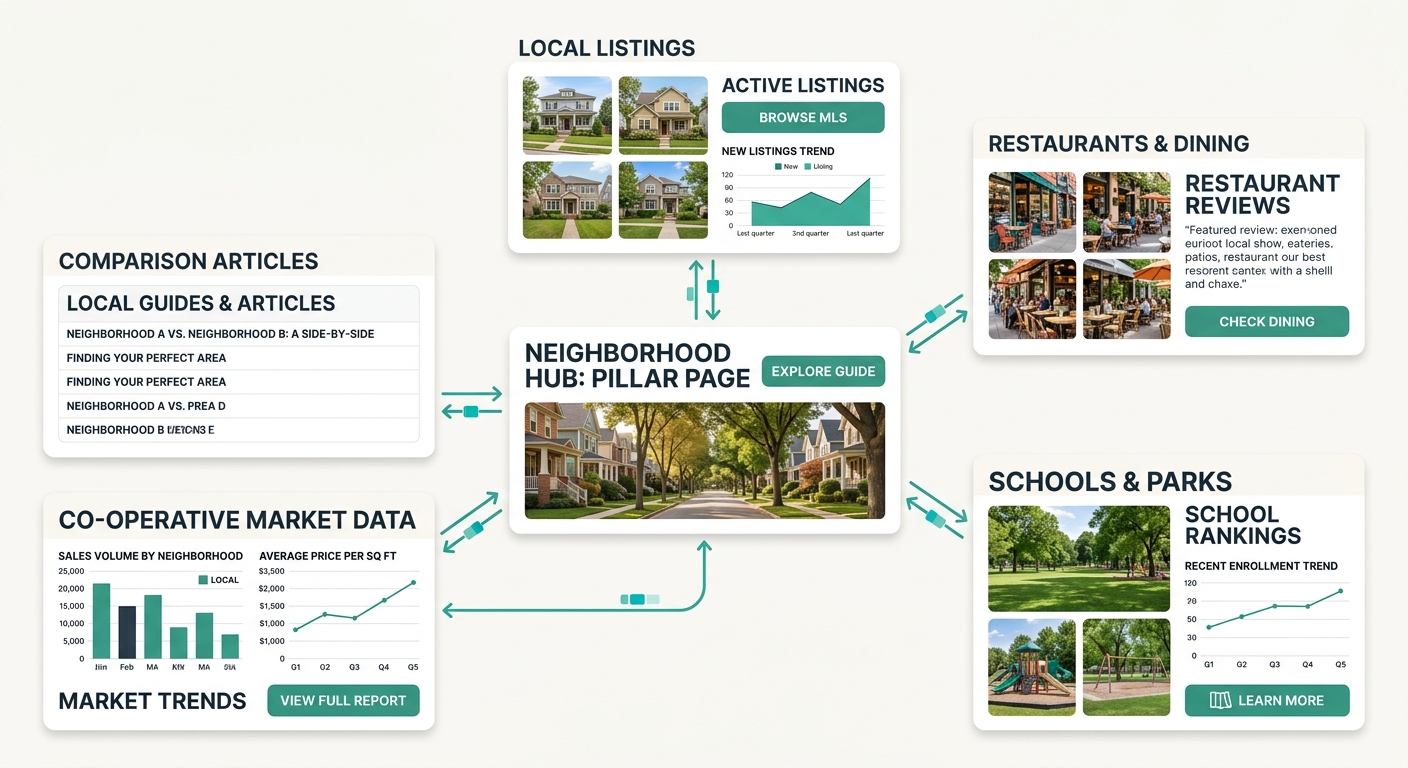
The restructuring followed the pillar-cluster topology that ALM Corp’s neighborhood SEO research describes as the current standard: a core neighborhood guide as the pillar, with listings and property-type pages, local FAQ content, comparison articles, and supporting blog posts radiating outward as cluster content, all connected by bidirectional links.
For South Congress specifically, the content looked like this. The pillar page was “South Congress Neighborhood Guide,” covering housing stock, walkability scores, median home prices, and commute times. Cluster pages included “Best Restaurants in South Congress,” “South Congress vs. East Austin: Where to Buy,” active listings filtered by the South Congress boundary, school zone information, and a market trends page with quarterly price updates. According to LinkerFlow’s analysis of this pattern, each cluster post linked to the pillar page, the pillar page linked back to every cluster post, and related cluster posts linked laterally to each other. The “Best Restaurants” post, for example, linked to the pillar guide, to the South Congress listing filter, and to the lifestyle content on the broader “Living in Austin” page.
This interconnected local content does two things simultaneously. It keeps visitors navigating between related pages (reducing bounce rate, increasing time on site), and it signals deep geographic expertise to search engines. A single neighborhood guide that exists in isolation is a page. The same guide with eight cluster pages all linking to and from it is a topic cluster, and Google treats those two scenarios very differently when deciding which site deserves to rank for “homes for sale in South Congress.”
A single neighborhood guide in isolation is a page. The same guide with eight cluster pages all linking to and from it is a topic cluster.
The ScaleAcres internal linking guide describes the ideal site architecture as a pyramid: homepage at the top, category/neighborhood pages in the middle, individual property listings at the bottom. Every level links to the levels above and below it. The critical rule is that no priority page should sit more than three clicks from the homepage. Once you push a neighborhood guide to four or five clicks deep, you’re starving it of the internal PageRank it needs to compete for local queries.
Anchor Text and the 5x Traffic Gap
The restructuring wasn’t random linking. Anchor text decisions drove a measurable share of the results. Data from the case study showed that pages receiving at least one exact-match anchor in their internal links carried roughly 5x more organic traffic than pages linked only with generic text like “click here” or “learn more.”
That stat deserves context. It doesn’t mean you should make every internal link anchor “homes for sale in South Congress Austin TX.” Over-optimization triggers exactly the kind of algorithmic scrutiny you’re trying to avoid. The pattern that worked was descriptive, context-rich anchor text that naturally included the target neighborhood keyword. Instead of “check out our South Congress page,” the link text read “the South Congress neighborhood guide covers current median prices and walkability scores.” The anchor describes what the reader will find. The keyword appears because the content genuinely covers that topic.
For agents building out this kind of property page linking architecture, the practical rule is straightforward: write the anchor text as if you’re telling a colleague what’s on the other end of the link. If your anchor text could apply to any page on any site, it’s too generic. If it reads like a keyword stuffed into a sentence, it’s too aggressive. The sweet spot is specific enough to include the neighborhood name, descriptive enough to set reader expectations, and natural enough that it doesn’t interrupt the sentence.
This principle matters even more for agents adapting their content for AI search results, where LLMs extract and cite content based partly on how well-structured and internally referenced it is.
The Orphan Page Problem Hiding in the Crawl Logs
The South Congress cluster rebuild exposed a second problem the Austin site shared with the majority of agent websites: orphan pages. According to crawl data analyzed across multiple real estate sites, approximately 25% of web pages receive zero internal links. These orphan pages are effectively invisible to search engines because Googlebot discovers pages primarily by following internal links. If nothing on your site points to a page, that page may never get crawled, let alone indexed.
Before the restructuring, the Austin site’s Googlebot crawl coverage sat around 40%. After remediating orphan pages (adding each one to the appropriate neighborhood cluster or removing pages that served no purpose), crawl coverage rose to 70%. That 30-percentage-point gain meant Google was actually seeing and evaluating content that had been published months earlier but never entered the index.
For a real estate site, orphan pages typically fall into three categories: old listings that were removed from navigation but never redirected, blog posts published without any internal links pointing to them, and neighborhood pages created during a content push but never linked from the homepage or city page. Running a crawl audit with Screaming Frog or Sitebulb takes about 20 minutes and will identify every page on your site that has zero inbound internal links. If you’ve never done a technical SEO audit on your site, start there before building new content.
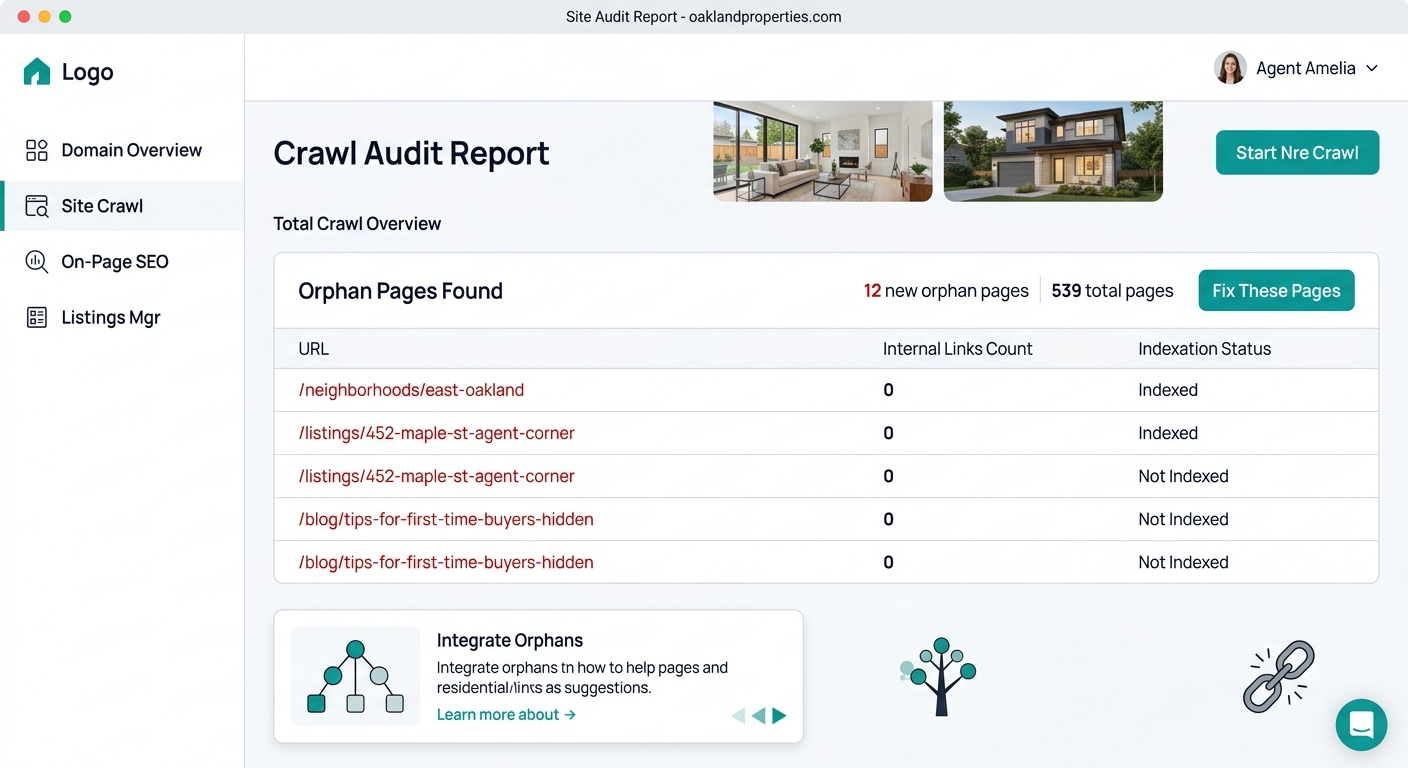
Tip: Run a crawl audit before creating new neighborhood content. Fixing orphan pages on existing content delivers faster ranking improvements than publishing new pages, because those pages already have age and (potentially) backlinks working in their favor.
The 90-Day Results and What They Didn’t Fix
The 30% organic traffic increase and 19% conversion lift arrived within 90 days. The gains concentrated on neighborhood-level queries: “South Congress homes for sale,” “best neighborhoods in Austin for families,” “South Congress vs. Mueller.” City-level queries showed minimal change, which makes sense. The restructuring didn’t add new city-level content. It built depth beneath existing content and connected it with internal links that made the site structure authority legible to Google.
The conversion increase is worth examining separately. The site didn’t change its CTAs, forms, or lead capture design. The conversion lift came from traffic quality. Visitors arriving on neighborhood-specific queries already had a geographic intent. They knew where they wanted to buy. When those visitors landed on a cluster page and found internal links to active listings in that same neighborhood, the path from content to contact form shortened dramatically. The internal linking strategy for real estate didn’t just improve rankings; it improved the match between visitor intent and available content.
What the restructuring didn’t solve: pages competing against each other for the same keyword. The Austin site had three separate blog posts touching “South Congress real estate market,” each targeting slightly different long-tail variations but all cannibalizing each other’s ranking potential. Local keyword clustering requires not only linking related pages together but also making sure each page in the cluster targets a distinct query. The pillar page owns the primary neighborhood keyword. Each cluster page owns a specific subtopic. When two pages go after the same search intent, consolidating them into one stronger page outperforms splitting the signal across two weaker ones.
The Austin case confirms what local SEO ranking factor research consistently shows: dedicated pages for each location you cover, connected by internal links with descriptive anchor text, remain the most reliable way for agents to outrank national brokerages on neighborhood queries. The national sites have domain authority. You have topical depth. Internal link architecture is how you prove that depth exists.