
The National Association of Realtors issued guidance warning that AI-generated MLS listing copy creates fair housing liability under Articles 2 and 12 of the Code of Ethics, according to a May 15 column published on HousingWire by Paul Parker, founder of AIandRealtors.com, who outlined a seven-point compliance checklist for agents using AI writing tools in property marketing.
TL;DR: NAR guidance confirms AI-generated listing copy remains subject to fair housing law and Code of Ethics truthful advertising standards, with specific compliance risks in pattern-recognition language that may steer buyers based on protected characteristics.
The guidance addresses what Parker described as “subtle steering” that emerges when AI tools trained on existing listing databases reproduce coded language, buyer-profile assumptions, or phrasing tied to protected characteristics such as age, familial status, and religion. NAR broker guidance states that AI-generated content may be inaccurate, may create fair housing risk, and must meet agent duties for truthful advertising under Articles 2 and 12, Parker reported.
Pattern Recognition Creates Compliance Exposure
AI systems learn from large pools of existing listing copy that may contain outdated phrasing or coded terms that violate fair housing standards, according to the HousingWire analysis. When agents prompt AI tools to make listings “more appealing,” the systems may generate phrases such as “perfect for young professionals,” “ideal for families,” “quiet neighborhood,” or “walking distance to church,” Parker wrote. Each phrase can imply preferences tied to protected characteristics under fair housing law.
NAR’s fair housing guidance instructs agents to describe the property rather than the buyer, Parker noted. Compliant copy focuses on verifiable features such as natural light, updated flooring, first-floor primary suites, transit access, lot size, storage, and views. NAR’s guidance provides a specific example: rather than writing that a home is “perfect for joggers,” agents should describe it as being next to a jogging trail, Parker reported.
Seven-Point Pre-Publication Checklist
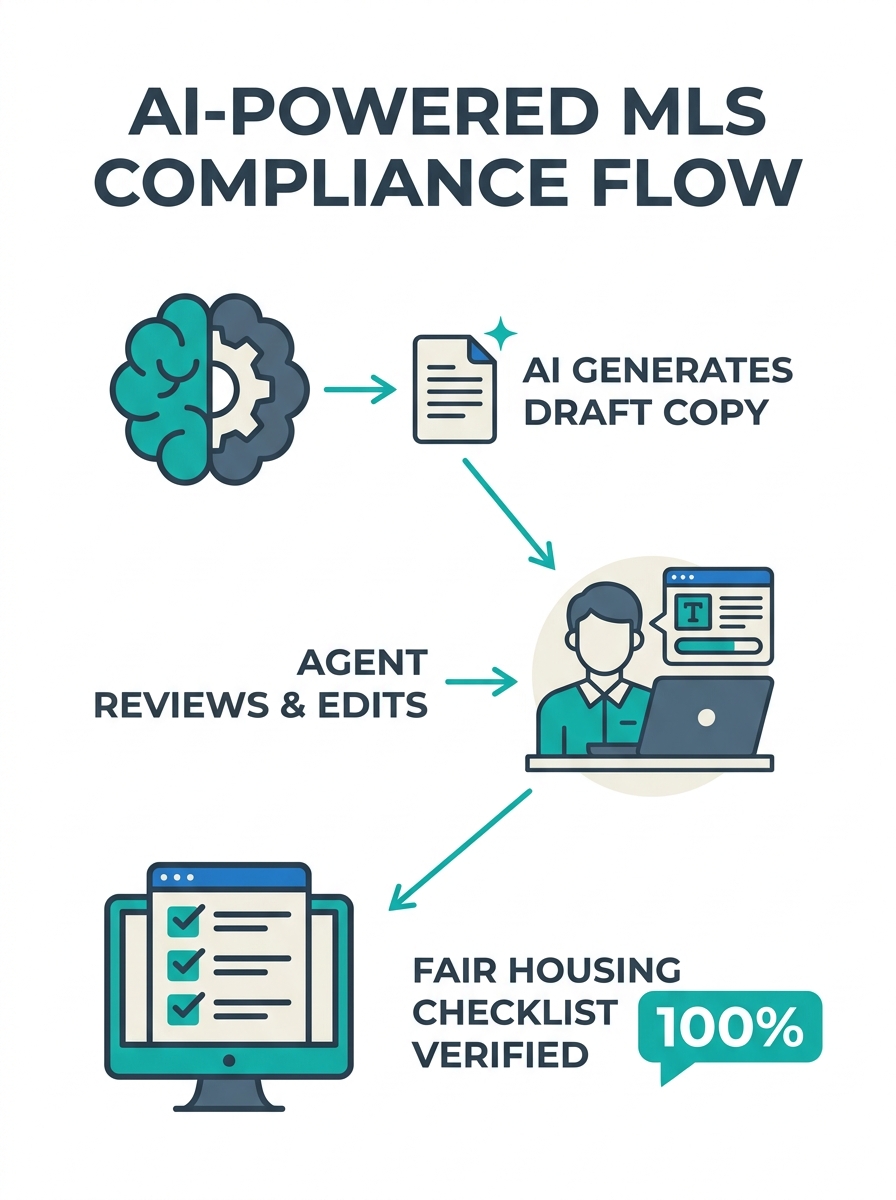
Parker outlined seven required review steps before any AI-generated copy enters the MLS. The first requires agents to feed AI tools objective facts such as property features, upgrades, layout details, and location data without lifestyle assumptions or buyer demographics in prompts. The second instructs agents to remove phrases describing ideal buyers, including references to “young professionals,” families, or retirees.
The third step eliminates coded language such as “quiet,” “safe,” “exclusive,” or religious references that create fair housing problems in marketing. The fourth requires line-by-line fact-checking, responding to NAR’s specific warning that AI output is not 100 percent accurate, Parker wrote. The fifth prohibits entering personally identifiable information, including client financial details, tenant information, access instructions, or private contact data, into public AI tools.
The sixth step mandates clear disclosure labels for virtually staged or digitally altered images. NAR’s Article 12 true-picture standard applies to listing photos, and the association advised agents in February 2026 to clearly label virtually staged images as states including California and Wisconsin adopt disclosure laws for digitally altered property photos, according to Parker’s column. The seventh step requires a trained professional to approve every AI-generated draft, positioning AI as a tool that generates first drafts while the agent provides final judgment.
Efficiency Does Not Transfer Liability
The guidance clarifies that publishing AI-generated marketing transfers full responsibility to the agent, Parker wrote. The MLS remains regulated, fair housing law continues to apply, and the Realtor Code of Ethics governs all public marketing regardless of the tool used to create it. Article 2 addresses exaggeration, misrepresentation, or concealment of pertinent facts. Article 12 requires honest and truthful communication and presentation of a true picture in advertising and marketing.
Parker, who has spent 25 years in sales and sales management and authored Crypto Confidence, positioned human judgment as the differentiating factor between agents who use AI tools and those who use them effectively. “Clients can get AI-generated wording anywhere, but not your judgment,” Parker wrote. “Only you can spot subtle steering, catch overstatements, or recognize risks in strong marketing language.”
The column follows February 2026 state-level action on AI-altered property images and arrives as AI agents automate real estate lead follow-up workflows across residential brokerage. The National Association of Realtors has not published an official AI policy update since Parker’s column appeared, and the guidance described represents broker-level interpretation of existing Code of Ethics standards applied to AI-generated content.
Reading Between the Lines
The seven-point checklist translates existing fair housing compliance into AI-workflow terms, but the underlying obligation hasn’t changed. Agents who relied on gut instinct to avoid steering language in hand-typed listings now need that same instinct applied to machine-generated drafts. The practical shift is speed: AI produces polished copy in seconds, compressing the review window and increasing the odds that subtle violations slip through when agents treat generated text as final rather than as a first draft requiring line-level judgment.
The California and Wisconsin disclosure laws cited for February 2026 signal that state regulators are moving faster than national trade groups on AI-specific rules. Agents operating across state lines will face a patchwork of disclosure requirements for altered images, virtual staging, and potentially AI-generated descriptions if more states follow. The seven-step process Parker outlined functions as a lowest-common-denominator baseline, but tracking state-by-state variations will become part of the compliance burden as AI adoption scales across MLS platforms and brokerage marketing stacks.
The guidance positions the agent as the quality-control gate between AI efficiency and legal exposure, which is where the value proposition has always lived in licensed representation. The tool changes, the speed increases, but the professional judgment requirement remains constant. Agents who automate copy generation without building manual review into every workflow are trading time savings for compliance risk at a moment when fair housing enforcement and AI oversight are converging.