
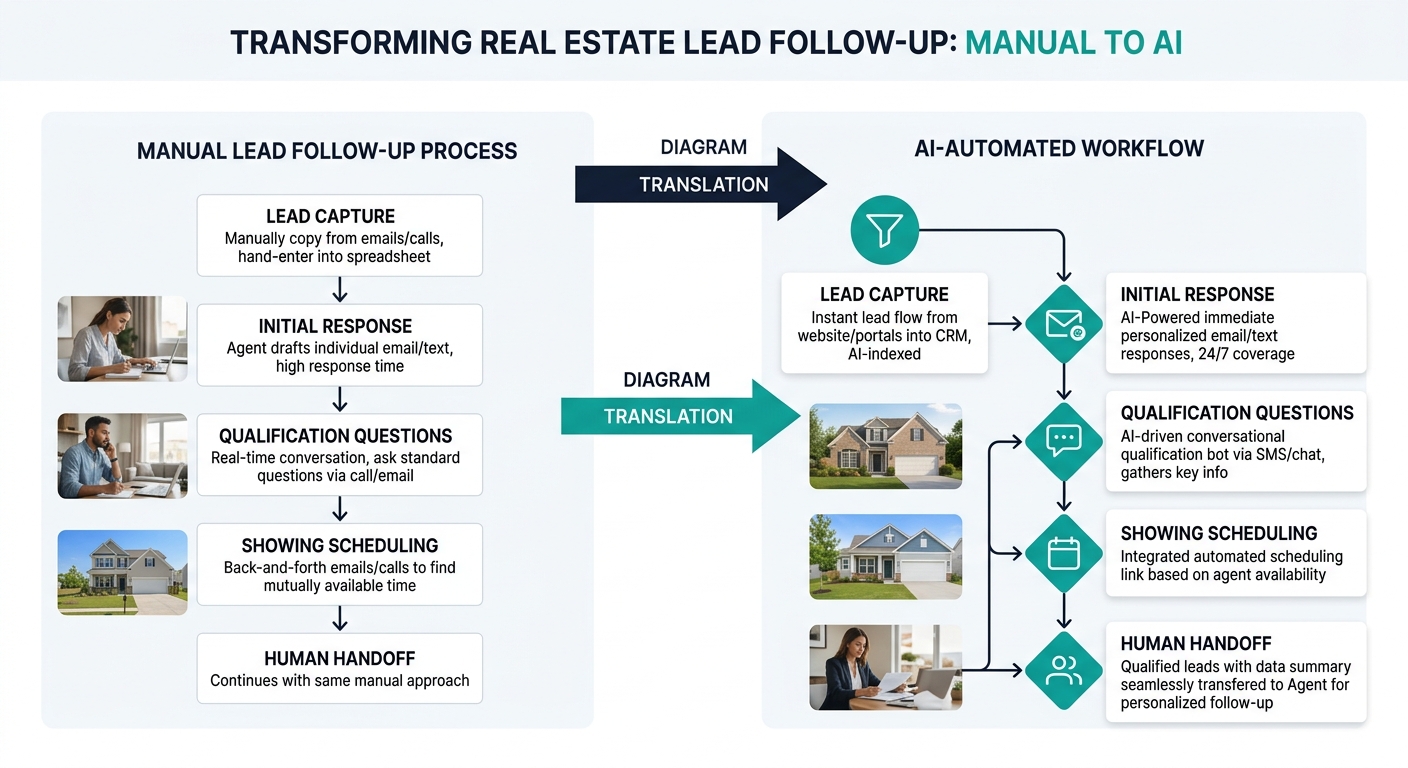
Lofty, Follow Up Boss, Lindy AI, and Zurple all shipped major AI follow-up features in the past 90 days. Best-in-class brokerages are now routing leads inside 90 seconds and booking showings at 2 a.m. without a human touching the CRM, according to a 2026 brokerage playbook from Digital Applied. For independent agents still manually texting Zillow leads at 10 p.m., the competitive window is narrowing in real time. The technology has moved from “chatbot that answers FAQs” to agentic AI that can pull CRM history, suggest listings, schedule a showing, and update a lead’s status without any agent intervention.
This shift is happening whether you’re ready or not. But adopting automated lead follow-up systems without a plan is how agents waste $300/month on tools that generate noise instead of closings. These seven rules will keep you from making the expensive mistakes early adopters already made.
Start with one lead source, not five
The urge to automate everything at once is strong, especially when you’re paying for leads from multiple portals. Resist it. A practical setup guide published this year puts it plainly: pick one lead source, connect it to one AI follow-up tool, run it for 30 days, and measure your average response time and lead contact rate before and after. That data tells you exactly where to expand next.
If you’re generating leads from Zillow, your website, and a Google Ads campaign simultaneously, each of those sources has different lead intent levels and requires different follow-up cadences. Dumping all three into the same AI workflow means your highest-intent buyer gets the same drip sequence as someone who clicked a listing photo out of curiosity. Start with whichever source produces the most volume, tune the AI’s messaging for that audience, and then replicate the system for source number two only after you’ve confirmed it actually books appointments.
Measure your baseline response time before you buy anything
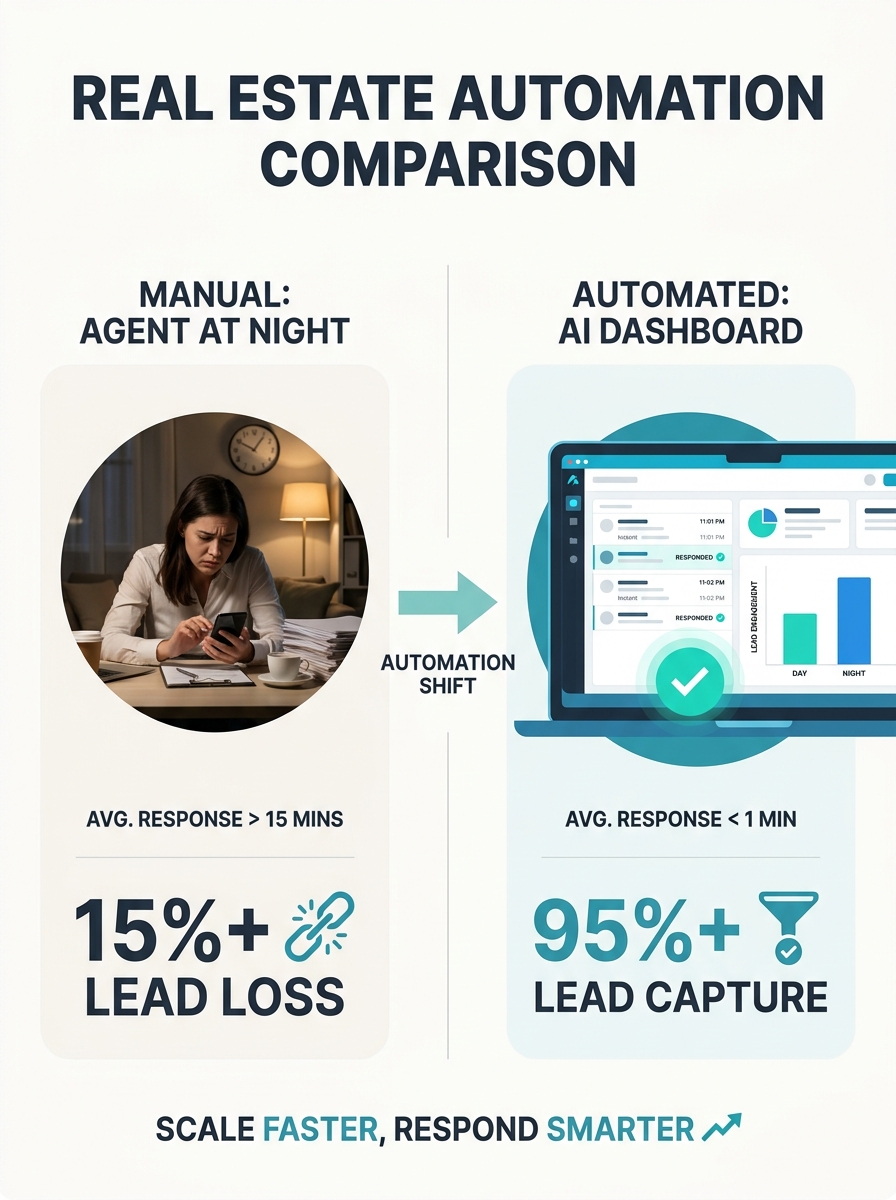
You can’t evaluate whether an AI tool improved your follow-up if you don’t know how bad your follow-up was before. Pull your CRM data from the past 60 days and calculate two numbers: average time from lead submission to first human contact, and percentage of leads who received any follow-up within 24 hours.
Most solo agents discover their honest numbers are brutal. Industry data consistently shows that leads contacted within five minutes are far more likely to convert than those contacted after 30 minutes, yet the average agent response time stretches well beyond an hour. If your current baseline is four hours, even a mediocre AI tool that responds in 90 seconds will produce a measurable lift. If you’re already responding in under five minutes during business hours, your bottleneck is probably somewhere else — perhaps in your lead nurturing process after initial contact rather than speed alone.
Always keep a human checkpoint for Fair Housing compliance
Every source covering real estate agent AI adoption in 2026 comes back to the same warning: AI cannot replace human judgment on compliance. Fair Housing laws prohibit steering, discriminatory language, and selective marketing based on protected classes. An AI agent trained on your past messages might inadvertently replicate problematic patterns you didn’t even realize were there.
Warning: AI-generated follow-up messages must be reviewed regularly for Fair Housing compliance. An AI that learns from biased training data can expose you to legal liability, regardless of your intent.
Build a weekly review step into your workflow. Every Monday morning, read through the AI-generated messages from the previous week. Look for language that steers buyers toward or away from specific neighborhoods, references to school quality as a proxy for demographics, or any phrasing that could be interpreted as preferential treatment. This 20-minute audit protects your license.
Prefer CRM-native AI over standalone chatbots
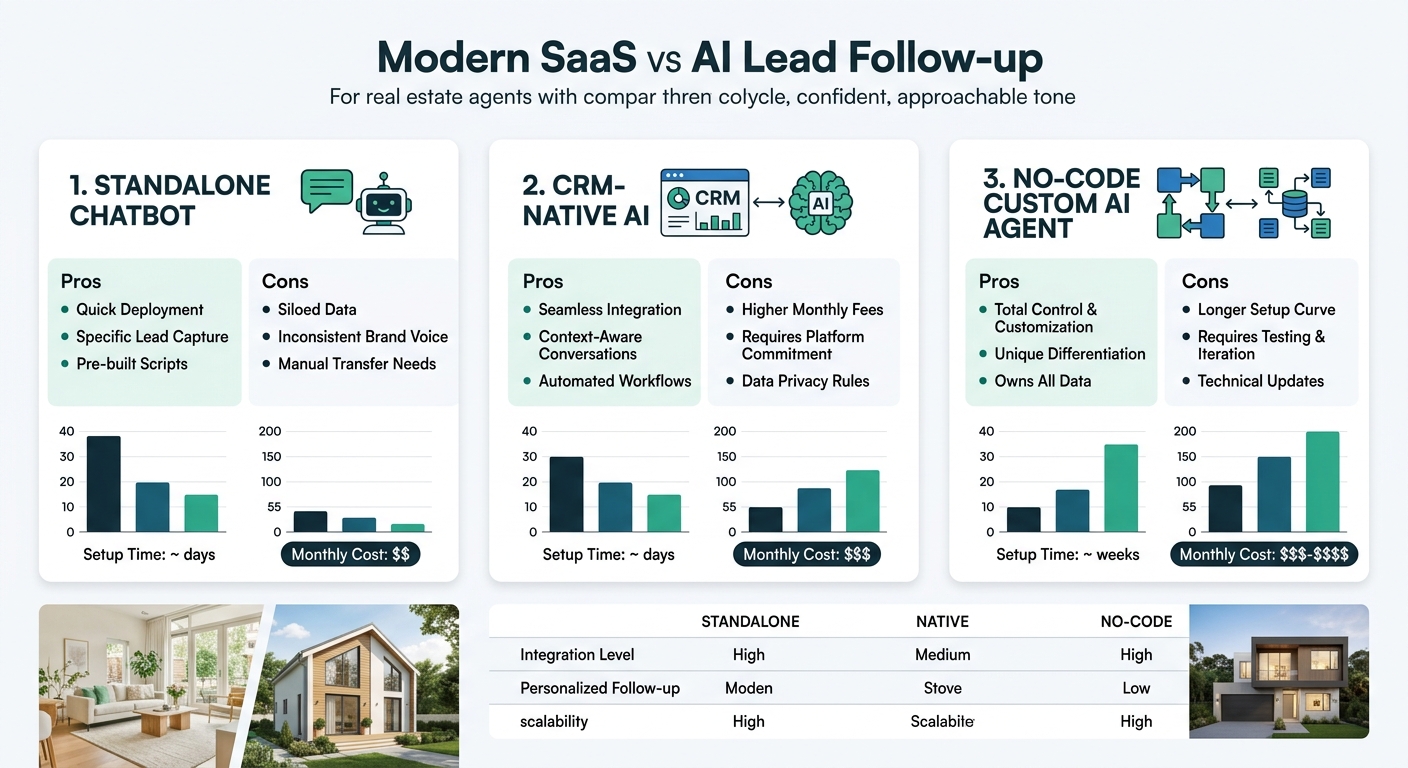
The market is flooded with standalone AI chatbot tools that sit outside your CRM and promise to qualify leads through conversational interfaces. Some of them are genuinely useful. But for most independent agents, the better move is to activate AI features already built into the CRM you’re paying for.
Follow Up Boss now integrates with Mod AI Automation’s agents for instant lead engagement, intelligent qualification, and automated booking. Lone Wolf’s Relationships product handles lead nurturing inside its existing contact management system. Zurple combines lead generation with automated intelligent nurturing in a single platform. When your AI follow-up lives inside the same system where you manage transactions, every interaction gets logged in one place, your lead scoring stays accurate, and you don’t end up with two databases that disagree about where a prospect stands in your pipeline.
If you’re still evaluating which CRM fits your practice, a good comparison of real estate CRM platforms can help you narrow the field before you layer AI on top.
The agents winning in 2026 aren’t the ones who outwork everyone else. They’re the ones who build systems that work while they sleep.
Audit your AI’s actual messages, not just its metrics
Dashboard metrics like “leads contacted” and “average response time” tell you whether the AI is doing something. They don’t tell you whether what it’s doing is any good. An AI that responds to every lead in 12 seconds with a generic “Thanks for your interest! When would you like to schedule a showing?” will have beautiful metrics and mediocre conversion rates.
Once a week, pull a random sample of 10 conversations your AI handled. Read them like a prospective buyer would. Are the responses relevant to the specific listing the lead inquired about? Does the AI acknowledge the lead’s stated preferences, or does it barrel through a script? Does the conversation flow naturally toward booking, or does it feel like talking to a phone tree? This is where many lead nurturing automation setups fall apart — the system contacts people on time but says the wrong things. You can also cross-reference these conversations with what actually closed. If your AI is booking plenty of showings but none of those leads convert, the qualification logic needs adjustment, and we’ve written about how AI-powered lead qualification reshapes follow-up in detail.
Don’t automate what you haven’t systematized manually first
This is the rule agents break most often, and it costs them the most money. If you don’t have a clear, documented follow-up process that works when you do it by hand — specific messages for specific lead types at specific intervals — then handing that chaos to an AI just means the chaos happens faster.
Before you connect any tool, write down your follow-up sequence for each lead type. New buyer inquiry from your website: what do you say first, what do you say on day two, day five, day fourteen? Seller lead from a home valuation page: different sequence. Open house sign-in: different again. If you can’t articulate these sequences clearly enough that a new assistant could follow them, your AI tool can’t follow them either.
The agents getting the most from AI agents in real estate marketing are the ones who already had a playbook and are now running it at scale and speed that wasn’t possible manually. MindStudio’s no-code platform, for example, lets you build custom AI agents that handle qualification and follow-up, but the quality of what those agents do depends entirely on the logic you feed them. Think of AI as an accelerant. If your process is solid, AI makes it faster. If your process is broken, AI makes it fail more efficiently.
Run a 30-day parallel test, not a cold switch
When you’re ready to turn on AI follow-up, don’t flip the switch on 100% of your leads overnight. Run the AI on one lead source or one geographic area while you continue handling the rest manually. Compare the two tracks after 30 days across three metrics: contact rate (percentage of leads who responded), appointment rate (percentage who booked a showing or call), and conversion rate (percentage who became clients).
This parallel approach does two things. It gives you real performance data specific to your market and lead sources, which no vendor case study can replicate. And it protects you from worst-case scenarios where the AI’s messaging alienates leads in a way you don’t catch until the damage is done. If you’re generating leads through your own property website, you can build your first property website with built-in lead capture that makes this kind of split-testing straightforward.
The agents who’ve already been through this cycle — and there are more of them every week — report that the data from a 30-day test makes every subsequent decision obvious. You’ll know exactly which lead types the AI handles well and which ones still need your personal touch. Most find that the AI excels at speed and consistency on initial contact but that high-value seller leads still convert better with early human involvement. Understanding how independent agents can compete with AI-powered tools without building custom systems gives you a broader framework for these decisions.
When These Rules Break
These rules assume you’re a solo agent or small team making deliberate, budget-conscious decisions about technology. They break in a few specific scenarios.
If you’re on a team at a brokerage that’s already standardized on a particular AI follow-up stack, rules one and seven (start small, run a parallel test) may not apply. Your brokerage has presumably already tested. Learn what they learned.
If your lead volume is under 20 leads per month, the ROI math on a $299/month AI tool probably doesn’t work yet. Your money is better spent on generating more leads through content, video, or targeted advertising, and following up with those leads personally until volume justifies the investment.
And if you’re in a luxury market where every prospect expects a white-glove experience from first contact, you may find that AI initial outreach actually hurts your brand positioning. In that segment, the personal call within three minutes is part of the value proposition. AI can still handle the backend — reminders, drip campaigns, market updates — but the first touch should be yours.
For everyone else, the adoption curve for real estate agent AI adoption in 2026 is steeper than most agents realize. McKinsey’s research on how agentic AI can reshape real estate’s operating model describes a future where agents spend their time on negotiation, advisory services, and relationship management rather than manual coordination. That future isn’t five years away. Agents who set up their first automated follow-up system this month will have 30 days of data and a working process by June. Agents who wait for the perfect tool or the perfect moment will still be texting leads at 10 p.m. while their competitors’ AI books the morning showing.