
TREM Group built its reputation handling everything for real estate teams: brand creation, website builds, ad management, listing content, social media calendars. That all-in-one pitch worked for a decade. Agents and small brokerages signed 12-month retainers, handed over their logins, and hoped the leads would follow. By late 2024, a noticeable crack had formed in that arrangement, and by mid-2025, the crack had widened into a full structural shift in how real estate professionals think about their marketing team structure in 2026.
The All-In-One Era and Why It Held Together So Long
The appeal of bundled marketing was always about time. An agent juggling 15 active listings doesn’t want to coordinate between a web designer, a Facebook ads specialist, a drone photographer, and a copywriter. Full-service firms like TREM Group and Luxury Presence packaged those services into a single invoice. According to HousingWire’s ranking of real estate marketing companies, large agencies “do it all, from brand creation to websites to advertising,” while smaller firms occupy specific niches.
That bundling created real convenience. One point of contact. One monthly report. One throat to choke when results slipped.
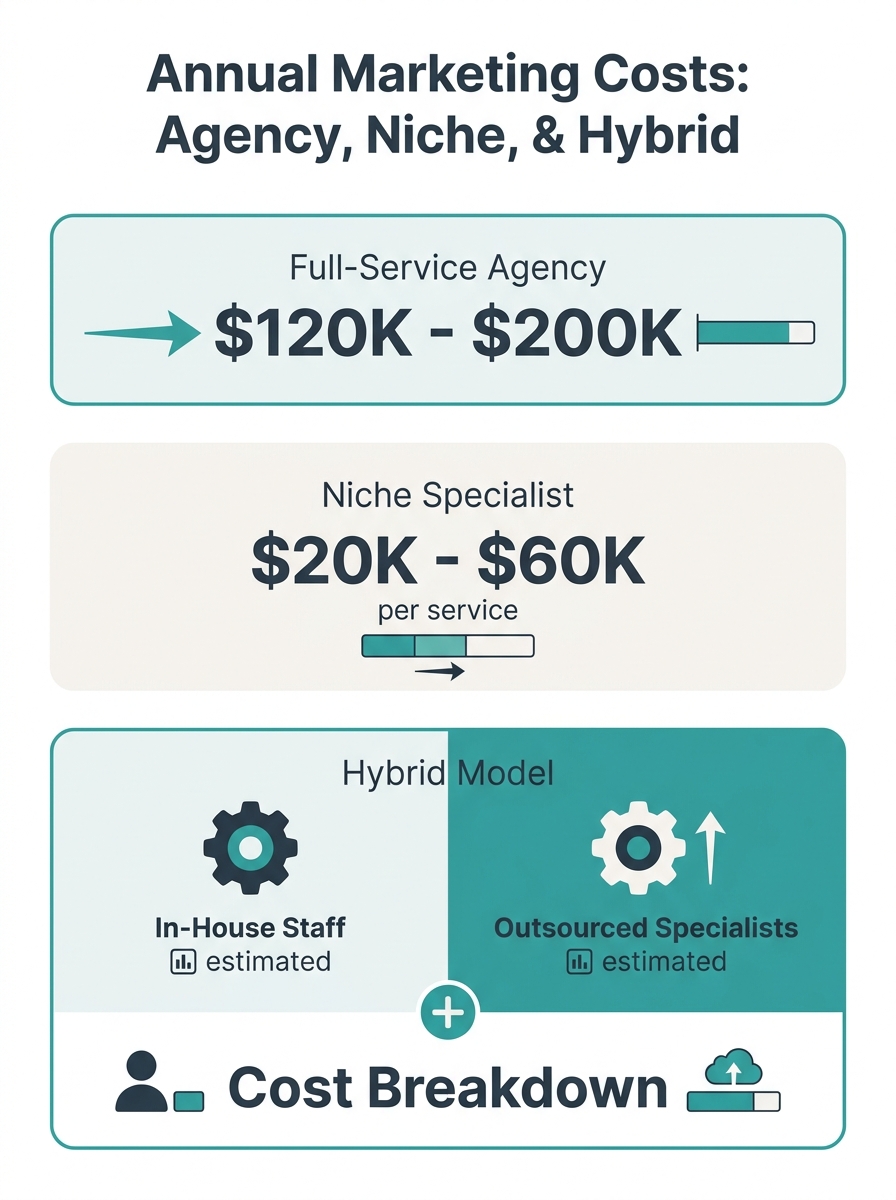
But the model also created dependency. Teams that outsourced everything had no internal knowledge of which channels actually produced closings versus which ones just produced impressions. When you’re paying $120,000 to $150,000 per year for a full-service marketing agency contract, that blind spot gets expensive fast.
The 2024-2025 Breaking Point
Three things converged to unravel the bundled model for real estate teams.
Cost pressure tightened. Interest rates stayed elevated through most of 2024 and into 2025, which compressed transaction volumes across the industry. A team that closed 80 transactions at a 3% rate environment was now closing 55. That $150,000 annual marketing retainer, which felt manageable when gross commission income was high, became the biggest discretionary line item on the P&L. According to WebFX’s cost comparison, internal marketing departments can run upward of $200,000 per year, but agencies range anywhere from $20,000 to $200,000 depending on scope. Teams started asking a natural question: what if we only paid for the parts that actually work?
NAR’s commission rule changes reshuffled priorities. After the settlement took effect, agents needed to articulate their value proposition more clearly than ever. Generic marketing copy produced by an agency managing 40 different real estate clients didn’t cut it anymore. One Reddit user who ran a real estate-focused agency for over 15 years noted the shift directly: the work had been “fairly regular” and “scalable” for years, but the NAR ruling changed the landscape enough to pull back from the niche entirely.
AI tools matured past the novelty stage. By mid-2025, agents could generate first-draft listing descriptions, social captions, and email sequences using tools that didn’t exist two years prior. The tasks that used to justify a chunk of a full-service retainer became things a part-time marketing coordinator could handle with the right software. If you’ve been exploring AI-powered tools for real estate workflows, you’ve already seen how much of the production work has shifted.
The Niche Specialists Filled the Gaps
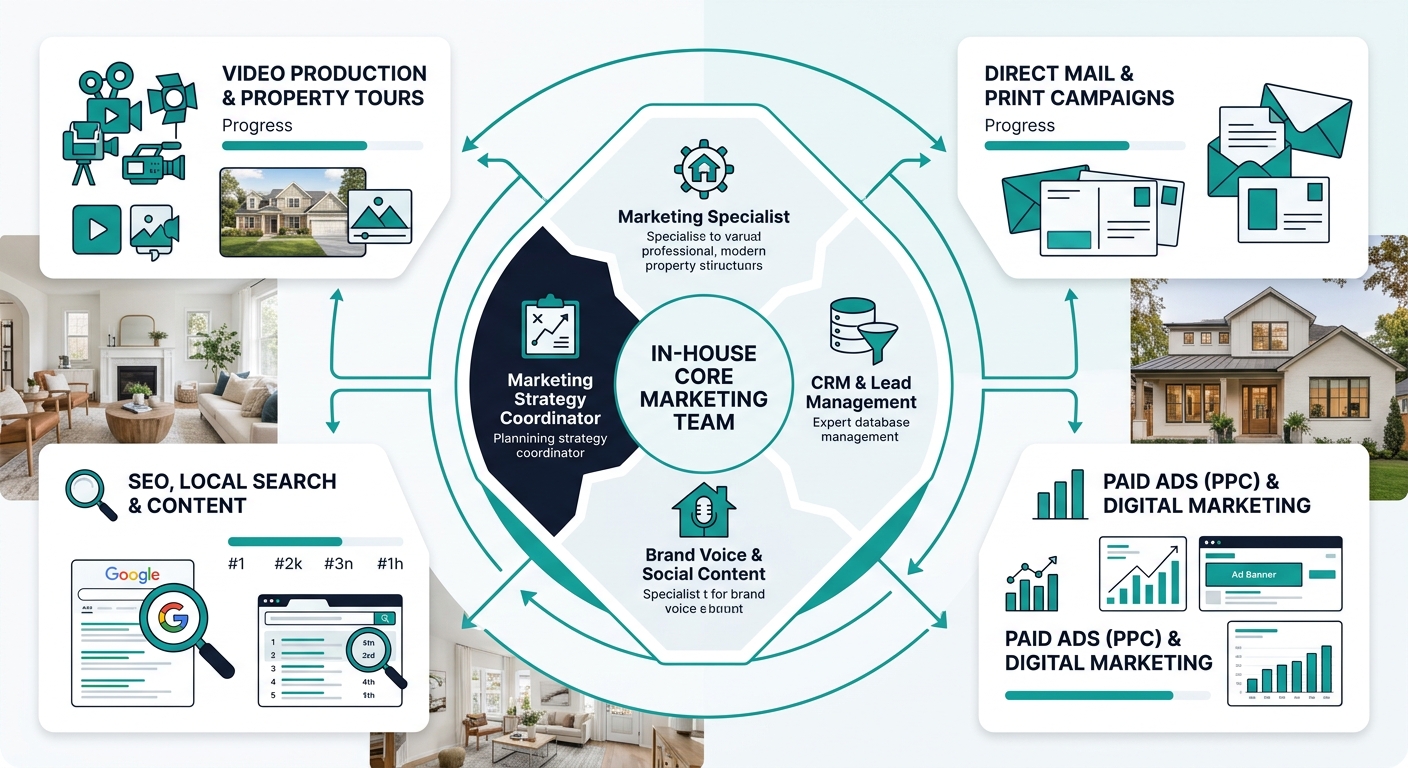
As full-service contracts expired, agents didn’t simply try to do everything themselves. They started assembling what the broader marketing world calls a “core-flex” structure: a small in-house core handling brand voice, CRM, and daily content, supplemented by outside specialists brought in for specific capabilities.
Firms like Wise Pelican carved out a position by focusing exclusively on direct mail for real estate, offering targeted mailing lists and niche marketing services for real estate rather than trying to be a full marketing department. InMotion Real Estate Media doubled down on video and visual content for luxury listings. Instead of one agency doing everything at a B+ level, teams started hiring A+ specialists for the two or three channels that actually drove their business.
This approach maps directly onto how successful real estate teams already structure their operations. A team with a lead listing agent, a buyer’s agent, a transaction coordinator, and a marketing specialist mirrors the hybrid marketing model: each person focuses on their area of strength, and outside resources fill the rest. The concept of shared resources within a real estate team extends naturally to shared marketing resources too.
What the Hybrid Model Actually Looks Like Day-to-Day
Here’s a concrete example. A six-person real estate team in a mid-size metro might structure their marketing this way:
- In-house: One part-time marketing coordinator who manages the CRM, writes email sequences, posts to social media three times a week, and coordinates the content calendar. They own the brand voice and know the local market cold.
- Outsourced to a video specialist: Monthly listing videos and quarterly neighborhood tours. Hired per project, not on retainer.
- Outsourced to a PPC agency: Google and Meta ads managed by a firm that specializes in real estate lead generation. Performance-based contract with clear cost-per-lead targets.
- Outsourced to a direct mail provider: Farming campaigns to specific zip codes, managed through a platform like Wise Pelican that handles design, printing, and mailing.
Total annual cost: roughly $70,000 to $90,000, compared to $120,000+ for a full-service firm. And the team retains control over the pieces that require local knowledge and personal relationships, which is where the real differentiation happens.
The tasks that used to justify a full-service retainer became things a part-time coordinator could handle with the right software and two or three niche specialists on call.
The Learning Curve Nobody Warned About
Hybrid models aren’t painless. The first six months are often rougher than agents expect, and it’s worth being honest about the friction.
Coordinating three or four vendors means more email threads, more invoices, and more decisions that used to be someone else’s problem. When your full-service agency handled everything, you had one weekly call and one dashboard. Now you’re checking ad performance in one platform, email metrics in another, and social analytics in a third. Building a marketing calendar that actually keeps everything synchronized becomes a real operational need rather than a nice-to-have.
There’s also a knowledge gap. The marketing coordinator you hire needs to understand enough about paid ads, SEO, and content strategy to manage vendors effectively, even if they’re not executing those tasks themselves. An agent who hires a cheap PPC firm and can’t evaluate whether the leads coming in are genuine prospects or junk will waste money just as fast as they did under a full-service contract. Understanding how lead qualification actually works is the difference between a hybrid model that saves money and one that just moves the waste around.
Tip: Before you cancel a full-service contract, audit which specific channels produced your last 20 closings. Keep paying an expert for those channels. Cut the rest and bring production work in-house first.
And one more thing agents underestimate: the in-house vs agency lead generation question doesn’t have a permanent answer. Your hybrid mix should change as your team grows. A solo agent might outsource 80% of marketing and keep only CRM management in-house. A 10-person team might flip that ratio, outsourcing only video production and high-budget ad campaigns while running everything else internally. The mix is supposed to evolve, and teams that treat their initial hybrid setup as permanent will end up with the same stale results they had under the old model.

What The Data Looks Like Today
The Sagefrog B2B Marketing Mix Report from early 2026 found that 46% of companies now use a hybrid marketing model, up from 36% in 2025. That makes hybrid the most common structure, ahead of both fully in-house (32%) and fully outsourced (22%). Real estate-specific data is harder to pin down, but the directional trend is consistent with what we see across brokerage conferences and team masterminds this year.
The primary driver? Lack of internal resources, cited by 42% of respondents. Teams aren’t going fully in-house because they can’t hire for every skill set. They’re going hybrid because they want control over the pieces that matter most while still accessing specialist talent for the pieces that require deep expertise.
For agents evaluating real estate marketing agency alternatives, the practical framework looks like this: own your brand voice, own your CRM and follow-up process, and own your local market knowledge. Those three things can’t be outsourced effectively because they require the kind of specificity that a firm managing dozens of clients can’t replicate. For everything else, whether that’s effective marketing software or a niche video production house, the specialist market has matured enough that you have real options.
The full-service model worked when agents had fewer choices and less access to tools. The landscape has changed, and the marketing team structure in 2026 reflects a profession that’s gotten more sophisticated about where its money goes. The agents who’ve made this transition successfully share one trait: they didn’t just swap vendors. They got specific about which marketing activities actually produce closings, invested in those, and stopped paying for the rest.