

Real estate agents should prioritize marketing formats that differentiate rather than formats that match competitor polish, according to a guide published September 3 by HousingWire that outlines 13 low-budget tactics organized around reply generation. The framework dismisses “better photos, better postcards, better software” as invisible investments and instead recommends strategies including filming seller goodbyes, sending one-paragraph emails, and hosting open-house shred events, according to the HousingWire article.
TL;DR: HousingWire published a 13-tactic marketing guide September 3 instructing agents to prioritize differentiation and reply generation over production quality, with strategies spanning video, email, and offline channels.
The publication frames the guide around a Netflix billboard stunt in which an actor lived inside a furnished billboard above Sunset Boulevard, writing messages on a whiteboard to passersby below. “You are not competing to be the best agent in your market. You are competing to be the only one who does what you do,” the guide states. The framework applies the “different beats better” principle to agent workflows by recommending content formats that conventional listing marketing does not use.
The guide includes a 10-second test for marketing materials: remove the agent’s name, headshot, and logo, then determine whether the content would still be identifiable as coming from that specific agent. Materials that fail the test “have not marketed anything,” according to the publication.
Five Video Tactics That Break Conventional Listing Formats
The guide recommends five video approaches that diverge from room-by-room walkthroughs. The first instructs agents to “tour life, not the rooms” by filming moments such as standing at a kitchen window and describing the 6 a.m. coffee routine rather than announcing room functions. The second recommends naming property flaws on camera and explaining what previous owners did about them, positioning honesty as a trust-building tool.
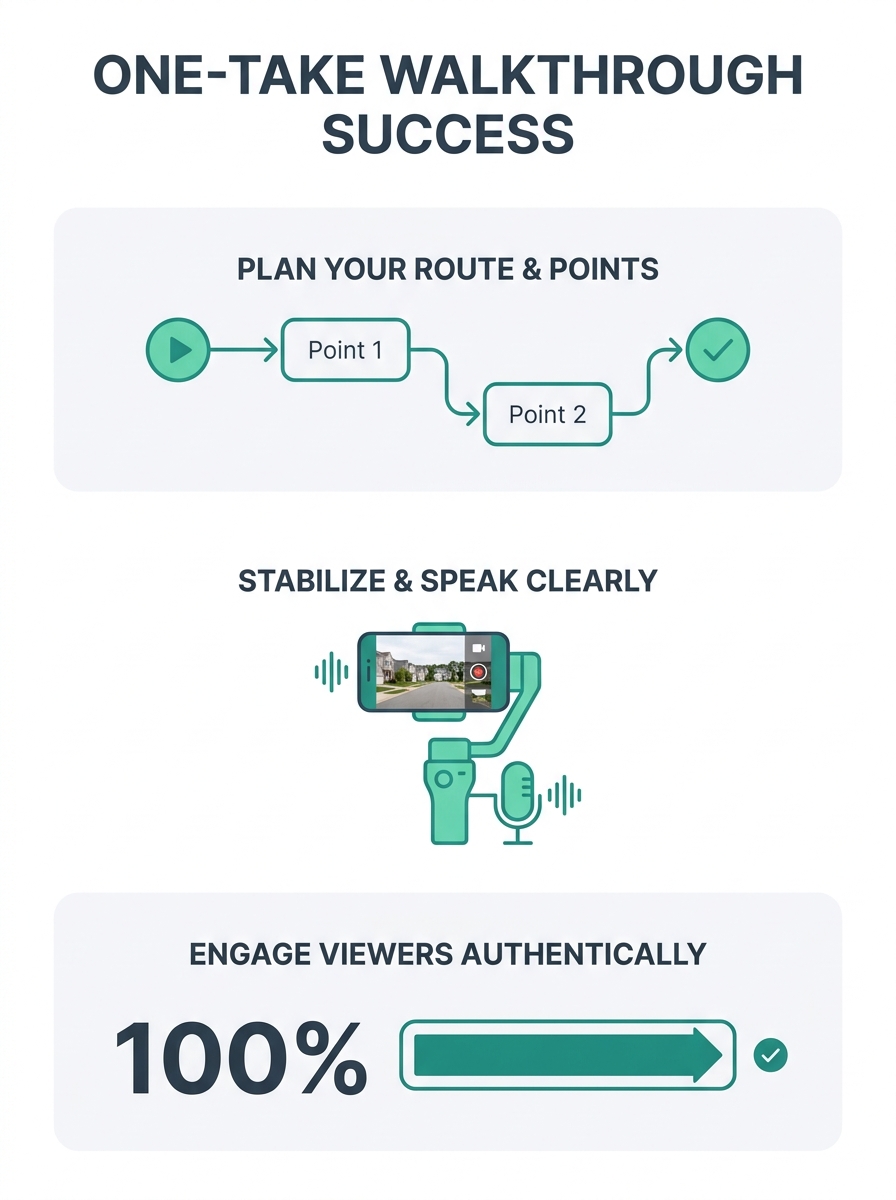
The third tactic involves filming the current homeowner answering a single question—”What will you miss most about this house?”—for 60 seconds. “It costs you a minute, and it will outperform anything you could have produced,” the guide states. The fourth recommends walking from a listing’s front door to the nearest coffee shop in real time, filming the entire route weekly to establish neighborhood authority.
The fifth video tactic prohibits drones, music, and multiple takes. “Polish reads as an advertisement. Slightly imperfect reads as a person,” according to the guide, which connects production restraint to the credibility of the Netflix billboard actor performing morning stretches in a bathrobe.
Four Email Formats Designed to Generate Replies
The guide identifies four email approaches as alternatives to monthly newsletters. The first—termed “the one-paragraph email”—recommends sending three sentences and one question rather than multi-section updates. “The reply rate on a short email that asks something is not slightly better than a newsletter. It is a different universe,” the publication states.
The second approach, called “the observation email,” recommends sending hyperlocal messages such as “Drove past your street Tuesday and noticed the Hendersons finally sold. Made me think of you.” The guide categorizes this as neighbor communication rather than marketing and notes it cannot be automated. The third tactic recommends replacing PDF market updates with 40-second voice memos, and the fourth recommends sending an annual one-page letter to past clients detailing what their home is worth, what sold on their street, and equity gained since closing, with no service request attached. Agents tracking lead response timing may find the voice memo tactic aligns with frameworks that prioritize speed over formatting.
Four Offline Tactics That Shift Agent Visibility
The guide recommends four offline strategies that remove agents from digital channels. The first instructs agents to write messages by hand, positioning handwriting as “a strange choice” that stands out in an automated market. The second recommends transforming open houses into service events by bringing shred trucks, notaries, or contractors who answer questions for free, framing the listing as secondary to the utility provided.
The third tactic recommends holding two-hour office hours at a coffee shop with a sign reading “Ask me anything about your house,” announced in neighborhood groups with no listing presentation. The fourth instructs agents to send physical items with weight—books, seed packets, or photos the agent took—rather than digital attachments.
The Response Principle That Determines Tactic Effectiveness
The guide devotes a closing section to reply mechanics, using the Netflix billboard’s whiteboard interaction as the model. “The clever part was never the whiteboard. The clever part was that he wrote back,” the publication states, contrasting one-directional broadcast with conversation. The framework instructs agents to build a response mechanism into every tactic, end emails with questions a real person can answer, ask video viewers something, and reply personally the same day rather than using templates. “Marketing that invites a response and then goes quiet is worse than sending nothing at all,” according to the guide.
The publication warns against “gimmick” implementations, clarifying that the billboard stunt succeeded because it featured “an ordinary person doing ordinary human things in a place where everyone expected” passive advertising. Agents seeking additional reply-focused tactics can review frameworks prioritizing personal brand over follower counts or video formats that drive inquiry volume.
Why This Matters Now
Agent marketing budgets increasingly flow toward production quality—professional photography, drone footage, polished video edits—while reply rates remain flat or decline. The HousingWire framework inverts that priority by treating differentiation as the variable that determines whether content gets noticed and production quality as irrelevant to engagement. For agents competing in markets where every listing uses similar visual standards, tactics that abandon polish in favor of personality create opening-rate and reply-rate advantages that polished competitors cannot replicate by adding budget.
The guide’s emphasis on low-cost execution removes the capital barrier that prevents newer agents from testing unconventional formats. An agent can implement the one-paragraph email, the observation email, the handwritten note, and the neighborhood walk video in a single week without vendor contracts or equipment purchases. The 10-second identifiability test provides a repeatable quality control checkpoint that agents can apply before sending any piece of content, reducing wasted touches that add to market noise without generating response.
The framework arrives as AI-generated content floods agent inboxes and social feeds with templated messages that pass grammar checks but fail differentiation tests. Agents who adopt response-focused formats position themselves in the shrinking category of marketers whose outreach cannot be automated, which the guide frames as the structural advantage in a market where automation is universal.