

Listings marketed with video receive 403 percent more inquiries than photo-only listings, and short-form video posts generate 12 times more shares than photo carousels, according to a guide published August 29 by Air Unlimited Corp, a Toronto real estate media provider. The firm’s 2026 benchmarks also show Instagram Reels reach 30.8 percent of an account’s audience—more than double a carousel’s reach—while TikTok real estate accounts averaging 52,400 followers report an average of 99,800 video views per post.
TL;DR: Video listings outperform photo-only marketing by 403% on inquiries and 1,200% on shares, with Instagram Reels reaching twice as many potential buyers as static posts in Toronto’s competitive market.
The data arrives as Toronto’s median home sale price hit $1,003,956 in July 2026 with an average 32-day market time, creating pressure on agents to differentiate listings early in the marketing cycle. Air Unlimited Corp’s framework targets the city’s condo-heavy inventory and mobile-first buyer demographic, both of which favor vertical video discovery over traditional MLS photo browsing.
Performance Gap Between Video and Static Content
Instagram Reels produce 67 percent more engagement than static images on real estate accounts and average a 0.52 percent engagement rate versus 0.37 percent for static posts, according to the guide. Short-form video under 90 seconds drives roughly twice the engagement of long-form video on every major platform except YouTube, the firm reported.
The reach differential compounds the engagement advantage. Reels average 3.2 times more saves and shares than photo carousels, metrics that directly influence algorithmic distribution to non-followers. Air Unlimited Corp noted that TikTok real estate accounts see most video views from users who do not follow the account, indicating discovery beyond existing audiences.
“A 25-second vertical walkthrough of a Liberty Village one-bedroom or a King West penthouse gets served by the algorithm to thousands of people who never typed a search,” the guide stated, contrasting platform distribution with MLS photo galleries that require active buyer searches.
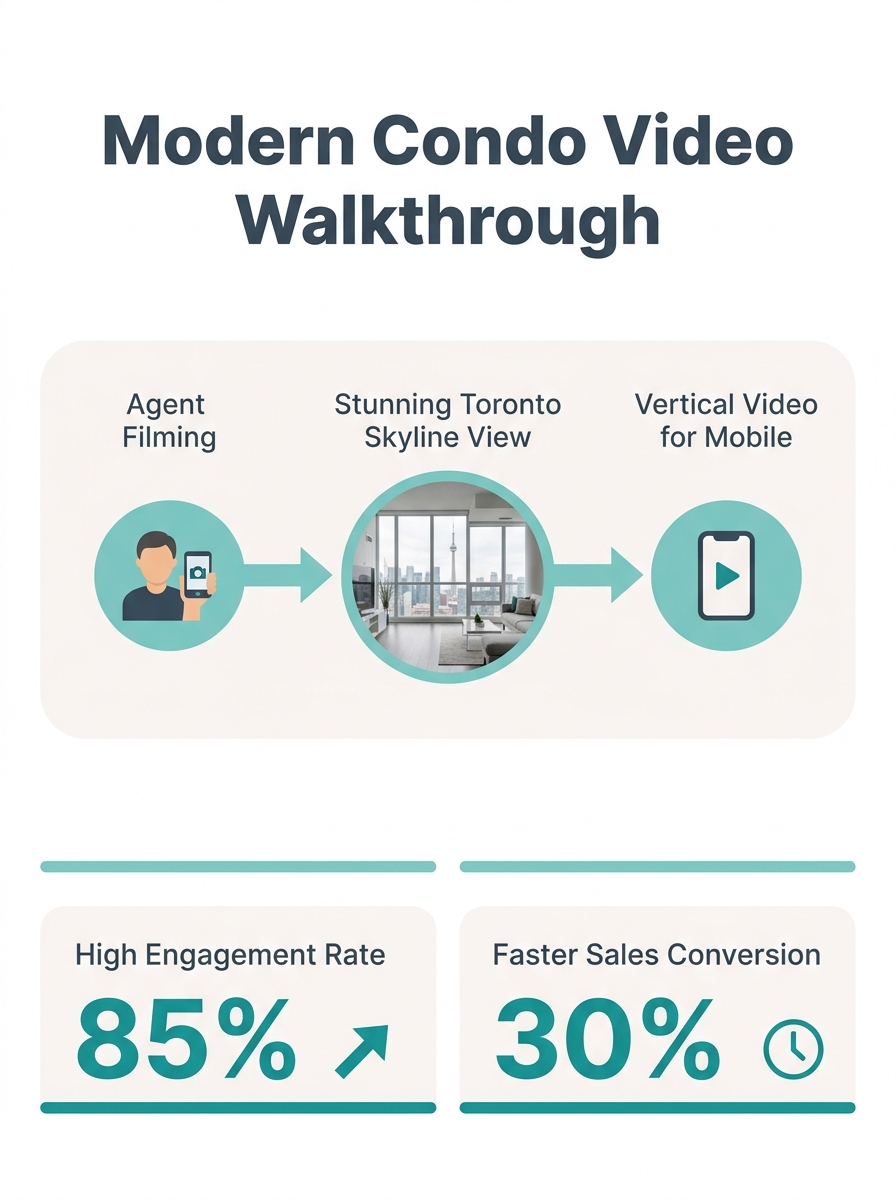
Toronto Market Dynamics Boost Video Impact
Toronto’s inventory depth and buyer comparison behavior make video particularly effective, Air Unlimited Corp reported. Buyers compare dozens of similar units in the same building or street, creating advantage for listings that communicate flow, light and scale fastest. The city also draws relocating buyers who shortlist properties entirely online before visiting neighborhoods, the firm noted.
The guide identifies downtown and midtown condos in King West, Liberty Village, CityPlace, Yonge and Eglinton and the waterfront as strongest candidates for video marketing, alongside renovated homes in Leslieville, Roncesvalles, the Junction, Riverdale and East York. Small units under 700 square feet benefit from continuous walkthrough shots that prove layout functionality better than wide-angle stills, according to the framework.
Luxury listings in Rosedale, Forest Hill, the Bridle Path and Yorkville also show strong returns from cinematic reels that match price-point expectations, Air Unlimited Corp reported. Pre-construction and new-build units in North York, Scarborough and Etobicoke can carry amenity and neighborhood context through video that static posts cannot deliver efficiently.
Production Requirements and Hook-First Structure
The guide distinguishes reels from traditional property videos, describing reels as “vertical, sound-on, hook-first sequences built for a viewer who decides in under two seconds whether to keep watching.” Air Unlimited Corp instructs agents to brief photographers for specific hook shots—the single most striking frame used in the first one to two seconds—before scheduling listing shoots.
Recommended hook shots include skyline views from balconies, light hitting renovated kitchens, or reveal moments as doors swing open. The framework emphasizes that “nothing else in the reel matters if the hook does not stop the scroll,” according to the published guide.
The firm’s shot list also calls for continuous walkthrough footage showing flow between rooms, close-ups of high-end finishes and fixtures, natural light demonstration throughout the day, neighborhood context including nearby amenities and transit, and lifestyle staging that shows how spaces function. Air Unlimited Corp notes that vertical video under 90 seconds performs best across Instagram and TikTok, platforms where Toronto’s buyer demographic concentrates.
Related strategies for maximizing social media reach appear in the site’s coverage of social media frameworks prioritizing personal brand over follower counts and how a New York A-frame sold in three days after an Instagram post generated 1,360 shares.
The Takeaway
The 403-percent inquiry lift and 1,200-percent share advantage represent a measurable shift in how Toronto buyers discover listings before they ever open a portal. Agents operating in condo-heavy markets with comparable inventory face direct competition on buyer attention—and the data shows video captures that attention at significantly higher rates than static posts. The share multiplier matters most: every share puts the listing in front of the buyer’s partner, parents and agent, extending reach beyond the agent’s own follower base into networks that drive actual showings.
Air Unlimited Corp’s framework is built for vertical video under 90 seconds, which aligns with platform algorithms favoring short-form content. Agents already shooting professional listing photos can add video coverage with minimal additional shoot time if they brief photographers for hook shots and continuous walkthrough sequences upfront. The performance gap between 0.52-percent and 0.37-percent engagement rates may seem narrow, but in a market where the average listing takes 32 days to sell, algorithmic reach in the first week determines whether a property sees early offers or sits into price-reduction territory.
The market-specific angle—Toronto’s $1 million median, condo concentration, and relocating-buyer demographic—means video marketing delivers disproportionate returns in this city compared to suburban or single-family-dominant markets. Agents can measure impact directly through inquiry volume and share counts rather than relying on subjective engagement metrics.