

Custom IDX integrations cost $2,000–$8,000 upfront before MLS access fees of $30–$100/month per region even begin, according to ProjectCostEstimator.com’s 2026 analysis. Your website builder’s advertised monthly price captures roughly 40–60% of what you’ll actually spend in year one, and the gap between sticker price and true lead acquisition cost is where most agents’ budgets quietly drain.
TL;DR: The monthly fee on your website builder is the smallest piece of your real cost. IDX fees, MLS access charges, plugin subscriptions, maintenance, and content creation can push a $99/month platform to $300+/month. A framework called Full-Stack Lead Cost (FSLC) captures every dollar and divides by actual leads, giving you the number that actually matters for ROI.
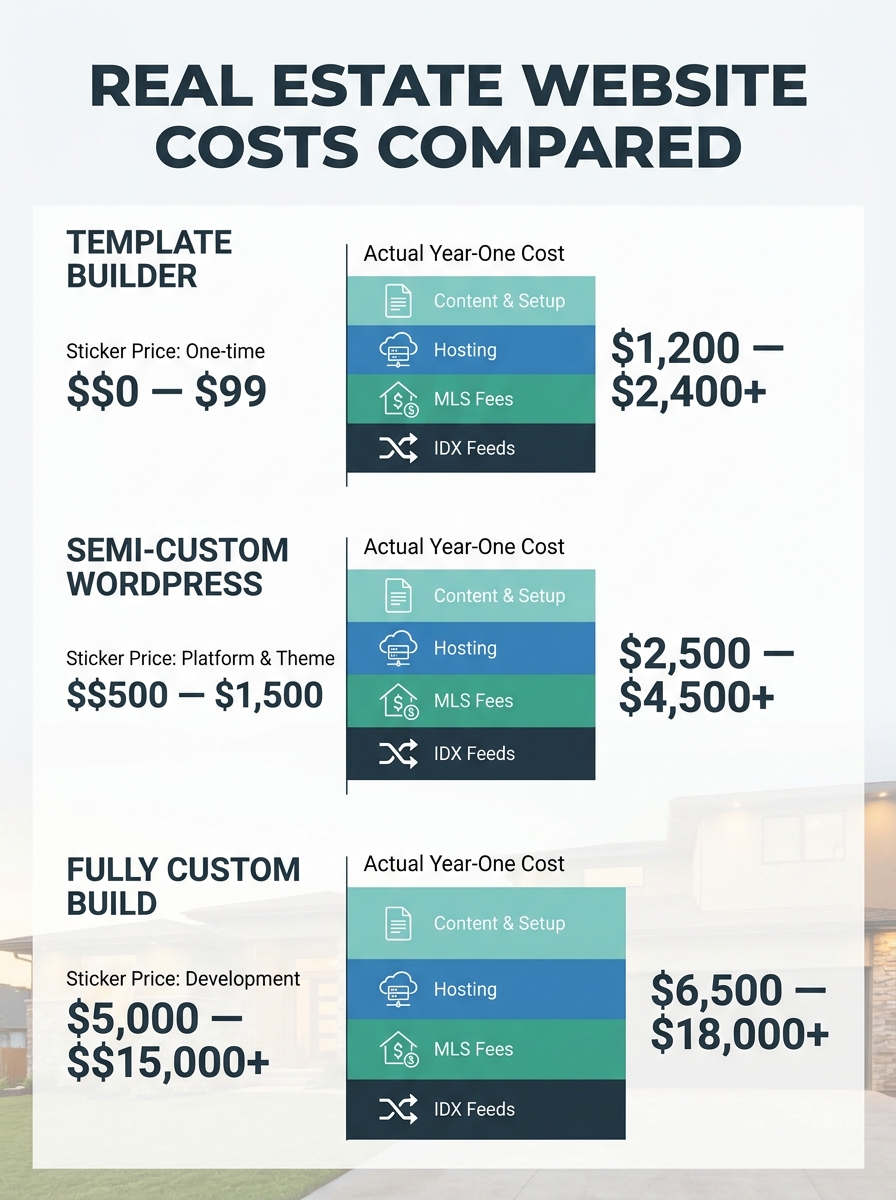
The Gap Between Advertised Price and Year-One Reality
Template-based platforms like Placester and Real Geeks quote $99–$399/month, which Luxury Presence identifies as the cheapest entry point for agents — fast launch, no upfront build cost, IDX sometimes bundled at the base tier. But that quoted price excludes several recurring and one-time costs that hit your bank account within the first 90 days.
Here’s what typically falls outside the monthly subscription:
- Domain registration and renewal: $10–$100/year
- Premium hosting upgrades: $100–$800/month for high-traffic sites
- IDX plugin fees: $30–$200/month on top of your base website cost, per Luxury Presence’s IDX pricing breakdown
- MLS data access fees: $30–$100/month per region served
- SSL certificates, security monitoring, and updates: $50–$200/month for complex builds
- Content creation (photography, copywriting, video): $1,000–$5,000 initially, with ongoing costs for blog posts and listing media
A Showcase IDX Essentials plan alone runs $949.50/year, according to their published pricing. Add that to a $149/month builder subscription and you’re at $2,737.50 in year one before you’ve paid for a single lead magnet, a single blog post, or a single hour of someone’s time configuring listing pages.
How IDX Integration Costs Reshape Your Budget
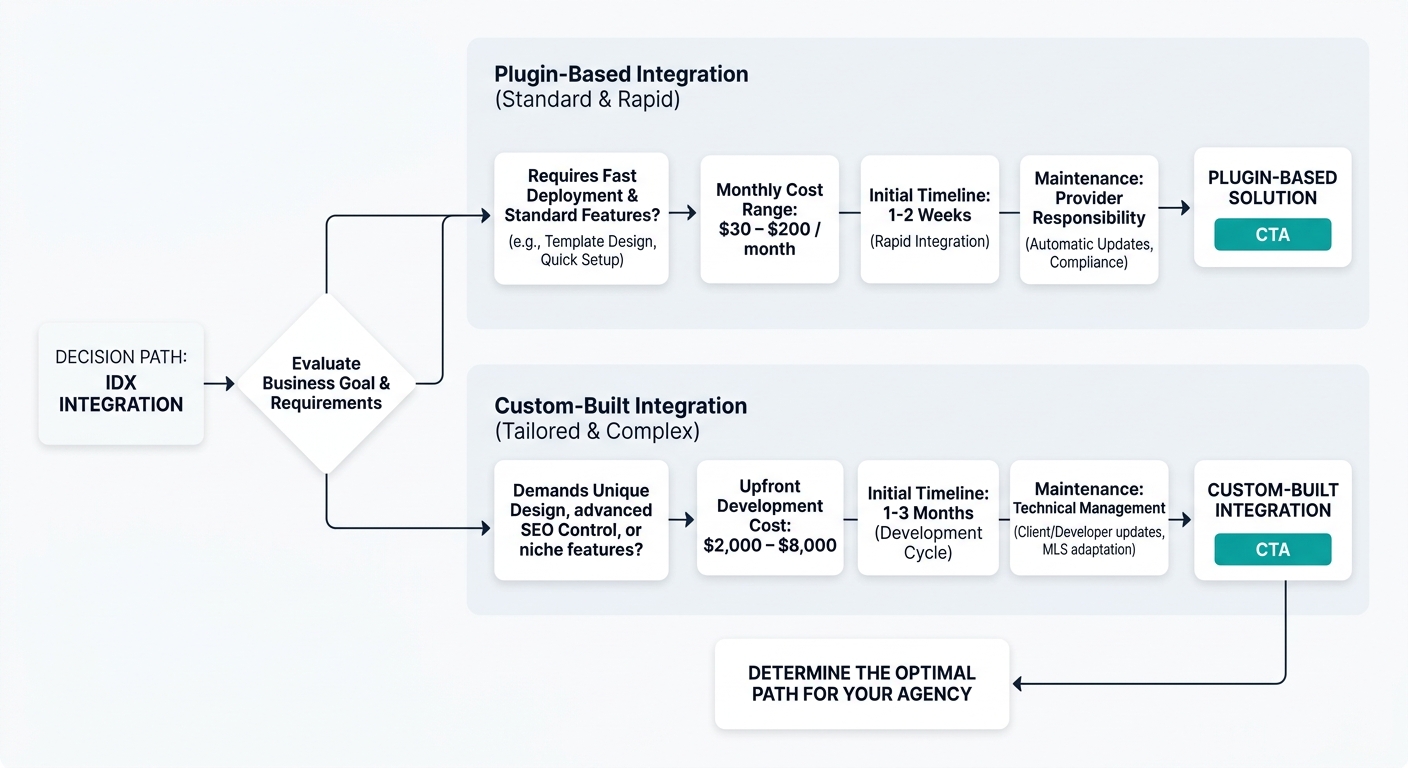
IDX eats more budget than any other single component because the integration itself is layered. Luxury Presence states that “IDX integration is one of the largest cost variables” and that “working with a developer who already has IDX infrastructure in place can save thousands compared to building it from scratch.” Plugin-based IDX (iHomeFinder, Showcase IDX) runs $30–$200/month. Custom IDX integrations jump to $2,000–$8,000 upfront, plus the recurring MLS fees on top.
The real estate website builder you chose determines which path you’re on. Agents on WordPress have the most plugin flexibility but also the most exposure to what Luxury Presence calls hidden cost creep: “plug-ins, widget subscriptions, and MLS data compliance fees often push semi-custom builds closer to fully custom pricing over time.”
An agent starting on a $150/month WordPress hosting plan with a $79/month IDX plugin and one MLS region at $50/month spends $279/month on infrastructure alone. That’s $3,348/year before any lead generation strategy enters the picture. If you’re weighing IDX setup options, our breakdown of builder trade-offs between speed, customization, and lead cost maps the decision by platform.
Calculating True Cost Per Lead by Platform
The cost per lead calculation most agents run is too simple: monthly subscription divided by monthly leads. A more honest formula accounts for every dollar that makes the website function as a lead generation tool. I’m calling this framework the Full-Stack Lead Cost (FSLC) formula:
FSLC = (Annual Builder Fee + Annual IDX Cost + Annual MLS Fees + Annual Hosting/Domain + Annual Maintenance + Annual Content/Design Spend) ÷ Total Annual Website Leads
Here’s how the numerator breaks down across three common setups:
| Cost Component | Template Builder | Semi-Custom WordPress | Fully Custom Build |
|---|---|---|---|
| Annual platform/hosting | $1,188–$4,788 | $1,800–$3,600 | $5,000–$25,000+ |
| Annual IDX costs | Often included | $360–$2,400 | $2,000–$8,000 (setup) + $360–$1,200/yr |
| Annual MLS access | $360–$1,200 | $360–$1,200 | $360–$1,200 |
| Annual maintenance | Included | $600–$2,400 | $1,000–$12,000+ |
| Annual content/design | $500–$2,000 | $1,000–$5,000 | $2,000–$10,000 |
| Estimated year-one total | $2,408–$9,188 | $4,120–$14,600 | $10,720–$57,400+ |
Those ranges are wide because the website customization expense analysis varies dramatically by market and ambition level. A solo agent in a mid-size market sits at the low end. A team targeting luxury buyers in a coastal metro pushes toward the ceiling. But what matters is the second half of the FSLC equation: how many leads the site actually generates.
A posting in r/realtors reported one agency’s client averaging a cost per lead under $2 from their website. The commenter noted: “It certainly is no easy feat to rank well on Google, but if you have either the money (or time) it can have a huge ROI.” That sub-$2 CPL reflects a site generating hundreds or thousands of organic monthly leads — an outlier, but an instructive one. An agent spending $5,000/year and generating 50 leads has a $100 CPL. The same $5,000 with 500 leads drops to $10.
An agent spending $5,000/year on their site and generating 50 leads has a $100 CPL. The same $5,000 generating 500 leads drops to $10. The denominator matters more than the numerator.
The lead cost per builder platform depends as much on what you do with the site as what you pay for it. And that’s where conversion infrastructure comes in. If your site architecture leaks leads at the navigation level, spending more on a premium builder won’t fix the CPL problem.
Where Costs Compound Without Warning
Three expense categories tend to surprise agents after the initial setup phase.
Maintenance on custom and semi-custom builds
Basic maintenance runs $50–$200/month, according to Triare’s development cost analysis. Complex custom platforms can require $1,000+ monthly for updates, security patches, and major upgrades. Luxury Presence estimates that a custom-designed real estate website “typically costs more than $1,000 per month when you factor in creation, hosting, and ongoing maintenance.” That maintenance figure alone can exceed what a template builder charges for its entire subscription.
Marketing spend that platforms don’t include
Getting traffic to your site is a separate line item from building it. SEO and content marketing require $500–$3,000/month for continuous effort. And with 68% of Google searches now ending without a click as AI-generated answers absorb organic traffic, the investment needed to drive visitors keeps climbing.
Lead capture tool add-ons
Many builders include basic contact forms but charge extra for advanced lead capture features. The gap between a standard form and a conversion-optimized lead capture setup with conditional fields and CRM integration often adds $50–$200/month in third-party tools. Those charges don’t show up in the builder’s pricing page, but they show up in your FSLC.

Running Your Own FSLC Calculation
To apply the Full-Stack Lead Cost framework to your situation, gather these numbers from your last 12 months or project them for your first year:
- Pull every recurring charge tied to your website: hosting, builder subscription, IDX plugin, MLS fees, domain renewal, SSL, any analytics or CRM plugins.
- Add one-time costs and amortize them across 12 months: initial design, custom development, IDX setup fees, professional photography for the site.
- Add your content and marketing costs: blog writing, SEO services, paid traffic specifically driving to the website.
- Divide the total by the number of leads your website generated (form submissions, chat initiations, phone calls tracked to the site).
Luxury Presence recommends agents “compare total year-one costs across at least three vendors before committing.” That advice holds up. The platform with the lowest monthly fee often carries the highest FSLC once IDX integration costs, maintenance, and conversion tools are included. If you want to see what Pillar costs with everything broken out by tier, comparing it against the FSLC you calculate for other options gives you an apples-to-apples number.
Tip: Ask every vendor you’re evaluating one question: “What will I pay in total across my first 12 months to have a fully functional site with IDX search, lead capture forms, and CRM integration?” Any vendor who can’t answer that clearly is one whose hidden costs you’ll discover the hard way.
What The Numbers Still Can’t Answer
The FSLC framework gives you a real number to compare across platforms, but it has blind spots. It can’t capture the quality gap between leads from a template site and leads from a custom-built brand experience. A $10 lead from a generic IDX page and a $10 lead from a tailored neighborhood landing page carry different conversion probabilities. The dollar figure is identical; the revenue outcome often diverges significantly.
The data also can’t capture opportunity cost. An agent spending 40 hours configuring a WordPress theme and troubleshooting IDX plugin conflicts is spending time they could have put toward client calls, showings, or relationship building. Agents who’ve analyzed how missed lead responses cost real revenue know that the hours lost to website maintenance carry their own price tag.
And the sub-$2 CPL outlier from Reddit? That agent built organic search authority over years of consistent investment. Their FSLC in year one was almost certainly much higher. The numbers reward patience and compounding, which means any single year’s snapshot tells an incomplete story. Your real estate website builder ROI emerges over 24–36 months, not 90 days. Track your FSLC quarterly. Watch whether the trend line is falling as your lead volume grows or staying flat because add-on costs keep pace. That trajectory tells you more about whether you chose the right platform than any single month’s invoice ever will.