
AceableAgent’s 2026 Housing Market Optimism Report released June 23 found that 85% of homebuyers now use artificial intelligence tools to research homes, while 81% still consider real estate agents essential during the transaction, according to Forbes. The data signals that AI has moved from experimental to mainstream in buyer behavior without displacing professional guidance in closing decisions.
TL;DR: Eighty-five percent of homebuyers now use AI research tools, but 81% still rely on agents for transaction guidance, showing technology boosts rather than replaces professional expertise in real estate deals.
The study surveyed homebuyers across the United States during the first half of 2026, tracking how artificial intelligence adoption affects both buyer confidence and agent utilization. Laura Adams, Senior Real Estate Analyst at AceableAgent—an online education platform for real estate professionals—emphasized the distinction between information access and transaction expertise. “Buyers are embracing AI, but they trust humans to guide their most important financial decisions more,” Adams said in the report. “AI can help buyers research and compare options, but when it comes to negotiations, understanding local markets, and making major financial decisions, the expertise of a trusted agent remains essential.”
AI Delivers Speed Without Replacing Judgment
Ninety-seven percent of homebuyers reported that AI tools increase their confidence during the buying process, the AceableAgent data shows. Buyers now access market trends, neighborhood comparisons, home value estimates, and instant answers to property questions within seconds—research tasks that previously required hours of agent time or manual searching across multiple platforms.
The acceleration creates better-prepared clients who arrive at showings with specific questions and narrowed search criteria. In competitive markets where speed determines which buyer secures a contract, faster research cycles compress the time from initial search to offer submission.
Yet the same study found information volume does not translate to transaction expertise. Adams noted a case where professional listing photography concealed significant property defects—marks on walls, clutter, and maintenance issues invisible in curated images. “Without that in-person visit,” she explained, “the buyer would have had no way of knowing what they were actually walking into.” The example illustrates the gap between AI-generated property data and the contextual judgment agents provide during physical inspections, contract review, and negotiation strategy.
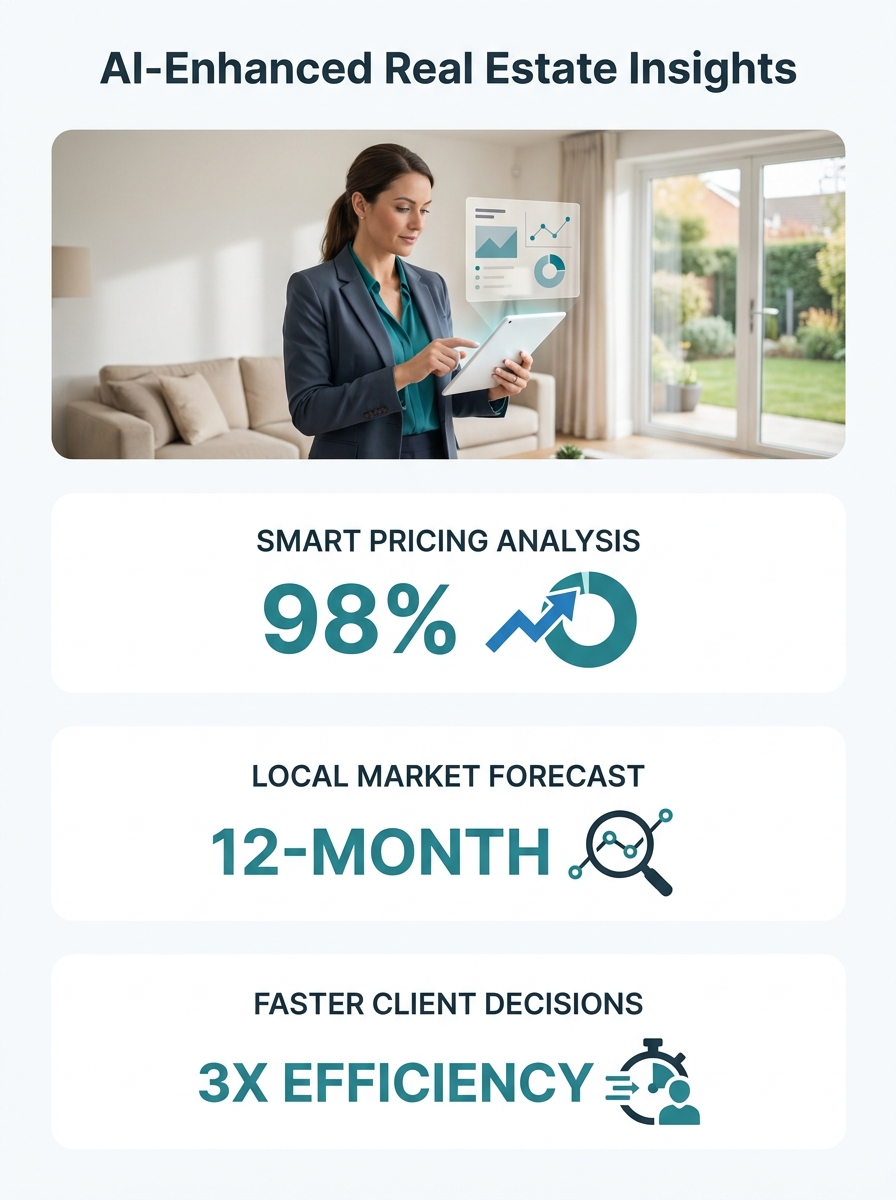
Agents who adopted AI-powered property description generators reported faster listing preparation, but those tools handle copywriting—not the risk assessment, local market interpretation, and pricing strategy that determine whether a property sells at target value. The broader brokerage AI adoption trend shows 97% of brokerages now deploy AI tools, yet productivity gains concentrate among a small group of power users who combine technology with traditional relationship and negotiation skills.
Cognitive Surrender Risk Grows With AI Confidence
A European Broadcasting Union study led by the BBC identified “cognitive surrender”—the tendency to accept AI-generated responses without verification—as a rising concern among technology users. When applied to real estate transactions, unverified AI recommendations can lead buyers to overpay for properties, overlook zoning restrictions, or misunderstand school district boundaries that significantly affect resale value.
Prosper Insights & Analytics survey data from 2026 found that 33% of Millennials and 36% of Generation Z respondents believe AI can produce incorrect information. The skepticism rates suggest younger buyers—often portrayed as tech-native and AI-trusting—recognize output accuracy limitations. Adams highlighted affordability calculators as a common error zone: “Buyers might use AI to estimate what they can afford or compare neighborhoods and get confident-sounding answers, but the tech may miss key local factors like school zoning or neighborhood-level pricing differences.”
An AI tool might estimate a home’s market value at $425,000 based on comparable sales data, yet an experienced agent knows the property backs onto a commercial development scheduled to break ground in six months—a detail that will depress resale value but appears nowhere in the AI’s training data. These judgment calls require local knowledge, relationship networks with city planners and other agents, and pattern recognition built over hundreds of transactions. No current AI model replicates that contextual layer.
Agents who integrate AI research tools into their client preparation process report more productive first meetings, with buyers arriving ready to discuss specific neighborhoods rather than requesting broad market overviews. The shift moves agent time from basic information delivery to higher-value consultation on risk assessment, offer strategy, and contract terms—tasks that still require human expertise in 2026.
What Happens Next
Real estate professionals face a repositioning challenge, not an obsolescence crisis. The 85% AI adoption rate among buyers means agents who dismiss technology as irrelevant to their workflow will lose clients to competitors who use AI to accelerate research, personalize property recommendations, and deliver faster responses to buyer questions. Yet the 81% agent-essentiality figure confirms that technology serves as an amplifier of professional expertise rather than a replacement for it.
Agents should treat AI tools as client preparation accelerators—technology that lets buyers arrive at consultations better informed, with more specific questions and clearer priorities. That shift moves agent value upward in the transaction chain, from information provider to strategic advisor on negotiation, risk mitigation, and long-term investment decisions. The agents who thrive in this environment will be those who integrate AI research into their listing presentations and buyer consultations while doubling down on the judgment-based services—market interpretation, contract negotiation, relationship networks—that AI cannot replicate.
The data suggests a durable middle path: buyers want AI speed combined with agent judgment. Professionals who deliver both will capture the informed, confident clients AI tools create while avoiding the commoditization trap that threatens agents who compete solely on information access.