

Brokerage adoption of artificial intelligence tools in residential real estate reached 97% in 2026, up from 80% in 2024, but productivity gains remain limited to a small group of power users while most agents report minimal impact on transaction volume, according to an analysis published by HousingWire on June 15. The disparity between widespread deployment and measurable results highlights a gap between tool availability and workflow integration that brokerages and team leaders must address to justify ongoing platform investments.
TL;DR: Ninety-seven percent of brokerage leaders report agents now use AI tools, but most agents see little impact on their numbers, with productivity concentrated among a small group of power users who integrate AI into high-value workflows.
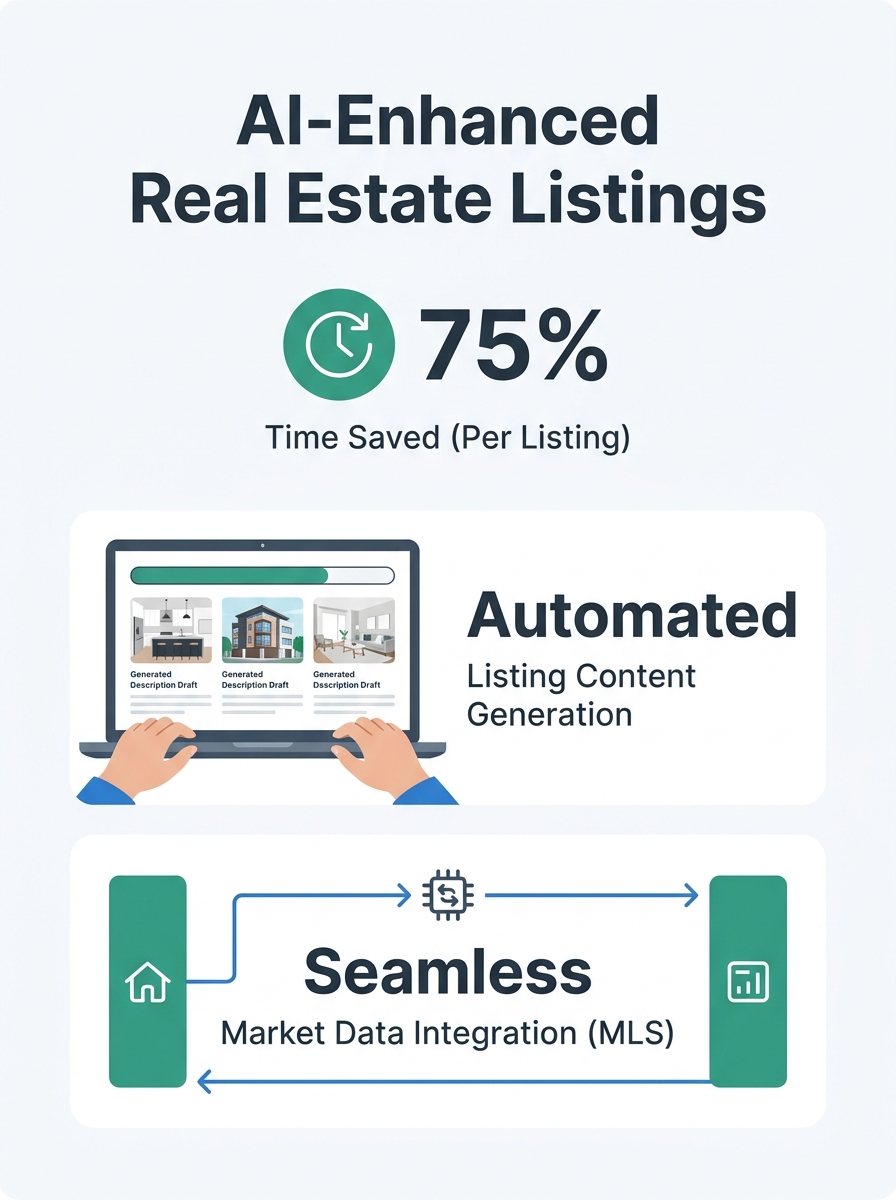
The data shows near-universal AI rollout at the brokerage level, with only 4% of brokerages reporting non-adoption and 2% saying they do not plan to adopt AI in 2026. Among agents using AI, 82% now write listing descriptions with AI assistance, up from 58% in 2024, while 74% use AI for blogs, social posts, and email campaigns and 49% use it for social media planning, according to the analysis.
Adoption Metrics Diverge From Output Measures
The adoption surge has not translated uniformly into productivity gains. Industry reporting over the past 90 days shows brokerages and teams rolling out AI assistants for lead management, CRM integration, and coaching, but separate data indicates that most agents report little to no meaningful impact on their closing numbers. The gap centers on workflow integration rather than tool access, with power users—agents who systematically apply AI to specific high-value tasks—capturing the majority of measurable productivity improvements.
New platforms marketed as agentic AI systems promise to execute multi-step workflows on behalf of agents rather than simply drafting content. Lofty, one entrant in this category, markets an AI operating system designed to run entire sequences—sending follow-up emails, updating CRM records, scheduling showings—without manual intervention for each step. Whether these systems deliver on the promise of autonomous execution will determine whether the productivity gap narrows or widens through 2026.
Free Public Models Compete With Brokerage Suites
Agents frequently bypass brokerage-provided AI tools in favor of free public models that prioritize speed over compliance and integration. The pattern shows agents dictating listing-presentation notes into consumer voice tools, drafting buyer emails in public chatbots, and writing listing descriptions in free language models before transferring the output into brokerage systems. This behavior reflects a maturity gap: brokerage tools are designed for security, data ownership, and MLS compliance, while public models optimize for immediate task completion without workflow constraints.
The divergence creates a measurement problem for brokerages tracking adoption by login counts rather than output metrics. A brokerage can report 80% of agents logged into the AI suite while only 12% use the tools for tasks that directly advance transactions—listing preparation, buyer follow-up sequences, or market-update campaigns that generate leads. The analysis recommends brokerages measure AI effectiveness through six-week productivity loops focused on specific workflows: time saved on listing presentations, deals advanced through automated follow-up, and lead conversion from AI-generated market updates.
Agents can identify their optimal AI workflow by running a two-column audit: tasks the brokerage suite handled effectively in the past 30 days versus tasks completed faster using external tools. The column with more entries should guide daily workflow decisions, since sellers evaluate outcomes rather than the tools that produced them. For team leaders and brokers concerned with rising AI platform costs, this audit discipline matters—technology budgets justified by adoption percentages rather than productivity improvements represent vanity metrics that obscure whether tools are moving the revenue line.
Prompt Structure Over Platform Selection
The data from both brokerage AI adoption reports and public-model usage patterns point to a consistent finding: productivity gains concentrate among operators who master specific prompt structures rather than agents who experiment across multiple platforms. Learning one prompt framework thoroughly—how to structure context, specify tone, and define output format—delivers more measurable impact than switching between 50 different AI hacks or tools. This holds true across both paid brokerage suites and free consumer models.
The agentic AI category entering the market in 2026 will test whether automation can replace operator skill. If these systems can execute multi-step workflows with minimal prompting, the advantage of prompt mastery diminishes. If they require the same level of structured input as current language models, operator skill remains the differentiator. Early deployments through mid-2026 will provide the signal.
Technology costs in real estate are rising faster than productivity gains for the median agent, a pattern explored in recent analysis of real estate marketing channels that deliver zero leads to most agents. The gap between tool availability and tool effectiveness compounds this issue: brokerages pay for enterprise AI suites while agents complete tasks in free consumer tools, creating duplicate spending without duplicate results.
Context and Outlook
AI adoption in residential real estate has crossed the threshold from experimental to standard infrastructure, with 97% brokerage penetration signaling the category’s permanence in agent workflows. The challenge now shifts from “should we adopt AI” to “how do we extract productivity from the tools we’ve already deployed.” The 18-month period ahead will determine whether the brokerage AI category matures into platforms that genuinely execute multi-step workflows or remains a content-generation layer that agents supplement with manual work and external tools.
For agents and brokers making platform decisions in 2026, the evidence suggests focusing investment on workflows that directly advance transactions rather than content-creation tasks that can be completed in free tools. Listing-presentation preparation, systematic buyer follow-up sequences, and lead-nurturing campaigns represent higher-value AI applications than social-media caption writing or generic blog posts. The agents capturing measurable productivity gains are those who apply AI to the specific tasks that compress time between initial contact and contract signature.
The broader shift toward predictive analytics in listing competition intersects with AI adoption trends: the agents who combine AI-powered workflow automation with data-driven targeting will separate from competitors still using either tool in isolation. As AI becomes standard infrastructure rather than competitive advantage, the differentiator returns to what it has always been—judgment, accountability, and client service—with technology enhancing rather than replacing those fundamentals.