

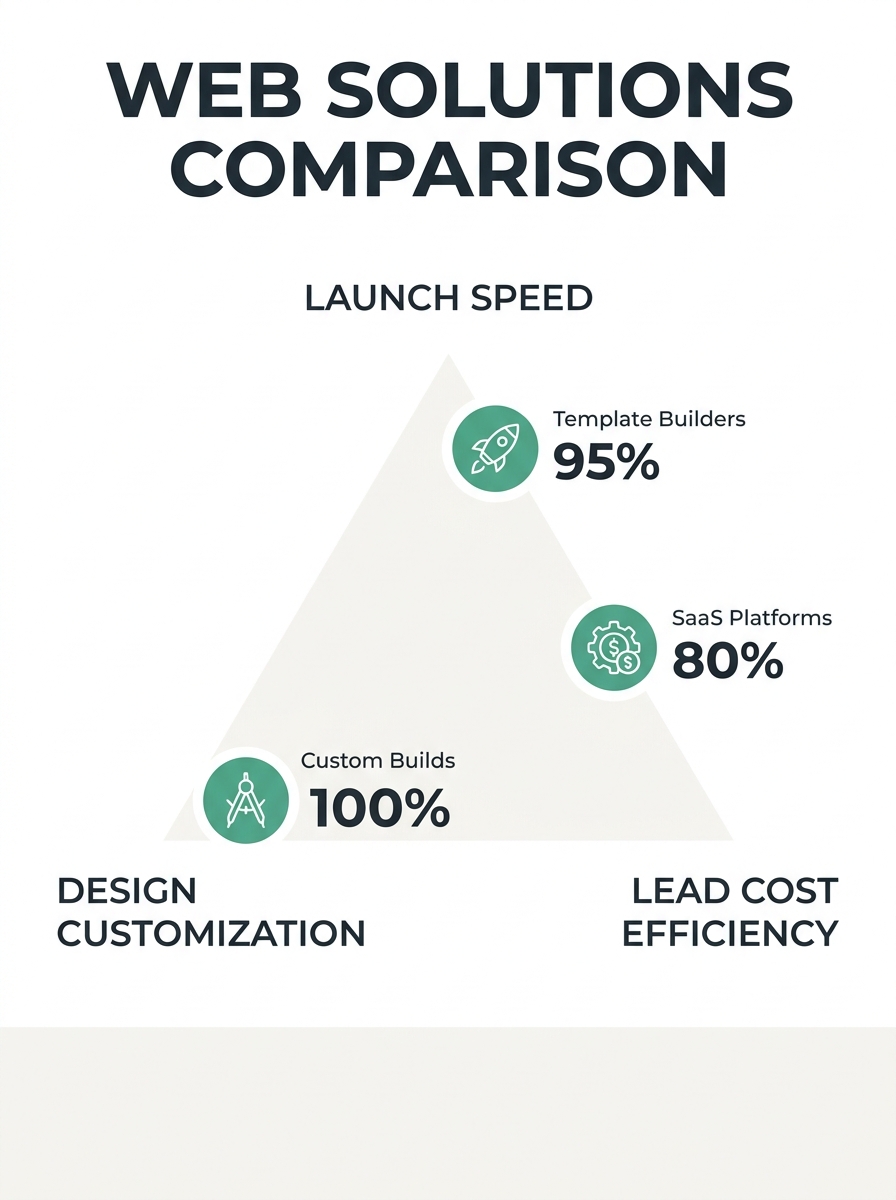
Every real estate website builder forces a three-way trade-off between launch speed, design customization, and cost per lead. Agents typically evaluate platforms on monthly subscription price alone, which hides the variable that actually determines ROI: how much each captured lead costs after factoring in conversion rate differences across builder types.
TL;DR: Cheap template builders launch fast but produce higher per-lead costs due to lower conversion rates. Custom builds convert better but take months and cost $5,000–$25,000+ upfront. SaaS real estate platforms split the difference, though each still penalizes one of the three variables. The right choice depends on which penalty your business can absorb.
The Three-Variable Constraint
The mechanism behind every website builder decision operates like a triangle with three vertices: launch speed, design customization, and effective cost per lead. You can optimize for two of these, but the third variable absorbs the penalty. This is the Builder Triangle, and understanding it prevents agents from chasing low monthly fees while hemorrhaging money on unconverted traffic.
Template platforms like Wix and Squarespace sit at the speed-plus-affordability vertex. According to a comparison of top real estate website builders, these platforms cost $15–$50 per month and get agents live within days. But their IDX options are limited or require third-party add-ons that, as one analysis put it, “never quite integrate properly.” That integration gap shows up directly in lead capture rates.
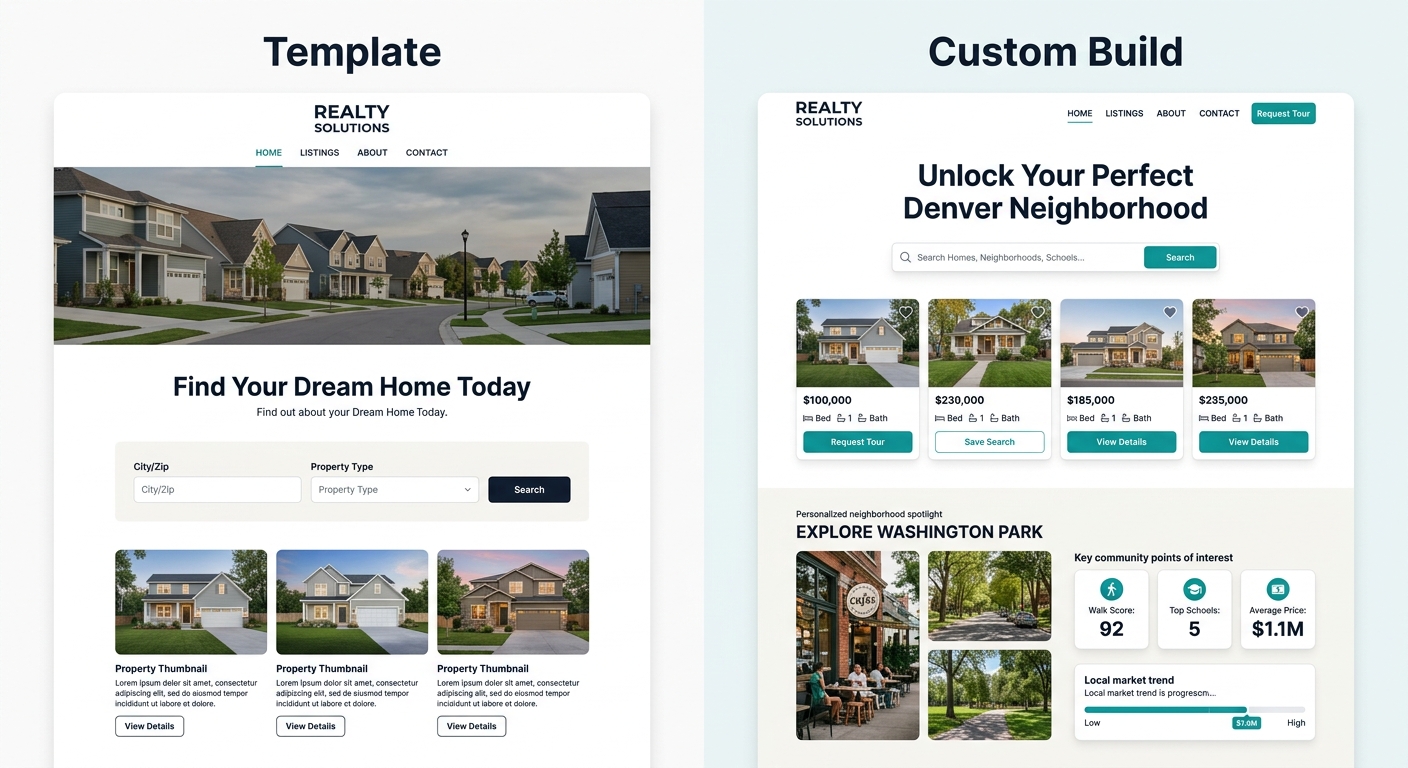
Custom-built sites occupy the opposite corner. They optimize for customization and conversion, with every button placement tested and every scroll purposeful. The penalty is time and upfront cash: $5,000–$25,000+ before a single visitor arrives, plus ongoing developer fees for updates.
SaaS real estate platforms (Luxury Presence, Sierra Interactive, Real Geeks) attempt to occupy the center of the triangle. They bundle IDX search, CRM integrations, and SEO tools into a single subscription. The trade-off here is subtler: you get speed and reasonable customization, but you’re locked into the platform’s design constraints and pricing structure forever.
How Template Builders Trade Conversion for Lead Volume
Why does a $29/month Squarespace site produce more expensive leads than a $200/month SaaS platform? Because templates aren’t built around your specific content and user journey, which results in lower conversion rates. The $29 monthly fee is misleading when your conversion rate drops by 40% compared to a purpose-built alternative.
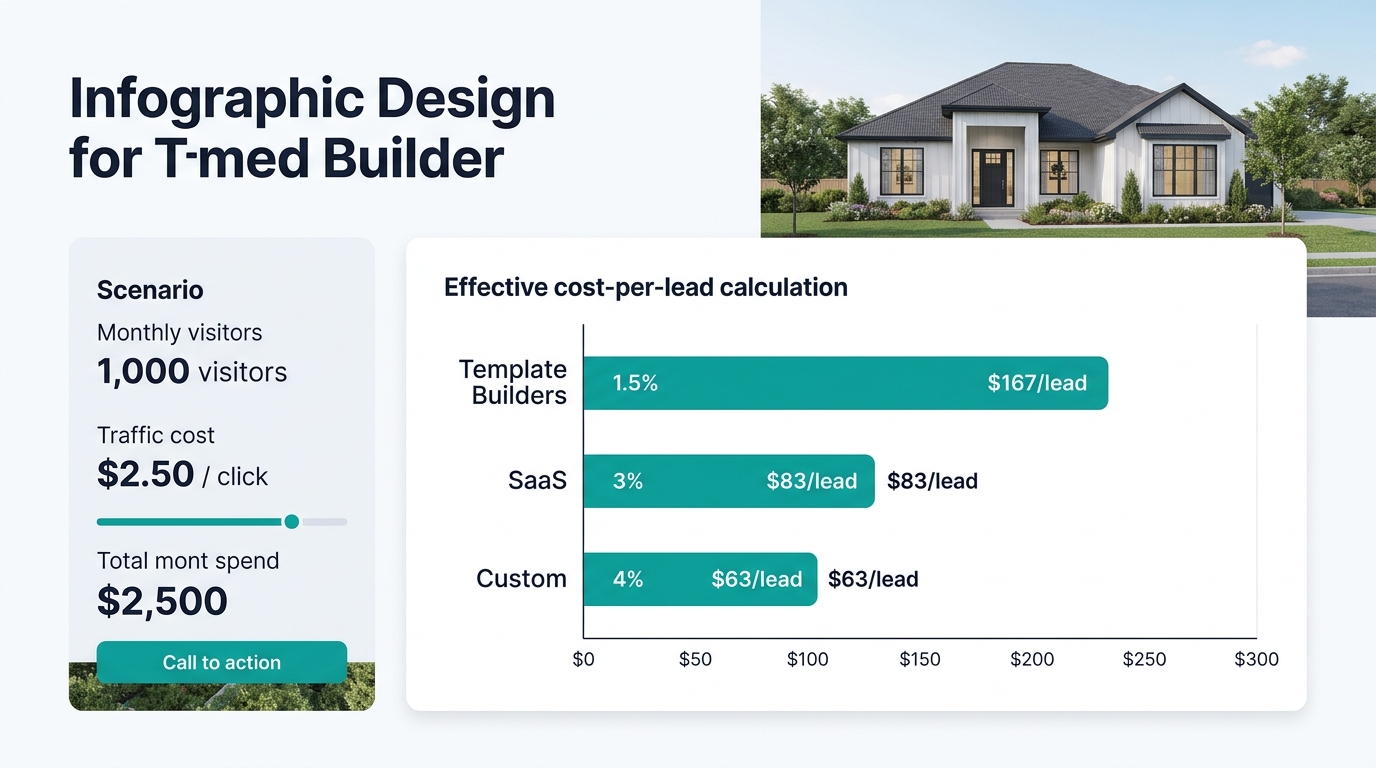
The math works like this. If you’re driving 1,000 visitors per month through paid ads at a blended cost of $2.50 per click ($2,500 total ad spend), a template site converting at 1.5% gives you 15 leads at $167 each. A custom or SaaS site converting at 3% gives you 30 leads at $83 each. The “cheaper” builder doubled your effective cost per lead. And those numbers compound: across all channels, the average cost per real estate lead in 2026 runs $416 to $480, but agents on high-converting sites pull that blended figure down significantly through organic capture.
Template builders have genuine strengths, though. An agent entering a new market who needs a web presence within 72 hours has a real business reason to choose speed over optimization. Solo agents spending under $500/month on total marketing may never generate enough traffic for conversion rate differences to matter. The Builder Triangle doesn’t say templates are wrong; it says the speed vertex carries a conversion penalty you should calculate before committing.
If you want to understand what drives those conversion differences at a technical level, the relationship between Core Web Vitals scores and lead capture rates is worth examining closely. Template builders often load unnecessary code libraries that inflate page weight and tank Largest Contentful Paint scores.
How Custom Builds Trade Time and Cash for Control
A fully custom real estate website takes 8–16 weeks to design, develop, and launch. During that window, you have no web-based lead capture at all. For agents in competitive markets where Google Ads buyer leads cost $20–$60 and seller-keyword leads cost $150–$400, that dead period represents thousands of dollars in lost opportunity.
The payoff, when it arrives, is measurable. Purpose-built sites integrate directly with your CRM, use custom schema markup for SEO, and place every element based on your actual visitor behavior data. According to analysis by Exotica IT Solutions, the conversion rate advantage of a custom site typically recovers the cost difference within a few months of launch. A team closing $8 million annually that improves conversion by even 1 percentage point is looking at 2–4 additional transactions per year.
The $29 monthly fee is misleading when your conversion rate drops by 40% compared to a purpose-built alternative.
But custom builds introduce a different kind of risk. Every update requires a developer. Security patches are your responsibility. And the site you paid $15,000 for in January can feel outdated by December if the market shifts or Google changes its ranking algorithm. The maintenance cost over 3 years often exceeds the original build cost.
This is why the WordPress flexibility paradox catches so many agents off guard. The platform offers extraordinary customization, but that flexibility creates ongoing maintenance obligations that eat into the conversion gains.
Where SaaS Platforms Sit in the Triangle
Real estate-specific SaaS builders have carved out a middle position by embedding IDX search, lead capture forms, and CRM workflows into a single subscription. Luxury Presence, which powers sites for 30% of the WSJ RealTrends Top 100 agents and handles over 60 million annual visitors, has deployed over 140,000 automatic SEO improvements without requiring manual effort from agents. That combination of customization and maintenance-free operation is the SaaS value proposition in a sentence.
The constraint these platforms impose is design ceiling. You’re working within the platform’s component library, not starting from a blank canvas. For most agents, this constraint is invisible because the available templates already exceed what they’d commission from a freelance designer. For luxury teams or brokerages with distinct brand identities, the ceiling becomes noticeable quickly.
SaaS pricing also shifts cost from upfront capital to ongoing operational expense. A platform charging $250/month costs $9,000 over three years. A custom build at $12,000 upfront plus $150/month maintenance costs $17,400 over the same period. But the SaaS agent was capturing leads from month one, while the custom build agent was dark for three months during development. When you run the numbers with competitive metro CPLs of $150–$350 per lead, that 3-month head start can represent $5,000–$15,000 in additional lead value.
| Factor | Template Builder | Custom Build | SaaS Platform |
|---|---|---|---|
| Monthly cost | $15–$50 | $150–$300 (maintenance) | $150–$500 |
| Upfront cost | $0–$200 | $5,000–$25,000+ | $0–$2,000 |
| Launch timeline | 1–5 days | 8–16 weeks | 2–4 weeks |
| IDX integration | Third-party add-ons | Native (developer-built) | Native (included) |
| CRM integration | Manual or Zapier | Custom API connections | Built-in |
| Conversion rate (typical) | 1–2% | 3–5% | 2–4% |
| 3-year total cost | $540–$1,800 | $10,400–$35,800 | $5,400–$18,000 |
Info: The 3-year total cost for custom builds includes both the upfront fee and ongoing monthly maintenance. It does not include the opportunity cost of the development window, which can add $5,000–$15,000 in lost leads depending on market competitiveness.
Understanding how your site architecture supports buyer intent matching matters regardless of which builder type you choose. Even the best platform can’t compensate for a structure that buries high-intent visitors in irrelevant content.
The Lead Cost Variable That Hides in Plain Sight
The real mechanism behind the Builder Triangle isn’t monthly fees or even conversion rates in isolation. It’s the interaction between your traffic source costs and your site’s ability to convert that traffic into actionable contacts.
Facebook leads cost $5–$25. Google Ads buyer leads average around $66. Zillow leads run $139–$300+. These numbers represent the acquisition cost of getting someone to your site or your profile. But the website’s conversion rate acts as a multiplier on every dollar you spend to drive traffic. A mid-market team featured in Goliath Data’s benchmarks cut their cost per close by 34% in a single quarter without changing their ad spend at all. The change was entirely on the website side.
This is where calculating your true lead cost beyond monthly pricing becomes essential. The formula that actually matters is: (monthly platform cost + monthly ad spend) ÷ (monthly visitors × conversion rate) = effective cost per lead. Run that equation with each builder type’s typical conversion rate, and the $29/month template often produces the most expensive leads of the three options.
In competitive metros, the math becomes more dramatic. Where CPL already runs $150–$350 through paid channels, every fraction of a percentage point in conversion rate translates to hundreds of dollars per month. Top performers in these markets spend more on their web presence, not less, because the conversion rate payoff scales with traffic volume and ad spend.
Where The Model Breaks
The Builder Triangle assumes your traffic volume is high enough for conversion rate differences to compound meaningfully. For an agent generating fewer than 200 monthly website visitors, the difference between a 2% and 4% conversion rate is the difference between 4 leads and 8 leads. At that scale, the $15,000 custom build takes years to pay off through improved conversion alone.
The model also assumes that lead quality remains constant across platforms. It doesn’t. A custom site with well-structured information architecture that matches buyer intent tends to attract more qualified visitors through organic search, which means those higher conversion rates produce better leads, not just more of them. Template sites relying on the same stock layouts as 10,000 other agents struggle to rank for neighborhood-specific queries that signal genuine purchase intent.
And the triangle has a temporal dimension the static comparison table can’t capture. SaaS platforms update continuously, so the platform you signed up for in March may have meaningfully different capabilities by September. Custom builds, by contrast, freeze at the moment of deployment unless you pay for ongoing development. A custom site that outperforms a SaaS platform at launch can fall behind within 18 months as the SaaS vendor ships features the custom site would need a $5,000 sprint to replicate.
The honest answer for most agents producing $3–$10 million in annual volume: a SaaS platform with native IDX and CRM integration represents the best balance of the three constraints. Agents above $15 million annually who already have traffic volume and ad budgets large enough to make conversion rate gains significant should run the numbers on custom development. And agents in their first year who need a web presence by Friday should launch on a template, then migrate within 12 months once they understand their traffic patterns well enough to choose wisely.