
Three distinct models dominate how agents build neighborhood pages for real estate SEO, and each one produces wildly different results in search rankings, lead quality, and the hours you pour into maintenance. The first is the template-driven approach, where you plug data into a repeating page structure and let IDX feeds do the heavy lifting. The second is the editorial deep-dive, where you write original, long-form guides for each area you serve. The third is the hub-and-spoke model, where a pillar page links out to satellite content covering schools, restaurants, market stats, and lifestyle angles.
All three can rank. All three can generate leads. But they demand different budgets, different skill sets, and different levels of ongoing effort. Picking the wrong one for your business means either burning weekends writing content nobody reads, or paying for automation that Google treats like spam.
Here’s how the tradeoffs actually break down.
Template-Driven Pages: Fast to Build, Hard to Differentiate
This is the approach most agents default to. Your website platform or your IDX provider generates a page for every neighborhood in your MLS coverage area. Each page pulls in median home prices, average days on market, active listings, and maybe a map widget. The structure is identical from page to page. The only thing that changes is the neighborhood name and the data.
The speed advantage is real. You can have 40 or 50 neighborhood pages live within a week if your IDX integration is set up properly. And those pages do serve a purpose for visitors who already know what neighborhood they want and need quick access to listings.
The problem is ranking. Google has gotten aggressive about flagging thin, duplicative pages as doorway content. If your Westfield page looks structurally identical to your Cranford page with the same headings, same sentence templates, and same paragraph order (different numbers swapped in), you’re building exactly the kind of content that gets filtered out. ALM Corp’s breakdown of neighborhood SEO strategy emphasizes that strong local search presence requires mapping content across at least six categories, not just homes-for-sale data.
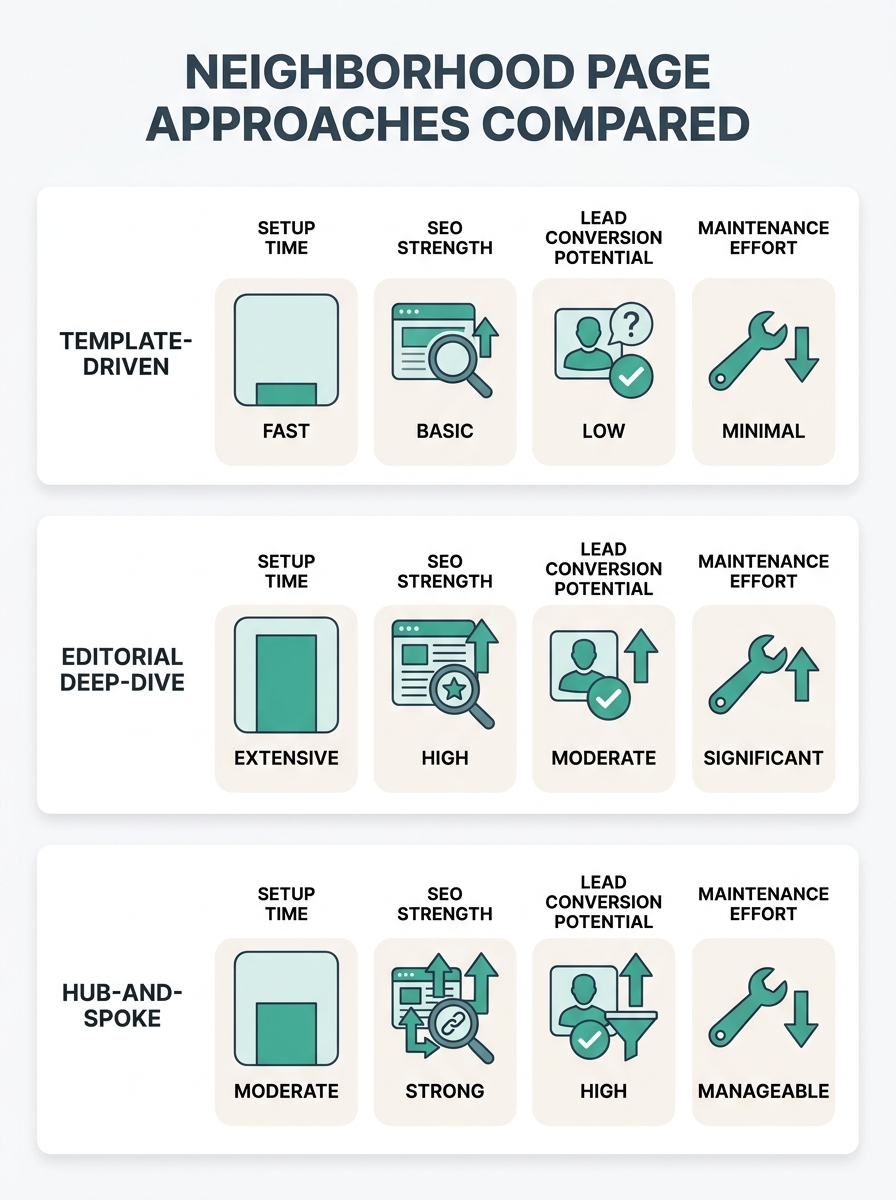
Where template pages work best: agents covering a massive territory (20+ neighborhoods) who need basic presence pages fast, with plans to upgrade their top-performing areas later. Where they fail: agents trying to own search results in three or four neighborhoods where competitors are publishing original content.
What template pages need to survive
If you go this route, add at minimum two to three original paragraphs per page. Write about what it actually feels like to live in that neighborhood. Mention the Saturday farmers market, the elementary school that runs a fall festival, the fact that the train platform gets crowded by 7:15 AM. That kind of specificity is what separates a page Google wants to rank from a page Google wants to ignore.
Editorial Deep-Dives Get the Best Rankings, at a Cost
The opposite end of the spectrum. You sit down and write 1,500 to 2,500 words about a single neighborhood, covering everything a relocating buyer would want to know. School ratings and boundary lines. Walkability and commute times to the nearest employment center. Restaurant recommendations. HOA quirks. The vibe on a Friday night versus a Tuesday morning.
This approach takes real work. A good editorial neighborhood page requires on-the-ground knowledge, a few hours of writing, and ongoing updates when school ratings change or a new development breaks ground. But the payoff in search performance is substantial, especially for competitive suburbs where multiple agents are trying to rank for the same terms.
The reason is straightforward: Google rewards pages that demonstrate experience and expertise. A 2,000-word guide to living in Montclair, NJ, written by someone who clearly knows the town, earns links from local Facebook groups, gets shared in relocation forums, and builds the kind of website architecture that drives lead quality over time.
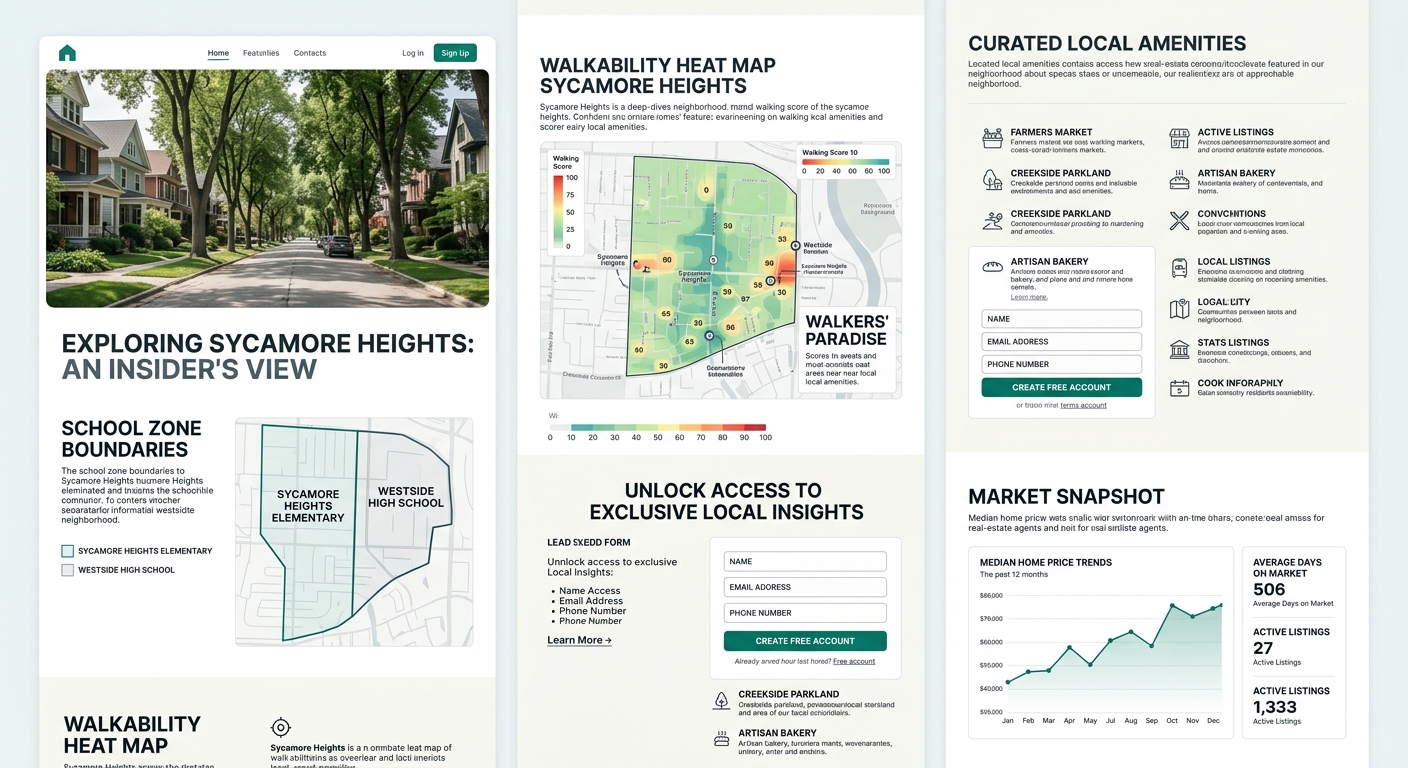
School district property pages deserve special attention here. Raleigh Realty’s research on schools and home values confirms what most agents already sense: buyers with children, buyers planning for children, and even investors looking for stable returns all factor school quality into purchase decisions. A page that maps school attendance zones, lists GreatSchools ratings, and explains the differences between elementary feeder patterns gives buyers information they can’t easily get from Zillow or Realtor.com.
The conversion angle
Editorial pages convert well because they attract visitors earlier in the buying process. Someone searching “best neighborhoods in [city] for families” or “what’s it like to live in [suburb]” is doing research, and research-stage visitors who find genuinely useful content remember the agent who provided it. Include a lead capture form mid-page, after the school section or the market snapshot, and you’ll collect emails from people who are months away from buying but already associating your name with local expertise. For guidance on where those forms should sit, the CTA placement principles we’ve covered before apply directly to neighborhood content.
Where editorial pages break down
Scale. If you serve 15 neighborhoods, that’s 15 pieces of original long-form content to write and maintain. Most solo agents don’t have the bandwidth for that. And if you write five great guides but never finish the other ten, the incomplete coverage can look worse than having no neighborhood section at all.
The Hub-and-Spoke Model Compounds Over Time
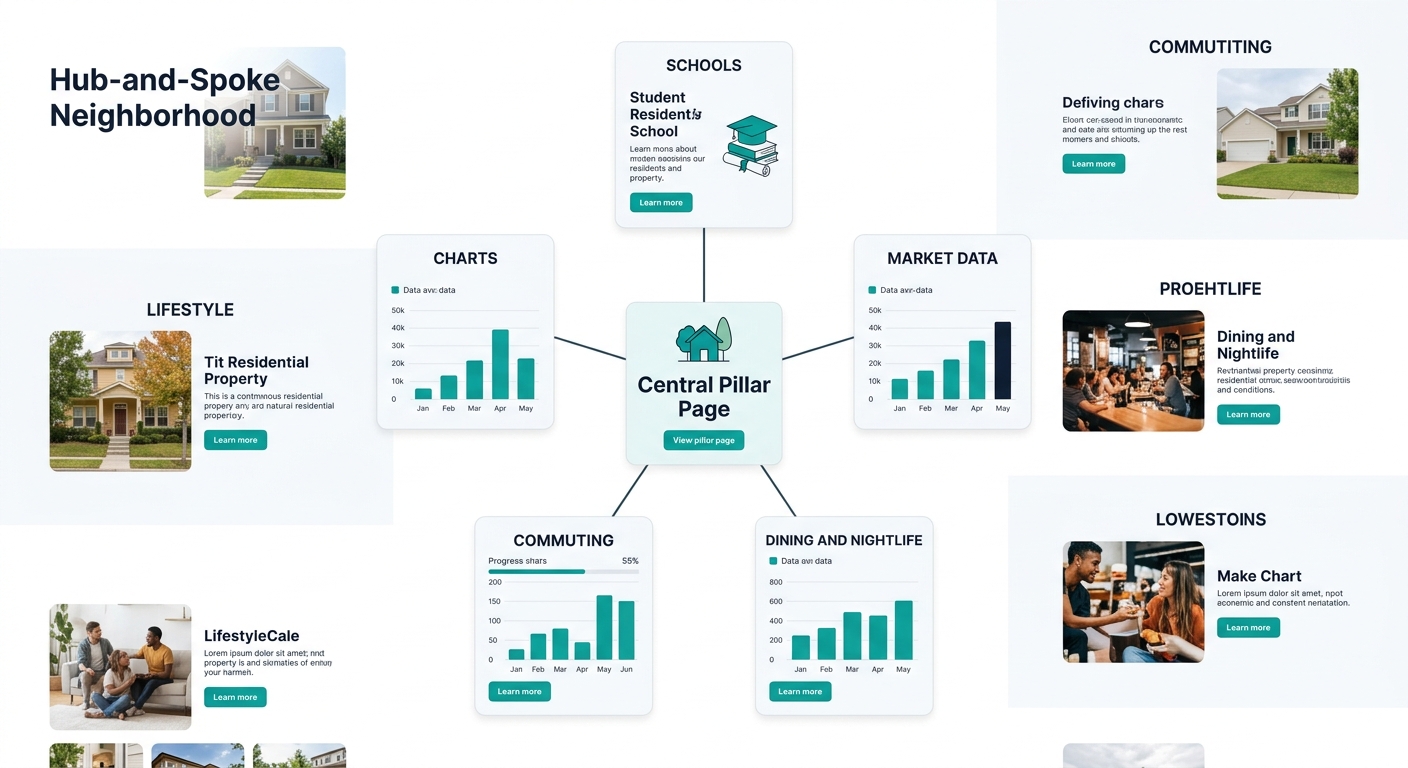
This is the approach that content strategists recommend and that most agents haven’t tried. Seer Interactive’s guide to content hub strategy explains the core logic: you create one pillar page for a neighborhood and then build satellite pages (spokes) that link back to it. The pillar covers the neighborhood broadly. Each spoke goes deep on one sub-topic.
For a neighborhood like Park Slope in Brooklyn, the structure might look like this:
- Pillar page: “Living in Park Slope: A Complete Guide” (1,200 words covering the basics)
- Spoke 1: “Park Slope School District: Ratings, Boundaries, and What Parents Say”
- Spoke 2: “Park Slope Real Estate Market: Prices, Trends, and What’s Actually Selling”
- Spoke 3: “Park Slope Restaurants and Nightlife: The Local’s List”
- Spoke 4: “Commuting from Park Slope: Transit Options, Drive Times, and Parking Reality”
Each spoke is its own page, targeting its own set of keywords. The pillar links to every spoke. Every spoke links back to the pillar. The internal linking creates a topical cluster that signals to Google: this site has authoritative coverage of Park Slope.
The SEO advantage is significant. Long-tail queries like “best schools in Park Slope Brooklyn” or “Park Slope commute to midtown” each get a dedicated landing page optimized for that intent. And because the spoke pages link to each other and to the pillar, the entire cluster strengthens together. This is exactly the kind of micro-content structure that builds ranking momentum for real estate websites trying to compete in local area overviews for lead generation.
A single 2,000-word neighborhood page competes for ten keyword phrases. A hub-and-spoke cluster with five spoke pages competes for fifty.
Building it without losing your mind
The hub-and-spoke model sounds like a massive project, but it doesn’t have to be built all at once. Start with one neighborhood. Write the pillar page first. Then add one spoke per week. In five weeks, you have a complete cluster. Repeat for your next priority neighborhood.
Each spoke page should run 600 to 1,000 words. That’s a Monday morning writing session, not a weekend-long ordeal. And because spoke content is tightly focused (just schools, just market data, just commute info), it’s easier to write than a page that tries to cover everything.
If you’re already investing in real estate SEO fundamentals, the hub-and-spoke model is where those fundamentals compound. Your individual spoke pages rank for specific queries, your pillar page accumulates authority from the internal links, and the whole cluster lifts as you add more content over the months.
The maintenance question
Hub-and-spoke does require more pages to keep current, but the updates are modular. School ratings changed? Update the school spoke. New condo development announced? Update the market spoke. You never have to rewrite the whole neighborhood guide from scratch, which makes long-term maintenance more predictable than the editorial approach.
Who Should Pick Which
Choose template-driven pages if you cover a very large geographic area, you’re just getting started with your website, and you need basic neighborhood presence quickly. Plan to upgrade your top three performing pages to editorial or hub-and-spoke format within six months.
Choose editorial deep-dives if you work two to four neighborhoods exclusively, you enjoy writing (or have a writer you trust), and you want the fastest path to ranking for competitive neighborhood search terms. Be honest with yourself about whether you’ll maintain the content quarterly, because outdated median prices and stale school ratings actively hurt your credibility.
Choose the hub-and-spoke model if you’re willing to invest in a longer-term content strategy, you want to capture long-tail keyword traffic across multiple search intents, and you’re thinking about your site as a local content platform rather than a digital business card. The upfront planning takes more thought, but the ongoing workload distributes more evenly.
Tip: Many successful agents combine approaches: hub-and-spoke for their core two neighborhoods, editorial pages for three or four secondary areas, and template pages for the rest of their coverage zone. That hybrid strategy gives you depth where it matters and breadth where you need basic visibility.
The common mistake is treating neighborhood pages as a one-time website build task. Whichever model you pick, the pages need fresh data, seasonal updates, and periodic rewrites as neighborhoods themselves evolve. The agents who win local search treat their neighborhood content the way they treat their CRM: as something that gets better with consistent, ongoing attention, and that falls apart the moment they stop showing up.