

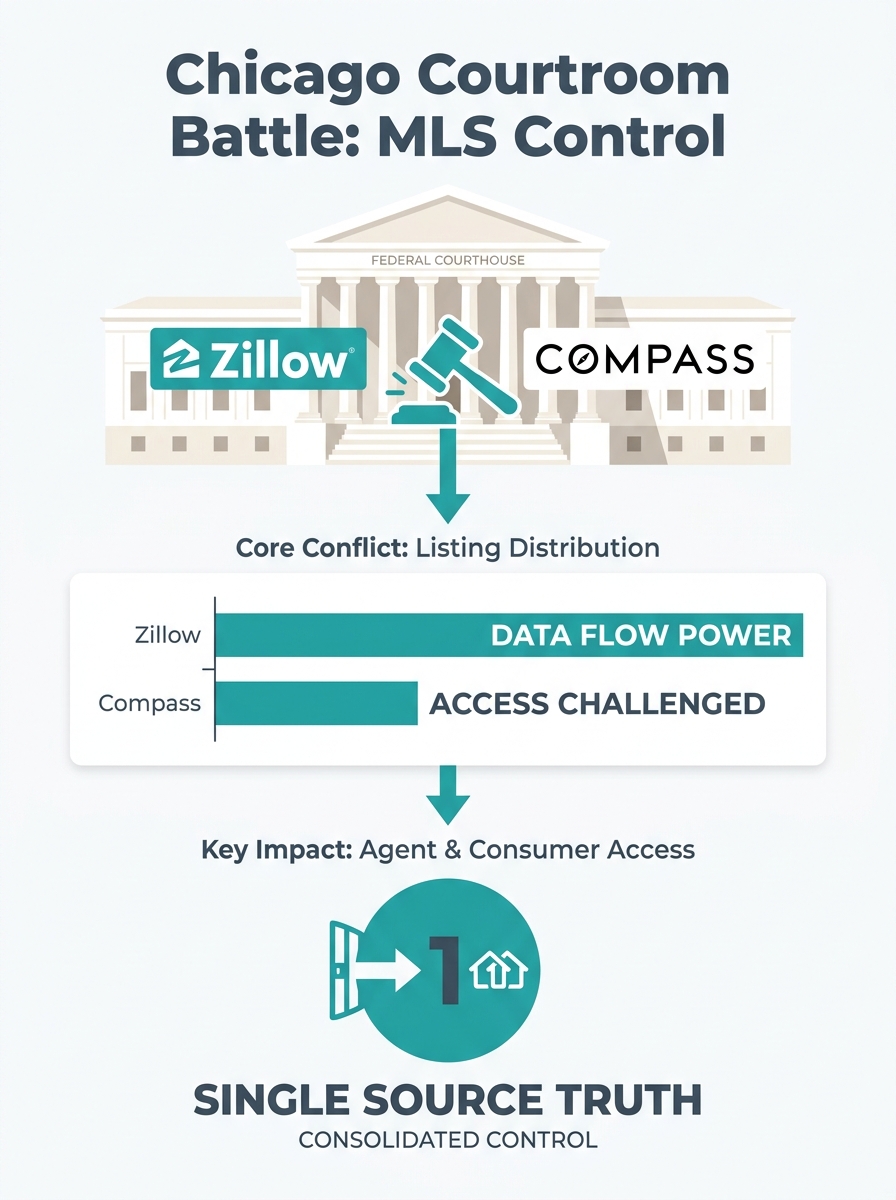
Federal Judge John J. Tharp Jr. heard two days of testimony July 3-4 in Zillow’s preliminary injunction case against Compass and Chicago’s Midwest Real Estate Data, with the dispute centering on who controls how residential listings flow from local MLS systems to national property portals, according to The Real Deal.
TL;DR: Zillow sued after Chicago MLS MRED severed its data feed May 20 over a dispute about Compass private exclusives, with testimony revealing accusations of monopolistic behavior and a claimed $1.6 billion revenue-uplift offer.
The Chicago courtroom clash followed MRED’s decision to cut Zillow’s listing feed on May 20, an action MRED CEO Rebecca Jensen defended from the witness stand as enforcement of “objective criteria” rules that restrict how brokerages filter listings. Jensen testified she serves as arbiter when brokerages dispute listing practices, while Zillow argued the blackout amounted to a coordinated group boycott designed to protect Compass private exclusive listings.
Competing Claims Over Private Listing Networks
Zillow’s Errol Samuelson testified that Compass’ practice of marketing homes through private channels before MLS submission traps inventory “behind a velvet rope,” restricting buyer access and agent competition. A Zillow spokesperson said the case tests “whether this playbook can become a national template for hiding homes that can be replicated in market after market,” warning it could end the open housing system that benefits buyers, sellers, and agents nationwide.
Compass CEO Robert Reffkin countered from the stand that Zillow runs a monopolistic operation, claiming the portal once offered Compass up to $1.6 billion in revenue uplifts to stop the brokerage from marketing properties outside Zillow’s platform. Reffkin accused Zillow of “weaponizing historical racial discrimination to protect its profits” rather than prioritizing consumer protections, though the filing provided no detail on what specific discrimination claim he referenced.
MLS Ecosystem Fractures Along Regional Lines
Testimony revealed Compass’ strategy to align regional MLSs into a national pro-seller-choice coalition. Reffkin called MRED “the best MLS in the country” on the stand, while Zillow attorneys presented written communications showing Reffkin criticized Maryland-based Bright MLS in a message to a Bright executive.
“I think Bright MLS is scared of being sued so they don’t want to enforce their own rule neutrally,” Reffkin wrote, according to courtroom exhibits. “The truth is you and Bright MLS and all the MLSes except MRED and Realtracs have completely sold us out.”
The mention of Tennessee-based Realtracs alongside MRED signals Compass is building alliances with MLSs willing to permit phased marketing strategies that delay full MLS syndication. Dueling economists presented conflicting analyses on whether private listing networks raise or lower final sale prices, with no consensus emerging from the two-day hearing.
Distribution Control Impacts Agent Lead Generation
The outcome will determine whether agents and brokers maintain control over when and how their listings appear on consumer-facing portals. Zillow’s position requires immediate syndication to national platforms, maximizing exposure but eliminating the staged marketing approach some luxury and high-end sellers prefer. Compass argues sellers should choose visibility timing, allowing agents to test private buyer networks before broad distribution.
For agents, the ruling affects lead generation strategy tied to listing visibility. If courts uphold MLS rules requiring immediate syndication, agents lose the ability to market pocket listings or exclusive previews as premium services. If Compass prevails, agents gain flexibility to offer tiered exposure, but risk reduced traffic from portals like Zillow that drive the majority of online buyer inquiries.
The case also tests whether local MLS organizations can enforce uniform distribution rules or whether brokerages can negotiate carve-outs market by market. MRED’s decision to sever Zillow’s feed demonstrated MLSs retain technical control over data flows, but Zillow’s legal challenge questions whether that control can be exercised to favor one brokerage’s business model over another’s.
The Takeaway
Judge Tharp’s ruling on the preliminary injunction will set the framework for how MLS systems, brokerages, and portals negotiate listing distribution nationwide. For agents focused on building online presence and visibility, the case directly impacts whether listings syndicate automatically to portals or remain under agent-controlled release schedules. The $1.6 billion figure Reffkin cited in testimony underscores the financial stakes portals attach to uninterrupted listing feeds, while MRED’s May 20 blackout proved MLSs can disrupt that access when they deem brokerage practices non-compliant.
Agents and brokers should monitor the ruling for clarity on whether phased marketing strategies remain viable or whether MLS participation mandates immediate portal syndication. The fracturing MLS ecosystem Reffkin described, with MRED and Realtracs willing to permit delayed distribution while Bright MLS enforces immediate syndication, suggests listing visibility rules will vary by region unless the court establishes a binding standard. A decision favoring Zillow would centralize control with portals; a decision favoring Compass and MRED would decentralize distribution, returning use to local MLS boards and individual brokerages.