

Predictive analytics platforms are replacing geographic farming and broad demographic outreach in real estate prospecting, according to a strategic analysis published June 1 by digital marketing strategist Steven Pulcinella on International Business Times. The shift centers on software that assigns probability scores to homeowners based on behavioral signals rather than zip codes, with early testing across more than 20,000 households showing stronger engagement rates among high-intent audiences compared to traditional targeting methods.
TL;DR: Predictive intent intelligence—software that estimates which homeowners are likely to list within 90 to 180 days—is gaining adoption as tight inventory and rising marketing costs push agents away from mass-reach campaigns toward precision targeting based on behavioral probability.
Why Broad-Reach Campaigns Are Losing Ground
Agents have historically relied on geographic farming, demographic lists, and door-knocking campaigns built around the assumption that effort and scale compensate for inefficiency, Pulcinella wrote. Those methods worked in markets where broad exposure could offset low conversion rates, but rising marketing costs and tighter housing inventory entering 2026 have eroded the economics of mass outreach.
“Agents today have more access to technology than at any point in the business, yet we’ve optimized for reach at the complete expense of precision,” Pulcinella stated in the analysis. The gap between who lives in a target area and who is actually preparing to move creates most of the wasted spend in traditional prospecting.
The shift toward predictive intelligence reflects a question change: instead of asking “Who lives here?” platforms now ask “Who is likely to move soon, and when?” according to the piece. An agent who reaches a homeowner six months before a listing decision holds a different competitive advantage than one sending quarterly mailers to an entire subdivision, Pulcinella noted.
How Predictive Scoring Works in Practice
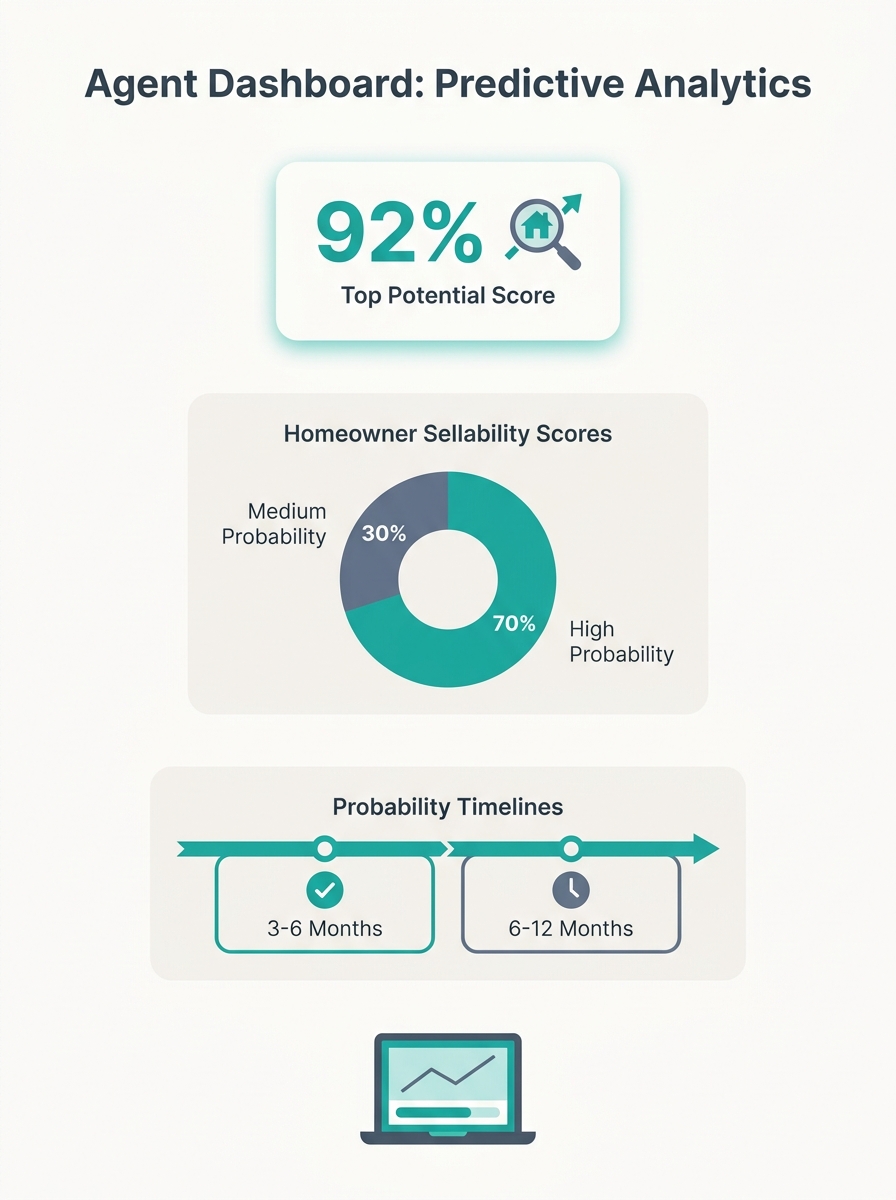
Listing Lens AI™ assigns Sellability Scores to single-family homes by evaluating property and behavioral datasets to estimate listing probability within 90 to 180 days, according to the analysis. The platform does not declare who will definitely sell but instead estimates probability based on patterns invisible to traditional prospecting methods.
Testing conducted across more than 20,000 households demonstrated higher engagement rates and listing likelihood among homeowners identified through predictive scoring compared with broader demographic targeting, the analysis stated. Pulcinella did not disclose specific percentage lifts or the testing timeline.
The distinction between predicting who is selling versus who is most likely to sell next represents the directional change for the business, according to the piece. Agents no longer need to market indiscriminately if software can narrow attention toward homeowners displaying statistical likelihood of movement.
Probability scoring changes marketing economics by shifting from broad exposure to precision, Pulcinella wrote. When targeting narrows to high-intent audiences, budgets stretch further and generic outreach transforms into relevant connections, producing higher conversion efficiency without repetitive prospecting cycles.
The Competitive Divide Between Persistence and Foresight
Many agents still operate with models built around persistence alone, but data intelligence increasingly determines whether persistence produces outcomes, according to Pulcinella. Agents using predictive systems gain earlier insight into potential inventory movement while competitors chase the same generalized audiences, the analysis stated.
Real estate has historically rewarded hustle, but the next decade may reward foresight even more, Pulcinella wrote. The transition mirrors what happened in finance (probability modeling for risk exposure), streaming platforms (predictive systems for viewer behavior), and retail (purchasing pattern forecasting before transactions occur).
The gap between agents relying on familiar demographic campaigns and those building workflows around intent forecasting may widen quickly as predictive systems improve, according to the analysis. Pulcinella, who has spent over 15 years in digital marketing, framed the shift as structural rather than tactical: timing has become more valuable than targeting in listing acquisition.
Agents fatigued by high-volume, low-conversion marketing cycles may find traction in approaches that prioritize lead qualification workflows built on behavioral signals rather than geographic proximity. The strategic question shifts from how many homeowners an agent can contact to how accurately an agent can identify which homeowners are actively preparing to move.
What Happens Next
Predictive intelligence platforms will likely face scrutiny around data privacy, algorithmic transparency, and fair housing compliance as adoption scales across brokerage workflows. The analysis does not address regulatory or ethical guardrails for behavioral scoring systems targeting homeowners based on activity patterns.
Agents evaluating predictive tools should test engagement rates and listing conversion against control groups using traditional prospecting methods before committing budget to probability-based platforms. The 20,000-household testing referenced in the analysis provides directional evidence but lacks disclosed methodology or independent verification.
The shift from mass reach to precision intent mirrors broader efficiency pressures across real estate marketing channels, where most tactics deliver zero measurable leads. Agents who integrate predictive scoring into listing prospecting workflows while maintaining relationship-building fundamentals may gain timing advantages competitors cannot easily replicate through effort alone.