
Thirteen of the twenty-one marketing channels used by working real estate agents deliver zero leads to more than 70% of the agents using them in a typical month, according to the 2026 State of Real Estate Marketing Report released May 28 by Knwn Local. The finding comes from a survey of 462 working agents conducted between May 7 and May 20, 2026.
TL;DR: A new survey of 462 agents found that most paid digital channels—including TikTok, LinkedIn, and YouTube—delivered zero leads to 80%+ of users, though agents who pay for portal leads rate them 10× higher than free users.
The report, sponsored by Beacon and Listing Leads, examined AI adoption, content creation, listing generation, and 2026 marketing budget plans across agents currently working in the field.
Channel-by-Channel Performance
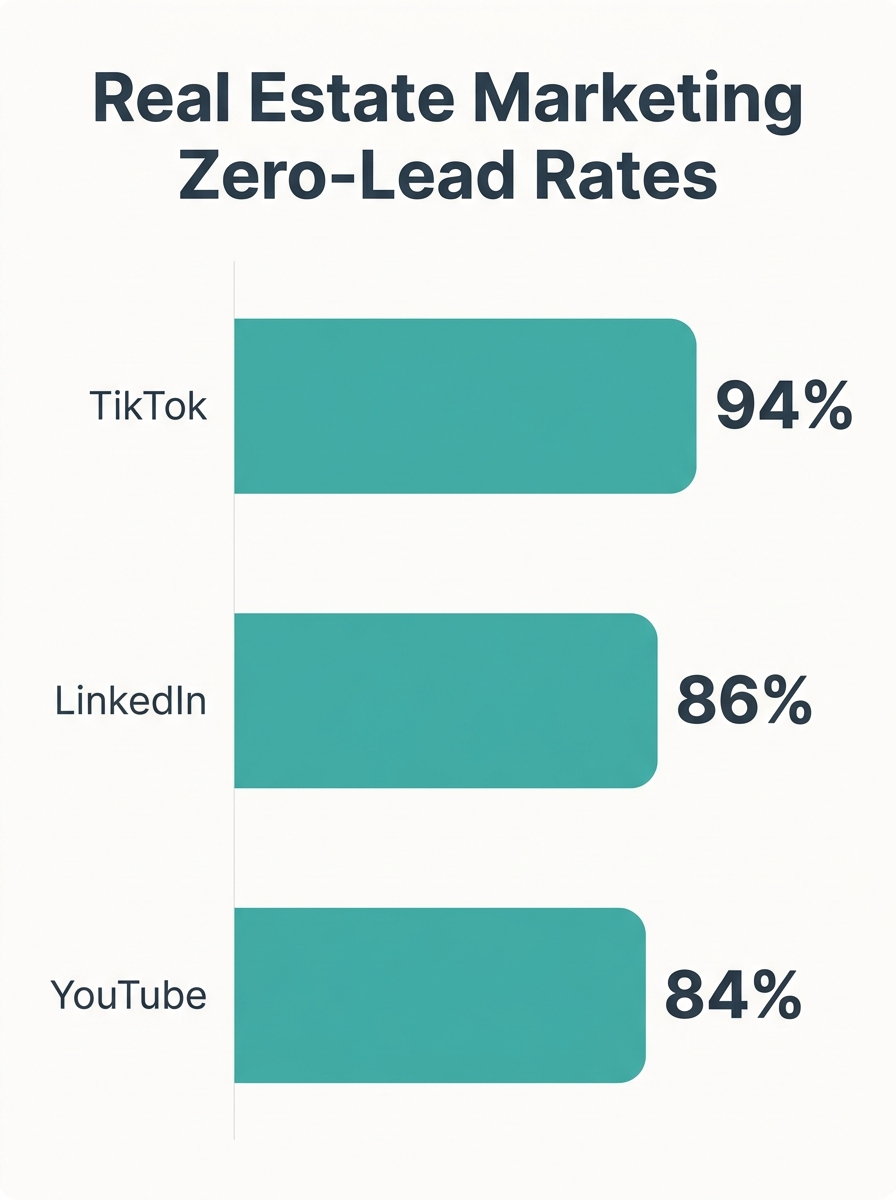
Across paid digital and portal channels, the average zero-lead rate reached 82%, according to the survey. TikTok delivered zero leads to 94% of agents using it. LinkedIn delivered zero leads to 86% of users, while YouTube delivered zero leads to 84%. Both major real estate portals delivered zero leads to roughly 80% of their users.
“The industry has spent twenty years being told that lead generation is a numbers game, that the right mix of paid channels will produce a pipeline if you just spend enough,” said Chris Smith, co-founder of Knwn Local, in the report. “The data says, for most agents on most channels, the number is zero. Not low. Zero.”
The findings challenge the conventional wisdom that diversification across multiple marketing channels improves lead flow for individual agents, a strategy many real estate marketing performance audits recommend.
The Zillow Spending Paradox
The report documents a sharp reversal of one of the industry’s loudest narratives. Agents who pay for Zillow rate their leads good or excellent at 31%, compared with 3% among free users—a 10× separation. Direct mail showed the same pattern at a 7× difference between paying customers and non-payers.
“The ‘X is broken’ narratives in real estate are almost always told by people who don’t pay for X,” said Jimmy Mackin, co-founder of Beacon and Listing Leads, in the report. “When you segment by who’s actually a customer, the failure narratives collapse.”
The finding suggests that channel quality assessments based on non-paying users may systematically underreport performance, according to the survey data. For agents evaluating whether to cut or expand portal spending in 2026, the data shows Zillow and Realtor.com are the only channels where more agents plan to reduce budgets than increase them.
AI Adoption and Content Strategy
Sixty-three percent of agents use AI tools every day, with 32% reporting they save six or more hours per week, according to the survey. Eighty-six percent of all AI tasks are text-based.
Content creation compounds over time in a measurable way. Agents with four or more years of consistent creation and five or more short-form posts per month report content driving “a lot of deals” at 9× the rate of agents with neither trait—the largest single effect in the dataset. That finding aligns with evidence that reviving old leads through sustained content outperforms new acquisition for many agents.
Sixty percent of agents either do not track listing sources or estimate less than 10% of their listings come from content, the survey found. The attribution gap means most agents cannot connect specific marketing activities to closed transactions.
Budget priorities for 2026 reflect these adoption patterns. AI tools, YouTube, short-form video, and email received the most “invest more” votes. TikTok’s 94% zero-lead rate has not yet translated into widespread budget cuts, according to the data.
Brokerage-Level Differences
Compass agents turn content into deals at 2.4× the rate of Keller Williams agents, according to the survey. Keller Williams agents return the advantage on Google Ads leads, converting at 3.1× the Compass rate, and on transaction volume, producing 31 or more transactions at 2.1× the Compass rate.
The brokerage-level differences suggest that training, culture, and lead distribution infrastructure affect channel performance independent of the channels themselves, according to the report.
Context and Outlook
For agents allocating marketing budgets in the second half of 2026, the survey data suggests that most channels—especially organic social platforms—do not generate leads for most users. The exceptions are channels where agents pay for placement and commit to sustained use over multiple years.
The 10× paid-versus-free difference on Zillow and the 9× content-compounding effect both point to a single pattern: agents who invest resources consistently in a channel outperform those who use free tools sporadically. The zero-lead phenomenon may reflect underfunded experimentation more than channel failure.
The report is available as a free download at 2026realestatemarketing.com. The survey did not publish a margin of error or sampling methodology beyond the May 7-20 fieldwork window and the 462-agent sample size.