

Real estate agents and brokerages evaluating AI software should measure time savings from task start to final output rather than accepting vendor demo speeds, according to a buyer’s guide framework published August 7 by HousingWire that addresses hidden costs and workflow integration failures common in AI adoption.
TL;DR: Real estate professionals should evaluate AI tools by measuring full-task completion time—including editing, fact-checking, and system transfers—rather than accepting vendor demo speeds, with total cost of ownership and workflow integration emerging as key decision factors.
The framework arrives as AI adoption among real estate brokerages reached 98.1% in 2026, shifting buyer priorities from early-stage curiosity to operational reliability and measurable return on investment. The guide draws on a March 2025 survey of 332 AI infrastructure decision-makers conducted by MetaLab for Crusoe’s 2026 AI Infrastructure Trends Report, identifying concerns that parallel real estate technology adoption challenges.
Survey Findings on AI Infrastructure Priorities
Operational efficiency drove AI investment decisions for 69% of the 332 executives, decision-makers, and technical practitioners surveyed across multiple industries in March 2025, according to the Crusoe report. Integration ease with existing infrastructure rated as important to 97% of respondents, while common implementation obstacles included security and compliance concerns, performance issues, scaling difficulties, unpredictable costs, and inadequate vendor support.
The survey was not conducted specifically among real estate professionals, HousingWire noted, but the underlying concerns—cost predictability, system compatibility, and vendor reliability—mirror obstacles agents and brokerages encounter when adding AI tools to existing CRM, MLS, and marketing workflows. Security and compliance concerns carry particular weight in real estate, where client financial information and property data trigger regulatory and MLS data-use requirements.
Full-Task Measurement Framework
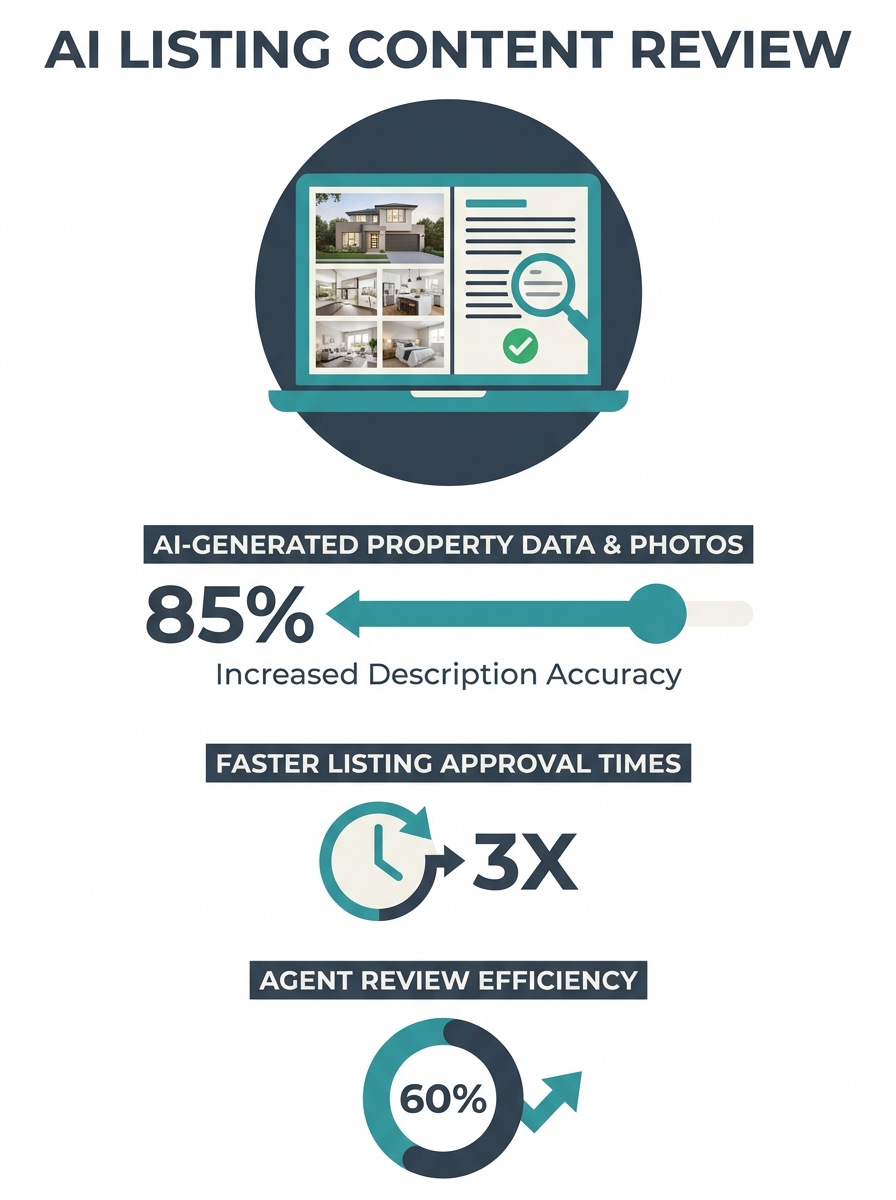
A listing-description generator may produce draft copy in seconds, but agents typically spend 20 additional minutes correcting property details, smoothing language, verifying facts, checking fair housing compliance, formatting output, and transferring content into MLS or marketing systems, according to the HousingWire analysis. The guide recommends measuring time from opening the AI tool through final deployment—after editing, fact-checking, formatting, and transfer into working systems.
The framework distinguishes between tools that eliminate work and tools that shift labor from content creation to cleanup and verification. Agents adopting AI tools report needing to define their marketing voice before automating content, a step that prevents generic output requiring extensive revision. An AI video tool that generates a polished listing reel in three minutes delivers no time savings if the agent spends 30 minutes correcting property misrepresentations or re-rendering after identifying errors.
Output volume does not equal business improvement, the guide notes. Additional social media posts do not guarantee conversations with prospects; higher lead counts offer no advantage if data quality is poor; automated follow-up sequences can damage relationships when timing or tone feels impersonal.
Total Cost of Ownership Beyond Monthly Fees
Advertised monthly subscription fees rarely reflect the full cost of AI tool ownership, according to the HousingWire framework. Credits deplete faster than initial estimates; contact lists outgrow entry-level pricing tiers; per-message charges for text-based follow-up accumulate; premium integrations and export limits can double or triple effective monthly costs once regular use pushes accounts into higher-priced plans.
Tool overlap represents hidden expense when AI subscriptions duplicate functionality already available in existing CRM packages, brokerage-provided platforms, or marketing tools. A low-cost AI subscription wastes money if it becomes an unused login; an expensive tool may deliver better value if it replaces multiple subscriptions and integrates into daily workflows. Website builders and marketing platforms carry similar hidden costs beyond monthly pricing when calculating true lead acquisition expense.
The National Association of REALTORS® published AI policy recommendations in March 2026 through REALTOR® News, advising brokerages to document which tools receive approval, how client and financial data is handled, and who reviews AI-generated material before publication, HousingWire reported. The article does not constitute formal NAR guidance or regulatory requirement but reflects industry movement toward standardized AI governance frameworks.
Integration and Support Requirements
Most agents already manage more software logins than they prefer, making workflow integration a higher priority than feature count when evaluating new AI tools. Effective integration means the product connects with existing CRM databases, calendar systems, listing workflows, and marketing platforms without manual data copying, duplicate entries, or hunting across multiple browser tabs for work-in-progress.
Products requiring manual handoffs between systems rearrange workload rather than reduce it, the guide notes. A tool that generates follow-up email drafts delivers minimal value if the agent must manually copy each message into the CRM send function, log the interaction, and update the contact record separately.
Vendor support quality becomes critical when AI tools integrate into live client workflows. During free trials, support responsiveness is easy to ignore because no revenue or client relationships depend on the software. That changes when a lead-routing failure drops a $800,000 buyer inquiry, when an automated campaign sends the wrong message to a seller client, or when a listing video tool fails to deliver promised output before a scheduled open house.
The framework recommends testing vendor support during trial periods by submitting a real technical question, noting response time, evaluating whether the answer solves the problem, and confirming whether a person can be reached when urgent issues arise. Software should not become business-critical unless the vendor can support it during high-stakes situations, according to the guide.
Agents should verify property facts, review advertising language, protect client and financial information, and follow brokerage policies, MLS rules, and disclosure requirements before publishing AI-generated content, HousingWire noted. Nothing should move from AI tool to public distribution without human review—a basic safeguard requiring approval steps, access permissions, and audit trails showing what was generated or altered and who performed final review.
Context and Outlook
The evaluation framework reflects an AI adoption maturity shift across real estate, from experimental “faster is better” enthusiasm to rigorous cost-benefit analysis grounded in workflow reality. As 98% of brokerages now deploy AI tools, competitive advantage flows to agents and teams that select software solving specific operational bottlenecks rather than accumulating subscriptions for features that sound useful in demos but remain unused in daily practice.
The framework’s emphasis on full-task measurement and total cost of ownership parallels broader ROI calculation methodologies for real estate technology, where monthly subscription fees represent only a fraction of true lead acquisition or time-savings costs. For agents and brokerages building their first property websites or expanding technology stacks, measuring AI tool performance from task start to final deployable output prevents adoption decisions based on incomplete vendor demonstrations that omit editing, verification, and integration labor.
Industry movement toward written AI policies—even through informal guidance rather than regulatory mandate—signals recognition that speed without accuracy, compliance, and brand consistency creates more operational risk than competitive advantage in client-facing real estate work.