

Mile High Title Guy blog published a guide revealing most real estate agents already subscribe to AI platforms with agentic capabilities—tools that complete multi-step tasks like CRM organization and listing preparation—but remain unaware the features exist beyond basic chatbot functions, according to the August 14 post.
TL;DR: Real estate professionals pay for AI subscriptions that can execute multi-step workflows including contact organization, data entry, and research preparation, but most agents use only the basic chatbot response features.
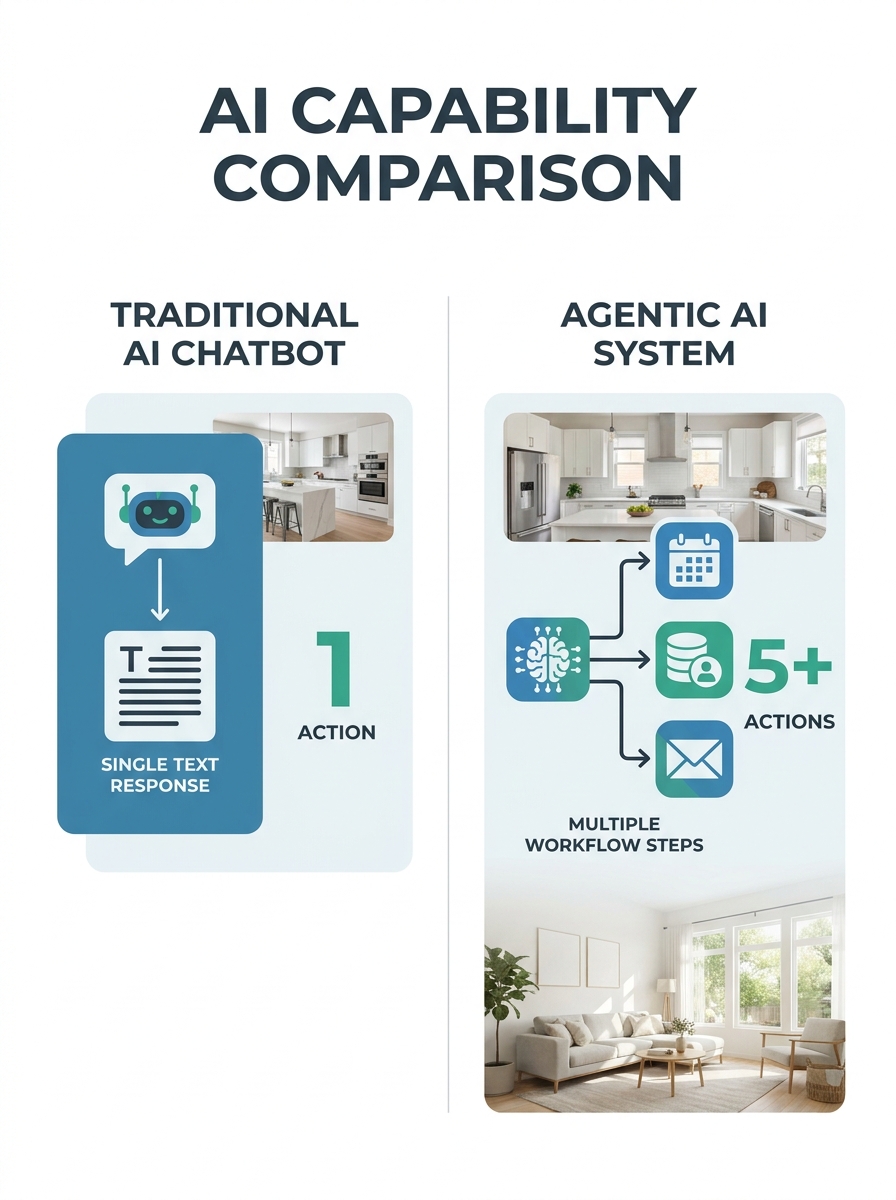
The distinction centers on task completion rather than response generation. Traditional generative AI accepts a prompt and returns text—a listing description, email template, or social media caption. Agentic AI can navigate browsers, enter information across systems, organize data files, and prepare finished deliverables for agent review, the post explains.
The author, who began testing agentic AI approximately one year ago after hearing Jason Pantana discuss the technology at a Tom Ferry conference, reports spending significant time teaching agents about capabilities already embedded in their paid subscriptions. “What continues to surprise me is how few real estate professionals realize that they may already have access to agentic capabilities through an AI subscription they are currently paying for,” the post states.
What Distinguishes Agentic AI From Traditional Chatbots
Traditional chatbots produce instructions or content drafts but leave execution to the user. An agent might ask ChatGPT to write a follow-up email for an open house visitor or create a neighborhood market research checklist, then manually complete those tasks using the AI-generated guidance.
Agentic AI platforms execute the subsequent steps when granted appropriate permissions. Instead of explaining how to organize a contact spreadsheet, an agent can provide file access and instruct the AI to review information, identify incomplete or duplicated records, sort contacts into categories, create a summary, and prepare a follow-up list for approval, according to the guide.
Capabilities vary by platform, subscription tier, and security settings. Some AI agents operate inside internet browsers, others through desktop applications or approved connections to business software. The common characteristic is multi-step action toward a defined goal rather than single-response text generation.
The post compares outcomes directly: a traditional chatbot writes an email template; an AI agent can review a contact list, identify the appropriate segment, personalize draft messages, and prepare them for approval. A traditional chatbot explains how to clean a database; an AI agent can review the file, standardize fields, flag duplicates, and return an organized version.
Most Agents Already Have Access Through Existing Subscriptions
The guide emphasizes that access to agentic capabilities does not necessarily require new software purchases. Many AI platforms agents currently subscribe to include these features, though adoption remains limited because users learned the tools as text-generation chatbots and never explored expanded functionality.
Real estate agents spend disproportionate time on administrative tasks surrounding client-facing work—following up with leads, updating sellers, researching market activity, organizing contacts, coordinating events, entering information into multiple systems, and maintaining database accuracy. “Real estate agents do not usually struggle because they lack ideas. They struggle because there are only so many hours in the day,” the post states.
Agentic AI targets the steps surrounding high-value human activities: building relationships, earning trust, advising clients, negotiating, solving complicated problems, understanding emotion and motivation, providing local market context, and creating memorable client experiences. The technology cannot replace those responsibilities but can reduce time spent on copying information, formatting reports, sorting files, and preparing drafts, according to the analysis.
The guide cautions that oversight remains essential. Agents still provide the objective, context, boundaries, and final judgment while the AI handles execution. The workflow succeeds when agents clearly understand the task, can easily review output quality, and apply the automation to frequently repeated processes.
Practical Applications in Real Estate Workflows
The post recommends starting with tasks agents repeat frequently, understand thoroughly, and can review efficiently rather than attempting complex or unfamiliar workflows. Specific applications mentioned include contact list organization, listing preparation research, market data compilation, database cleanup with duplicate flagging and field standardization, and draft content personalization for approved audience segments.
Each application requires the agent to define clear parameters, grant appropriate system access, and review output before client-facing use. The technology performs best on structured, repeatable processes where quality standards are explicit and verification is straightforward.
Real estate professionals seeking to automate lead-generation and client service workflows face similar implementation questions around which tasks to automate first and how to maintain quality control. The agentic AI framework adds execution capability to planning and content-generation functions agents may already use.
Industry observers tracking how agents evaluate AI tool performance note a shift from demo speed to full-task completion measurement, aligning with the agentic model’s emphasis on delivered results rather than generated suggestions.
Why This Matters Now
Real estate agents face persistent time-scarcity problems that prevent consistent follow-up, relationship maintenance, and marketing execution despite understanding what actions drive results. The revelation that many agents already pay for task-completion AI capabilities they haven’t activated represents immediately accessible efficiency gains requiring training rather than budget allocation.
The accessibility gap matters because agents competing for listings and buyer relationships increasingly need differentiation through responsiveness and thoroughness. Reducing hours spent on data entry, contact organization, and preparation work directly expands capacity for client communication and in-person service. Agents who build a free property website or implement other lead-generation systems benefit most when administrative automation creates time to actually work the leads those systems generate.
The practical implementation barrier is educational rather than technical. Agents don’t need to wait for new software releases or platform integrations—the tools exist inside subscriptions many already maintain. The requirement is learning which features enable multi-step task execution, defining appropriate use cases with clear quality standards, and establishing review protocols before client-facing deployment. Training investment replaces software budget as the limiting factor for adoption.