

Google’s first organic search result now appears approximately 635 pixels below the top of desktop search pages—effectively mid-screen on standard laptop displays—while becoming completely invisible on mobile devices in nearly two-thirds of searches, according to research presented May 30 by Tom Capper, an expert at a rank-tracking firm, in a webinar documented by RSWebSols.
TL;DR: Google’s number-one organic ranking no longer guarantees above-fold visibility: AI Overviews and paid ads now occupy up to 60% of the visible screen space on commercial searches, pushing top organic results well below the fold on both desktop and mobile devices.
The shift marks a fundamental change in how search visibility translates to actual user attention, with direct implications for real estate agents competing in commercial-intent searches like “homes for sale in [city]” or “Realtors near me.” Only 57% of top-ranked organic results remain visible above the fold on desktop devices, while that figure drops to roughly 40% on smartphones, the research shows.
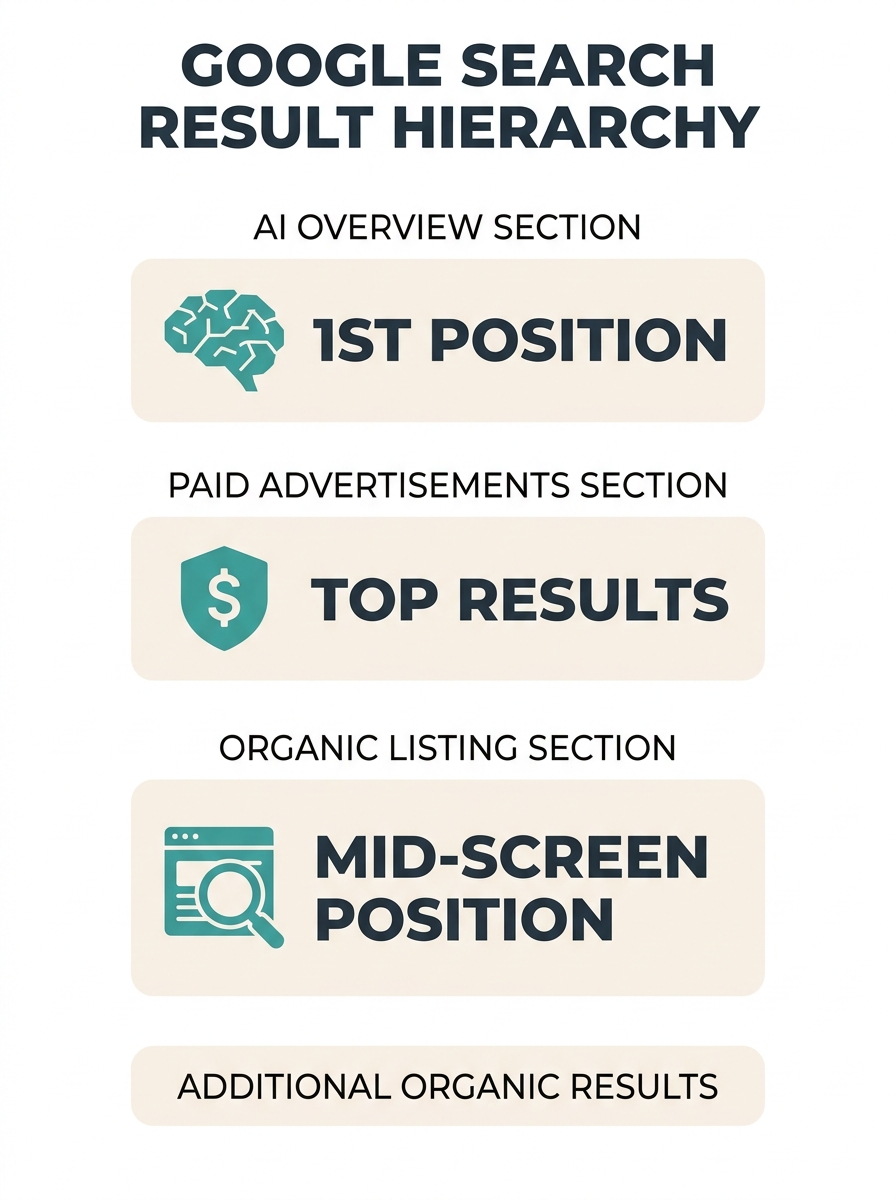
AI Overviews and Shopping Ads Claim Majority of Screen Space
On informational searches, AI Overviews consume nearly one-third of the above-fold visual area, Capper reported. When combined with Knowledge Graph panels, that figure climbs to approximately 41%—meaning two-fifths of what users see before scrolling consists of Google-generated content rather than traditional organic listings.
Commercial search results show an even more dramatic displacement. Paid ads and shopping placements occupy over 60% of visible screen real estate, with Popular Products sections exceeding two-thirds of the view in certain product categories. Organic results account for just 16% of above-fold space on commercial SERPs, according to the presentation.
“In nearly two-thirds of instances, the top organic result is completely invisible, seldom even appearing in the initial text line on a standard smartphone,” Capper said during the webinar. Position two on mobile devices frequently falls entirely below the fold, requiring users to scroll through approximately five full screens to reach the tenth organic result.
The displacement affects real estate agents’ website performance strategies in measurable ways: ranking first no longer guarantees the lead-generation visibility that agents historically expected from top search positions.
Visual Size Now Outweighs Rank Position
Capper recommended that digital marketers shift focus from keyword rankings to evaluating search visibility by pixel height—the actual screen space a listing occupies. A standard organic result consumes approximately 120 pixels of vertical height, while listings enriched with images, prices, and ratings (IPR) expand to about 240 pixels, effectively doubling their visual impact and user attention.
The visual-size advantage explains why some third-position listings with rich snippets generate more click-through than bare first-position results, Capper noted. In one example cited during the webinar, a visually comprehensive Brex Flowers listing dwarfed a simple Trustpilot link positioned above it, despite the Trustpilot result holding a higher numerical rank.
For real estate agents managing local SEO migration projects or optimizing listing pages, the implication is clear: structured data markup that produces rich snippets (review stars, listing prices, availability) delivers measurable visibility gains that rank position alone cannot capture.
Brand Search Volume Emerges as Ranking Signal
Capper revisited analysis first presented nine years ago showing that branded search volume predicts organic rankings more effectively than traditional Domain Authority metrics. A 2026 update to that research confirms the brand signal has only intensified, with stronger correlation to ranking performance than link-based authority measures.
“Branding is becoming an ever more potent predictor of your ranking,” Capper stated. The dynamic creates a reinforcement loop: heightened SERP visibility builds brand recognition, which increases branded searches (such as “[Agent Name] + [City]”), which improves rankings, which further boosts visibility.
Real estate agents who treat SEO purely as a lead-generation channel may miss this second-order effect. Search visibility functions simultaneously as a brand-awareness channel, with impressions—not just clicks—contributing to long-term positioning in local markets. The insight aligns with broader marketing performance benchmarks showing that agents who track impression volume alongside conversion metrics identify ranking opportunities competitors overlook.
The Takeaway
Real estate agents relying on organic search for lead generation face a visibility crisis that ranking reports won’t reveal. When the top organic result sits 635 pixels down the page—below AI-generated summaries and competitor ads—a number-one ranking no longer guarantees above-fold placement or meaningful traffic. Agents need to shift measurement from “Are we ranking?” to “How much screen space do we occupy?”
The practical response involves three adjustments. First, implement structured data markup on listing pages to capture rich-snippet features (star ratings, price displays, availability badges) that double pixel height. Second, track branded search volume as a leading indicator of organic performance—agents whose names generate search volume see compounding ranking benefits over time. Third, reframe SEO as a dual-purpose channel: it generates leads through clicks but also builds brand awareness through impressions, even when users don’t scroll to the organic section.
Agents who continue optimizing for rank position while ignoring actual visibility will watch competitors with richer snippets and stronger brand signals capture attention from the same SERP real estate—regardless of who technically ranks first.