

Industry leaders are questioning whether to eliminate IDX, the Internet Data Exchange system that allows brokers to display each other’s MLS listings on their own websites, according to HousingWire. Removing IDX would end broker-to-broker listing sharing while leaving portal syndication to Zillow and Realtor.com intact, fundamentally reshaping where buyers begin property searches.
TL;DR: Brokerage leaders are debating whether to shut down IDX, the system that lets brokers share MLS listings across their websites, a change that would force buyers toward portals and advantage the largest brokerages.
The timing reflects Compass International Holdings’ position as the world’s largest brokerage following its January 2026 acquisition of Anywhere Real Estate, which gave the company roughly 340,000 agents. At that scale, sharing inventory across competitor websites conflicts with keeping listings inside a single network where the brokerage controls buyer leads and data.
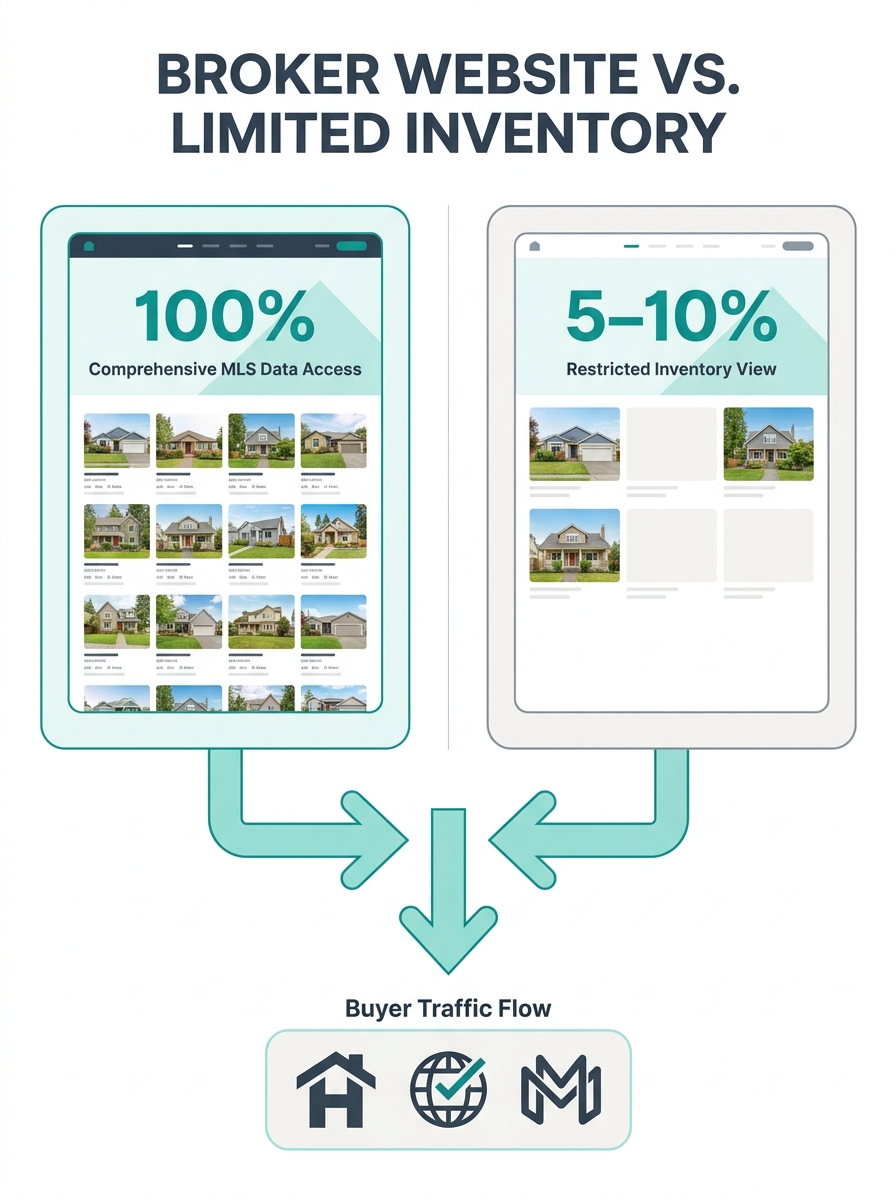
What IDX Controls
IDX is a permission-based system that allows every participating broker to display the full MLS inventory on their own website. Brokers agree to show competitors’ listings in exchange for their own listings appearing on other brokers’ sites, transforming the MLS from a back-office database into broad public reach distributed across thousands of agent and broker websites.
The system operates separately from portal syndication feeds. Listings sent to Zillow, Realtor.com, and Redfin run on different agreements, meaning the industry could theoretically disable broker-to-broker sharing while maintaining portal distribution. That technical distinction makes the debate structurally feasible even as it raises strategic questions about market control.
Why Scale Changes the Equation
When a single company reaches 340,000 agents and controls a substantial inventory share, the calculus of sharing shifts. Compass has built its growth around listings that begin as Private Exclusives or Coming Soon properties inside its own network before reaching the broader MLS, if they reach it at all.
“Why distribute your inventory to every competitor’s website when you can keep it inside your own walls, where you control the buyer, the lead and the data the listing generates?” the HousingWire analysis noted. The question frames data ownership rather than website functionality as the core issue.
For independent and mid-size brokerages that compete today on equal footing because IDX lets them display the same inventory as national brands, ending the system would eliminate that parity overnight. The sites worth visiting would become those owned by companies with the most listings.
Three Market Shifts From Removing IDX
Eliminating broker-to-broker sharing would redirect buyers toward portals, according to the analysis. A consumer seeking to view the full market would no longer find it on the average broker or agent site and would instead need to visit a portal that still displays complete inventory. The industry would be shrinking its own reach while strengthening the platforms it has spent years attempting to compete against, as detailed in related coverage of portal control disputes.
Seller exposure would contract to whoever visits a single brokerage’s site. Zillow’s analysis of millions of transactions found homes given full market exposure sold for 1.5% to 3.7% more than privately marketed properties, with the higher percentage concentrated in markets including California and New York. The mechanism is competition, fewer buyers seeing a home means less bidding pressure.
The largest brokerages and portals would benefit, while independent brokers, sellers seeking wide audiences, and the shared MLS marketplace would lose ground. “That is worth sitting with, because it mirrors the broader dynamic in today’s market,” the report stated. “In the contest between the biggest brokerages and the portals over who controls listing data, nearly every outcome leaves the traditional MLS as the casualty.”
What This Means for Estate Agents
Agents whose lead generation strategies rely on displaying full MLS inventory on their own websites face potential disruption if IDX disappears. The ability to show buyers every available property on an agent-controlled platform, rather than directing them to portals where competing agents also appear, would evaporate unless that agent works for a brokerage holding substantial local inventory.
Independent agents and those at smaller brokerages would need to recalculate their digital marketing mix. If broker sites can no longer compete on inventory completeness, investment in SEO, content, and site architecture designed to capture buyers through comprehensive property search becomes less defensible. The traffic and leads would shift toward portals and the largest brokerage networks, forcing agents to either join those networks or accept diminished online reach.
Seller conversations would also shift. An agent pitching MLS listing today promises broad exposure across thousands of websites. Remove IDX and that promise narrows to exposure on a single brokerage’s site plus portal syndication, a weaker value proposition that discount models and flat-fee MLS services could more easily replicate. Agents relying on exposure breadth as a listing differentiator would need new arguments or risk losing sellers to lower-cost alternatives that deliver the same limited reach.