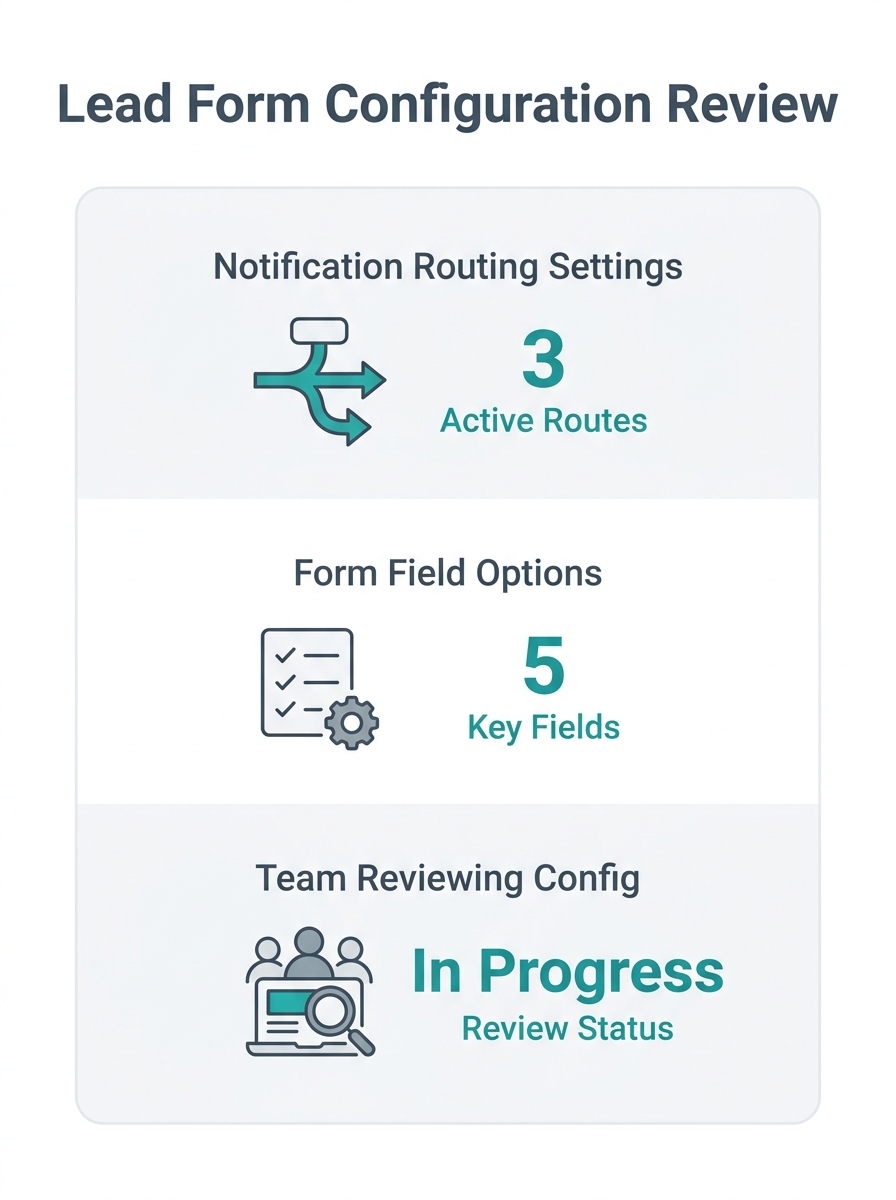

Real estate teams should deploy a single form system across every agent bio page and listing page to prevent inquiry notifications from routing to former agents or disappearing into spam filters, according to technical guidance NorthMac Services published October 2. The implementation guide identifies inconsistent form systems as the primary cause of silent lead loss on team websites where hundreds of listing pages and dozens of agent profiles each carry separate contact forms with independent notification settings.
TL;DR: NorthMac Services published guidance October 2 instructing real estate teams to use one form system across all pages and test notification paths regularly to prevent leads from routing to inactive agents or spam folders.
The guide, written by Steve Schramm, details how team websites break down when each agent bio page and listing page uses separately configured forms. Agent pages built one at a time often copy notification settings from previous agents without updating the recipient, the document states, creating situations where two agents’ pages send leads to the same person while another page sends inquiries nowhere. Listing pages generated through IDX plugins frequently use built-in inquiry forms with settings completely separate from the team’s main contact forms, according to the guide.
Forms Fail When Notification Paths Age Out
Lead forms on team websites fail most often not through visible errors but through notification routing that gradually becomes obsolete, the NorthMac guide reports. An agent leaving the team triggers no automatic update to the contact forms on their bio page, listing pages they originally posted, or any specialty pages they created. The website visitor sees a standard confirmation message after submitting the request, but the inquiry lands in an inbox no one monitors, according to the document.
Plugin updates and mail server changes create a second category of invisible failure, the guide states. A WordPress form plugin update may alter how notifications are transmitted, causing legitimate leads to trigger spam filters on the receiving end. The team lead who changed the main office email address updates the contact page but overlooks the listing inquiry form that continues sending to the old address for months, according to the implementation framework.
Single-System Approach Prevents Routing Drift
The guide recommends selecting one form platform and deploying it across the contact page, every agent bio page, and every listing page rather than treating each page’s form as a separate project. When every form on the site originates from the same template, a team can update one routing rule instead of editing forty individual pages when an agent leaves, the document states. The shared form can include hidden fields that carry context without adding visible complexity—a listing page form silently includes the property address and MLS number so the receiving agent knows which home prompted the inquiry, according to the guide.
Forms following basic usability guidelines capture submissions without errors 78 percent of the time compared with 42 percent for forms that ignore established patterns, according to Nielsen Norman Group research the NorthMac guide cites. The implementation framework recommends keeping showing-request forms limited to name, phone number or email, and an optional message rather than collecting price range, pre-approval status, and preferred contact time on the initial submission.
Mobile-specific form design matters because most listing traffic originates from phones, the guide states. Field labels should appear above input boxes instead of relying on placeholder text that disappears when typing begins, and email and phone fields should trigger the appropriate mobile keyboard, according to the document. Button labels should state the specific action—”Request a Showing” or “Ask About This Home”—rather than generic “Submit” text, the guide recommends.
Regular Testing Catches Silent Failures
The implementation framework instructs teams to test the complete lead path monthly by submitting forms on agent pages and listing pages, then confirming the notifications arrive at the correct recipient. The guide recommends rotating which team member conducts the monthly test to prevent familiarity from masking problems that would confuse an actual prospect. Teams should verify not only that notifications arrive but that they include all expected context fields such as property address, agent name, and the prospect’s message, according to the document.
The testing schedule should increase when the website undergoes changes, the guide states. Any plugin update, theme change, or CRM integration modification should trigger immediate end-to-end testing of every form type on the site, according to the framework. Teams that changed email service providers or modified spam filter settings should similarly test all forms before assuming the notification path still functions, the document recommends.
Context and Outlook
The NorthMac guidance addresses a lead-loss category that rarely appears in brokerage analytics because the failure occurs after the website successfully captured the visitor’s interest but before the inquiry reaches an agent who could log it. Teams reviewing their lead generation performance typically measure traffic, form submissions, and agent response rates, but a form that displays a confirmation message while silently failing to deliver the notification would register as a successful conversion in website analytics while producing zero actual contact. The disconnect between reported form submissions and agent-logged leads often goes undiagnosed until a team member happens to test a form and discovers it no longer works.
The standardization approach NorthMac recommends aligns with broader technical guidance on real estate lead nurturing response time, where teams that centralize their inquiry routing through a single system can more reliably meet the five-minute response benchmark that determines whether a web lead converts to a conversation. A team running three different form systems across its website faces three separate points of failure and three notification inboxes to monitor, while a team that standardized on one form platform monitors one routing path and can automate escalation when the primary recipient doesn’t respond within the target window.
Brokerage technology leaders implementing the single-form approach should audit not only their agent bio pages but also any specialty landing pages created for specific neighborhoods, developments, or marketing campaigns, since those pages frequently use copied templates that inherit obsolete notification settings from whenever they were first created. The monthly testing schedule the guide recommends becomes particularly important for teams operating in markets where listing inventory turns over rapidly, as each new listing page represents a new potential failure point if the IDX or listing feed integration doesn’t correctly inherit the team’s standardized form configuration.