
PPC.Land published a Google Business Profile implementation guide October 1 instructing business owners to claim and verify their free local listing to control how they appear in Google Search and Maps results, according to the platform’s explainer covering verification methods, service-area configuration and recent feature deprecations.
TL;DR: PPC.Land released a comprehensive Google Business Profile guide October 1 detailing claim procedures, verification options, local ranking factors and API limits for businesses managing local search visibility.
The guide addresses a tool real estate agents rely on daily yet often configure incorrectly—Google Business Profile serves as the primary control panel for how a brokerage or individual agent appears in local pack results and Maps listings, where competing brokerages frequently outrank agents who skip verification or misclassify their business type. With sponsored listings now occupying roughly 22 percent of local pack placements as of January 2026, organic profile optimization has become critical for agents unwilling to pay for top placement.
Verification Methods and Profile Types
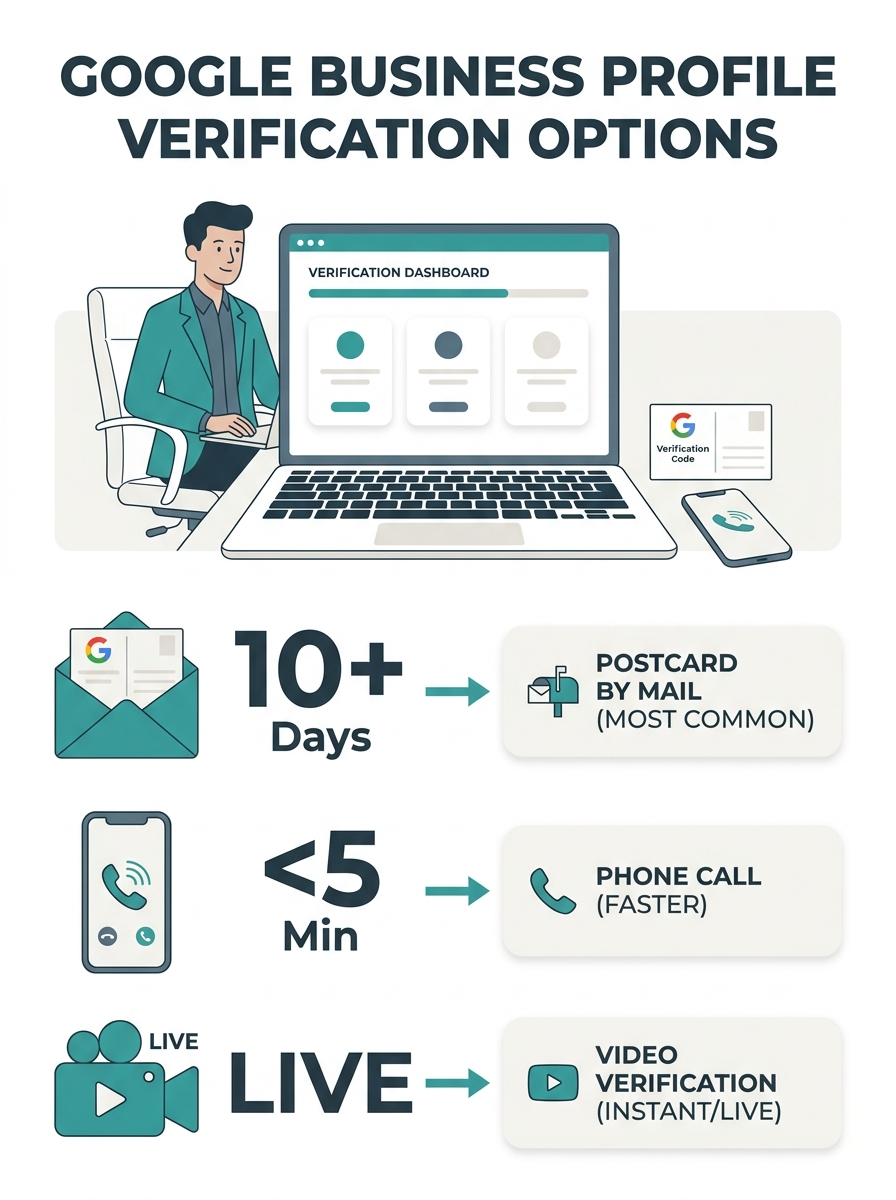
Google determines which verification method a business receives based on business type, region and existing public records, and applicants cannot change the assigned method, according to the guide. Options include phone call, text message, email, recorded video walkthrough, live video call and postcard carrying a five-digit code that typically arrives within 14 days and expires after 30 days. Review takes up to five business days once verification steps are completed.
The guide identifies three profile types with distinct visibility rules. A storefront profile displays its street address and must maintain permanent signage at that location. A service-area business hides its address and lists up to 20 service areas that should remain within approximately two hours’ drive from its base. A hybrid profile combines both approaches. For real estate agents, service-area configuration allows brokers to claim territories without listing every home address, while solo agents operating from home offices can maintain privacy while advertising coverage zones.
Chains operating 10 or more locations qualify for bulk verification through Business Profile Manager, the dashboard designed for multi-location operators. The API access tier supports 300 queries per minute per API endpoint, 300 new locations per day and a fixed ceiling of 10 edits per minute on any single profile, according to Google’s developer documentation as of September 2026.
Local Ranking and Advertising Integration
Google’s documentation names three ranking inputs for local pack placement: relevance to the search query, distance from the searcher and prominence, which draws partly from inbound links and review counts. The guide notes that Google offers no mechanism to request or pay for improved organic local ranking, though advertisers can purchase sponsored local pack placements through Google Ads location assets.
Sponsored listings in the local pack climbed from under 3 percent of tracked mobile keywords in early November 2025 to approximately 22 percent by January 2026, in data covering 1,200 mobile ranking reports shared by consultant Joy Hawkins. The shift pushes organic listings further down the page, making profile optimization more valuable for agents competing without ad budgets.
Google Analytics began importing seven Business Profile metrics on June 8, 2026—views, searches, calls, bookings, direction requests, website clicks and messages—placing them beside web traffic data for the first time. The integration lets agents track which local search actions convert to listing inquiries without switching between dashboards.
Recent Feature Changes
Google removed several profile features over the past two years, narrowing the platform’s scope to core business information and review management. Chat functionality ended July 31, 2024. Community questions and answers gave way to an AI-generated Ask button in December 2025, a month after the matching API closed. Profile-hosted websites built with Google’s tool were switched off in March 2024.
The guide emphasizes that profile names must match real-world trading names exactly—taglines, service descriptions, trademark symbols and location details in the name field can trigger suspension. Links face daily crawler checks that ignore robots.txt instructions, and social media pages no longer qualify as business links as of September 3, 2025.
Industry experts previously identified Google Business Profile audit platforms among 25 underutilized SEO tools for local search optimization, noting that many agents claim profiles without completing verification or updating hours and service descriptions.
Reading Between the Lines
Real estate agents often treat Google Business Profile as a set-it-and-forget-it checkbox, claiming the listing once during onboarding and never returning until a bad review arrives. The ppc.land guide makes clear that the platform now functions as a live lead channel rather than a static directory entry—metrics flow into Analytics, sponsored placements displace organic results and API limits shape how brokerages scale profile management across hundreds of agents.
The steady removal of features (websites, chat, Q&A) suggests Google intends profiles to serve as lightweight lead capture points rather than standalone web presences, a shift that favors agents who pair optimized profiles with dedicated property website templates and fast follow-up systems. Agents who invest time in accurate service-area configuration, weekly photo updates and same-day review responses gain visibility that paid placements can’t guarantee—because Google still ranks prominence signals like review velocity and link diversity above advertiser willingness to spend.
Service-area businesses get the most flexibility here: real estate teams can list 20 neighborhoods without revealing office addresses, matching the territory coverage buyers search for while maintaining privacy solo agents working from home require.