

Faribai published a lead nurturing software comparison September 21 that instructs agents to evaluate platforms on first-response speed before feature lists, citing a lead response management study showing five-minute reply windows produce the highest contact and qualification rates, according to the Faribai guide.
TL;DR: A software comparison guide published September 21 by Faribai ranks lead nurturing platforms on five-minute response capability and behavior-triggered sequencing rather than calendar-based drip campaigns, comparing eight CRM and AI tools with pricing and third-party ratings.
The guide splits the lead nurturing software market into two categories: CRMs with integrated nurturing capabilities and standalone AI tools that layer onto existing systems. Kate Evans, marketing manager at Faribai, authored the 16-minute comparison covering pricing structures, response automation, and the tradeoffs agents face when choosing between platform types.
Response Time Determines Platform Rankings
The guide positions first-response speed as the primary evaluation criterion, ahead of feature breadth or interface design. “Speed is the first feature that matters: responding to a new inquiry within five minutes gives you the highest statistical chance of a contact and a qualification,” the guide states, referencing a lead response management study that quantifies conversion drop-off beyond the five-minute threshold.
The framework instructs agents who cannot personally reply within five minutes to select software that automates initial responses while maintaining control over message content. The guide requires agents to review what automated systems send under their names, labeling review-before-send functionality as “a feature, worth paying for.”
This approach aligns with marketing automation frameworks that show two-hour response delays cost agents deals, with the five-minute window representing a tighter standard than prior industry benchmarks.
Behavior-Triggered Sequencing Replaces Calendar Drips
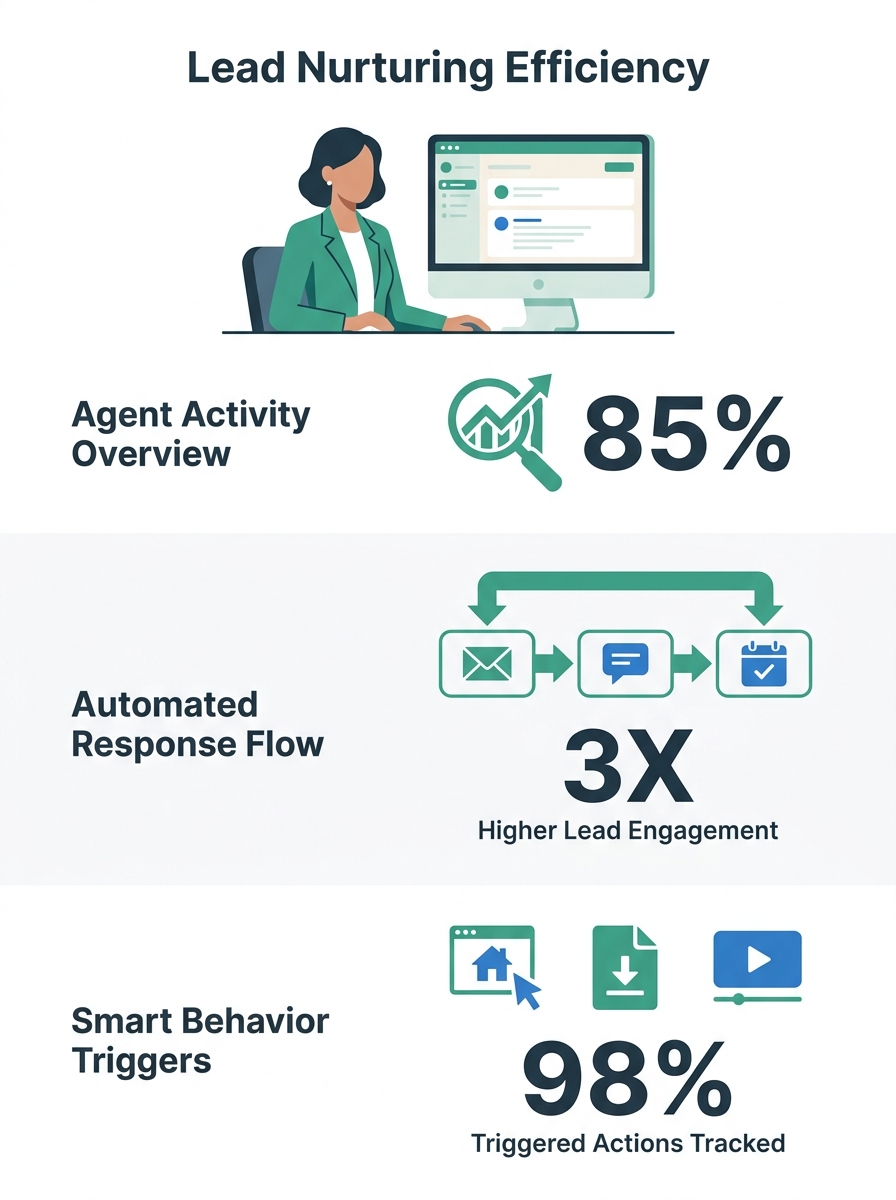
The comparison distinguishes between calendar-based drip campaigns and behavior-triggered nurture sequences, with the guide stating “behavior-triggered beats calendar-based” as a selection principle. Platforms earn higher rankings when they react to lead actions—repeat listing views, saved searches, property alert clicks—rather than sending messages on fixed schedules.
The guide positions this capability as separating entry-level and advanced platforms in the 2026 market. “Calendar drips are the floor. The better systems react to behavior,” Evans writes in the evaluation framework section.
Agents evaluating CRM platforms can cross-reference this criterion against the HousingWire 2026 CRM buyer’s guide spanning $33 to $1,500 monthly price points, which catalogs behavior-tracking capabilities across vendor tiers.
Eight-Platform Comparison Includes Pricing and Ratings
The guide compares eight platforms with disclosed pricing structures and third-party ratings, though the source excerpt does not name specific vendors. The framework evaluates each platform on five criteria: first-response automation, trigger types, review controls, relationship ownership, and integration requirements.
“Software runs the cadence, and you own the relationship: every platform below prepares the work, and the agent who shows up for the conversation wins the deal,” the guide concludes in its selection framework, positioning automation as lead preparation rather than full-cycle management.
The comparison acknowledges that some agents operate nurturing inside existing CRMs while others layer dedicated AI tools on top of legacy systems. The guide does not recommend a single winner, instead providing decision criteria based on existing tech stacks and response capacity.
Context and Outlook
The September 21 guide arrives as 98 percent of real estate brokerages report AI adoption, with lead nurturing automation representing one of the nine workflows agents can automate in client service and generation systems. The five-minute response standard cited in the Faribai guide sets a tighter benchmark than prior industry thresholds, reflecting automation tools’ capacity to compress manual follow-up timelines.
Lead nurturing software evaluation increasingly emphasizes trigger logic and behavior tracking over static drip sequences, with platforms that react to contact actions gaining market share against calendar-based systems. Agents selecting platforms in 2026 face a choice between all-in-one CRM solutions and specialized AI tools that integrate with existing software, with total cost and implementation complexity varying by approach.
The guide’s framework—prioritizing speed, then triggers, then review controls—provides agents a decision sequence that narrows vendor options before comparing feature lists or pricing tiers. For agents running high lead volumes, the combination of sub-five-minute automated responses and behavior-triggered follow-up sequences represents the current technical floor for competitive nurture systems.