

RealtaSnap published a property marketing guide September 11 that instructs New York City agents to deploy 3D virtual tours as a lead-qualification tool, with Matterport walkthrough technology enabling buyers to explore room layouts and spatial relationships before requesting in-person showings, according to the guide.
TL;DR: RealtaSnap’s September 11 guide frames 3D Matterport tours as lead-qualification infrastructure for NYC agents, arguing that interactive property walkthroughs produce better-informed inquiries than photo-only listings by letting buyers self-navigate complex urban layouts.
The guide positions virtual walkthroughs as infrastructure for filtering casual browsers from serious buyers in markets where architectural complexity—pre-war co-ops, Brooklyn brownstones, duplex conversions—makes spatial relationships difficult to convey through static photography alone. The publication targets agents marketing properties with split-bedroom layouts, multi-level floor plans, private terraces, or flex spaces that photographs fail to contextualize.
RealtaSnap frames the shift as a response to inquiry quality rather than inquiry volume. The guide argues agents fielding 3D-tour-qualified leads handle fewer basic questions about laundry locations or door clearances and more substantive discussions about built-in office shelving, stroller access routes, or terrace-to-living-room flow—indicators that prospects have already completed a self-guided property evaluation.
Matterport Scan Technology for NYC Listings
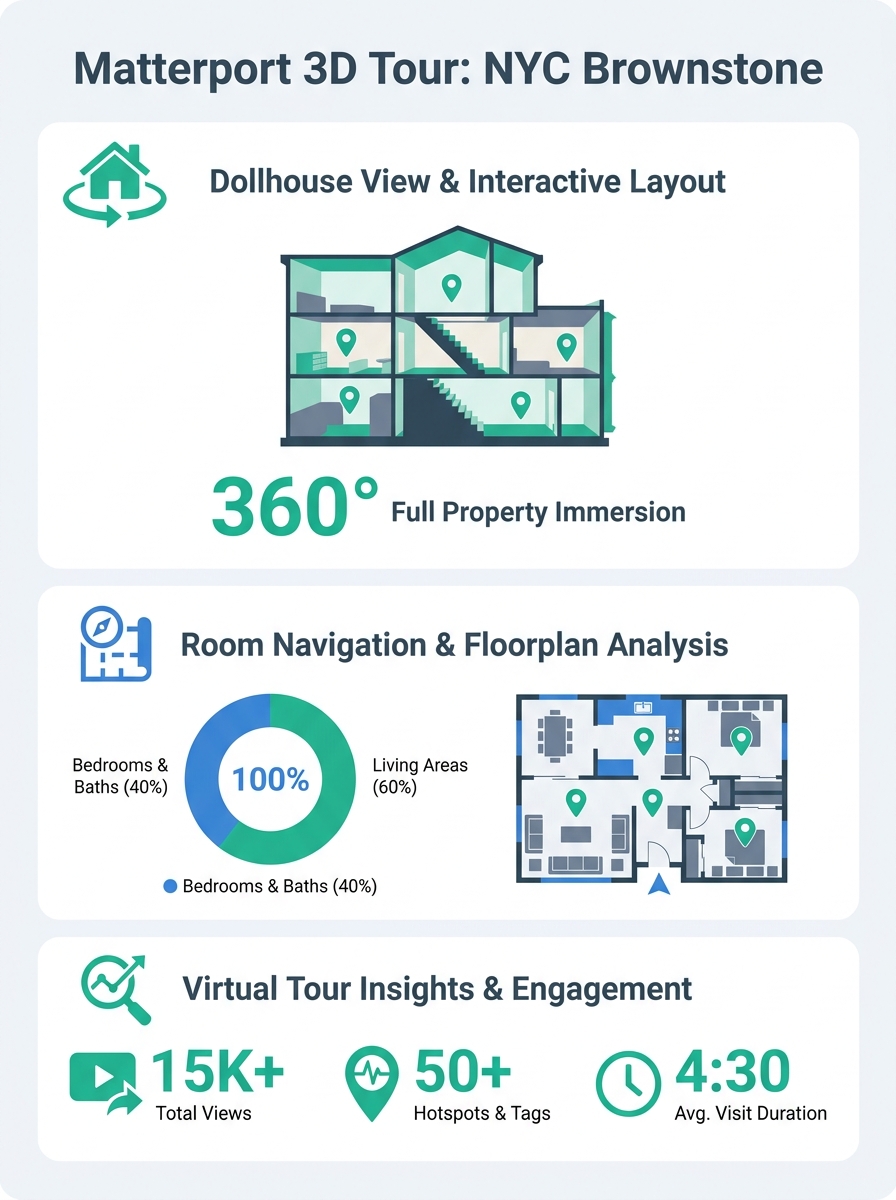
The guide identifies Matterport as the dominant 3D scanning platform in the New York area, with on-site scanning capturing layouts and finishes as interactive environments rather than pre-recorded video paths. According to the publication, Matterport’s clickable room-to-room navigation lets users revisit spaces at will, while dollhouse mode provides bird’s-eye layout views that clarify multi-level properties.
RealtaSnap recommends Matterport tours for six property types: brownstones or lofts with layered spaces, split-bedroom apartments, duplex or combination units, homes with private terraces or flex rooms, occupied listings requiring persistent clean presentation, and new developments marketed to out-of-area buyers. The guide advises agents to skip 3D tours for straightforward studio apartments where floor plans and professional photos suffice.
The publication instructs agents to embed interactive info tags highlighting special finishes or amenities and to generate shareable links for distribution across email, social media, and listing portals. Optional 2D floor plan add-ons further clarify spatial relationships for buyers accustomed to traditional architectural drawings.
Pre-Scan Property Preparation Requirements
RealtaSnap’s guide dedicates substantial instruction to pre-scan staging, noting that 3D technology captures everything present during the shoot. The publication lists ten preparation steps: removing personal items and pet gear, clearing hallways and doorways for visual flow, hiding exposed cords and cleaning supplies, straightening cushions and window treatments, activating all interior lighting, storing toiletries and closing toilet lids, removing countertop clutter and packaging, and confirming building elevator access and photography rules with property managers.
The guide warns that occupied apartments require coordination to maintain tour accuracy as furnishings change. RealtaSnap advises agents to schedule scans during vacancy windows or to brief sellers on maintaining presentation standards if tours will remain live during extended marketing periods.
For co-op and condo buildings, the publication recommends verifying front-desk protocols and reserving freight elevators at least 48 hours in advance to prevent day-of access delays that compress scanning schedules.
Strategic Tour Deployment for Lead Conversion
The September 11 guide instructs agents to treat 3D tours as active conversion tools rather than passive listing enhancements. RealtaSnap recommends embedding tours prominently on property websites—referencing single property website frameworks agents already use—and sending direct tour links to active buyer leads narrowing showing schedules.
The publication advises agents to deploy virtual walkthroughs as post-open-house follow-up collateral, giving attendees a second look at layout details they may have missed during group showings. For relocating buyers or international investors evaluating NYC properties remotely, RealtaSnap positions 3D tours as collaborative decision tools that multiple family members can explore asynchronously before committing to travel for in-person visits.
The guide notes that virtual tours extend listing reach to buyers initially filtering properties by online presentation quality, a factor that influenced agent selection for 58 percent of recent home sellers in separate research.
What This Means for Estate Agents
Agents competing in urban markets where spatial complexity differentiates inventory should evaluate whether their current photo-only listings leave qualified buyers guessing about layout flow and room relationships. The RealtaSnap guide provides a tactical framework for deploying Matterport technology as lead-qualification infrastructure rather than as a vanity marketing feature—a distinction that matters when justifying scan costs against closed-deal economics.
The publication’s emphasis on pre-scan staging and building coordination highlights operational requirements agents must account for when scheduling 3D shoots. Properties requiring freight elevator reservations, occupied-listing seller briefings, or multi-level lighting checks demand more scheduling buffer than standard photography sessions. Agents should assess whether their current vendor relationships include Matterport-certified photographers and whether pricing structures accommodate interactive tour production as a standard listing expense rather than a premium add-on.
For brokerages building differentiated property marketing stacks, the guide’s focus on 3D tours as buyer self-service tools aligns with broader industry movement toward lead-generation automation that filters inquiries by engagement depth. Agents willing to invest in property-level digital infrastructure can expect fewer tire-kicker calls and more substantive buyer conversations anchored in layout-specific questions that signal genuine purchase intent.