

Respond.io published a WhatsApp AI Agent setup framework on August 24 instructing real estate teams and other high-volume B2C businesses to connect WhatsApp Business API, build qualification logic, route leads by intent or region, sync captured data to CRM systems, and measure conversion performance by entry point, according to the implementation guide.
TL;DR: Respond.io released a five-step framework today for deploying AI-powered lead qualification on WhatsApp, targeting agents managing inbound leads from ads, QR codes, and website chat widgets at scale.
The guide targets sales teams managing inbound leads from Facebook ads, website widgets, QR codes, and direct chat links who need automated qualification and routing across multiple agents. Real estate teams running click-to-WhatsApp ad campaigns from property listings or open house promotions can use the framework to capture buyer intent, score lead quality, and assign qualified prospects to the appropriate agent without manual triage.
Five-Step Implementation Framework
The respond.io guide breaks WhatsApp AI Agent deployment into five sequential steps. Teams first connect their WhatsApp Business number to the platform via WhatsApp Business API to centralize all inbound conversations. Second, they configure an AI Agent with qualification questions, intent triggers, and lead-scoring criteria so the system can assess prospects from the first message.
Third, teams set up routing rules that assign qualified leads to specific agents, teams, or queues based on intent, product category, or geographic region, with an AI-generated conversation summary attached at handover. Fourth, they integrate their CRM so captured lead fields, lifecycle stages, and conversation outcomes sync automatically. Fifth, they track response times, qualification rates, conversion by entry point, and agent performance to identify drop-off points.
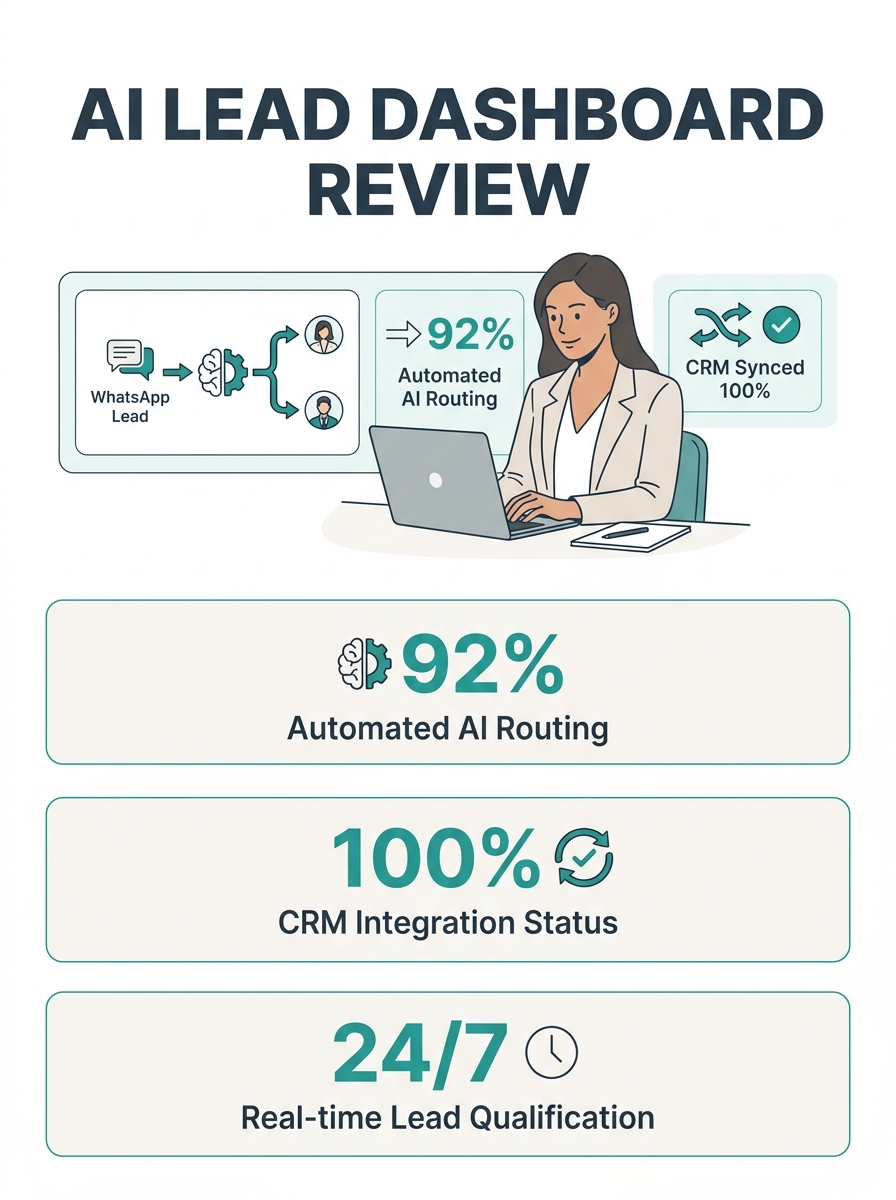
The framework assumes WhatsApp API access and inbound lead sources rather than cold-outreach automation, according to the guide. Agents already running lead-generation workflows through forms or email can layer WhatsApp automation on top of existing systems by connecting the platform to their current CRM.
AI Agent Versus Rule-Based Chatbots
Respond.io’s guide includes a comparison table showing AI Agents handle complex conversations by escalating to humans with full context summaries, while rule-based bots break on unexpected inputs and cause conversations to stall or loop. Both AI Agents and rule-based bots deliver instant responses at any volume and cost less than human-only teams, but AI Agents adapt to natural language variations where scripted bots fail.
Human agents handle nuance, negotiation, and exceptions better than both automation types, the guide notes. The platform recommends using AI for high-volume, repeatable lead handling and reserving human capacity for exceptions and high-stakes decisions.
Real estate teams managing lead response times can use the AI handover feature to ensure qualified buyers receive human follow-up within minutes while the agent completes showings or open houses with other clients.
Prerequisites and Operational Constraints
The guide lists five prerequisites: WhatsApp API access, a conversation management platform, an AI knowledge source, CRM and analytics access, and Conversions API if teams run click-to-WhatsApp ads. These components enable the agent to capture lead data, trigger routing, hand over to humans, and report performance across the full lifecycle.
Respond.io cautions that AI Agents can misunderstand ambiguous or policy-sensitive requests. Without clear handover rules, teams risk qualifying the wrong leads or providing incorrect answers. The guide recommends defining escalation triggers, reviewing transcripts weekly, and updating qualification logic when patterns change.
Conversion Impact Across Five Areas
The framework claims AI Agents improve lead conversion by responding instantly, qualifying consistently, and reducing manual load. For high-volume teams, impact appears across five areas: instant responses 24/7 prevent lost leads from delayed replies outside working hours; WhatsApp conversations feel faster and more natural than forms, increasing engagement; click-to-chat ads convert better when leads enter a conversational flow rather than a static landing page; consistent qualification ensures every lead receives the same data-capture questions; and CRM sync eliminates manual data entry.
Real estate agents running property-specific ad campaigns can direct click-to-WhatsApp traffic to an AI agent that asks buyers about budget, timeline, preferred neighborhoods, and financing status before routing the conversation to the listing agent or buyer specialist with a pre-filled lead summary.
Reading Between the Lines
WhatsApp AI Agents solve the same lead-triage problem real estate teams face with web forms and email inquiries, high volumes, inconsistent quality, and delayed human follow-up, but shift the interaction to a messaging platform buyers already check hourly. The five-step framework respond.io published today gives agents a repeatable deployment path, but the value depends entirely on whether an agent’s lead sources already include enough WhatsApp traffic to justify API access and platform fees.
The comparison table showing AI Agents outperforming rule-based bots on complex conversations understates the real trade-off: WhatsApp automation works only when buyers prefer texting over calling or emailing, and only when the agent’s market uses WhatsApp. In U.S. markets where SMS dominates consumer messaging, the framework’s value collapses unless the agent specifically runs international buyer campaigns or serves immigrant communities where WhatsApp is standard.
The operational constraint around misunderstood requests and qualification errors points to the hidden maintenance cost of AI lead routing. Agents deploying WhatsApp automation need to review transcripts weekly, update qualification logic as buyer questions evolve, and define escalation triggers that balance automation efficiency against the risk of losing a high-value lead to a scripted dead-end. The framework is repeatable, but only if the agent treats it as a system requiring ongoing tuning rather than a set-it-and-forget-it tool.