

Chicago Title Colorado sales executive Jerad Larkin published a hyperlocal SEO framework on August 15 instructing Denver Metro real estate agents to build 10 to 20 dedicated neighborhood pages on owned websites, replacing portal subscriptions that one agent reported lost all lead flow within three business days of cancellation, according to the guide posted on Mile High Title Guy.
TL;DR: Chicago Title Colorado executive Jerad Larkin published a neighborhood page framework August 15, recommending Denver agents build 10-20 hyperlocal pages on owned websites to replace portal lead rentals that stop producing immediately after payment ends.
The framework targets the gap between rising portal lead costs and agents’ reliance on rented traffic channels, positioning neighborhood pages as long-term owned assets that continue generating search traffic and AI engine citations years after publication. Larkin teaches marketing and AI systems to Denver Metro agents weekly and reported the strategy surfaces in nearly every session, typically after agents discover their existing “Areas We Serve” directory pages rank for zero search queries.
What the Framework Prescribes for Each Neighborhood Page
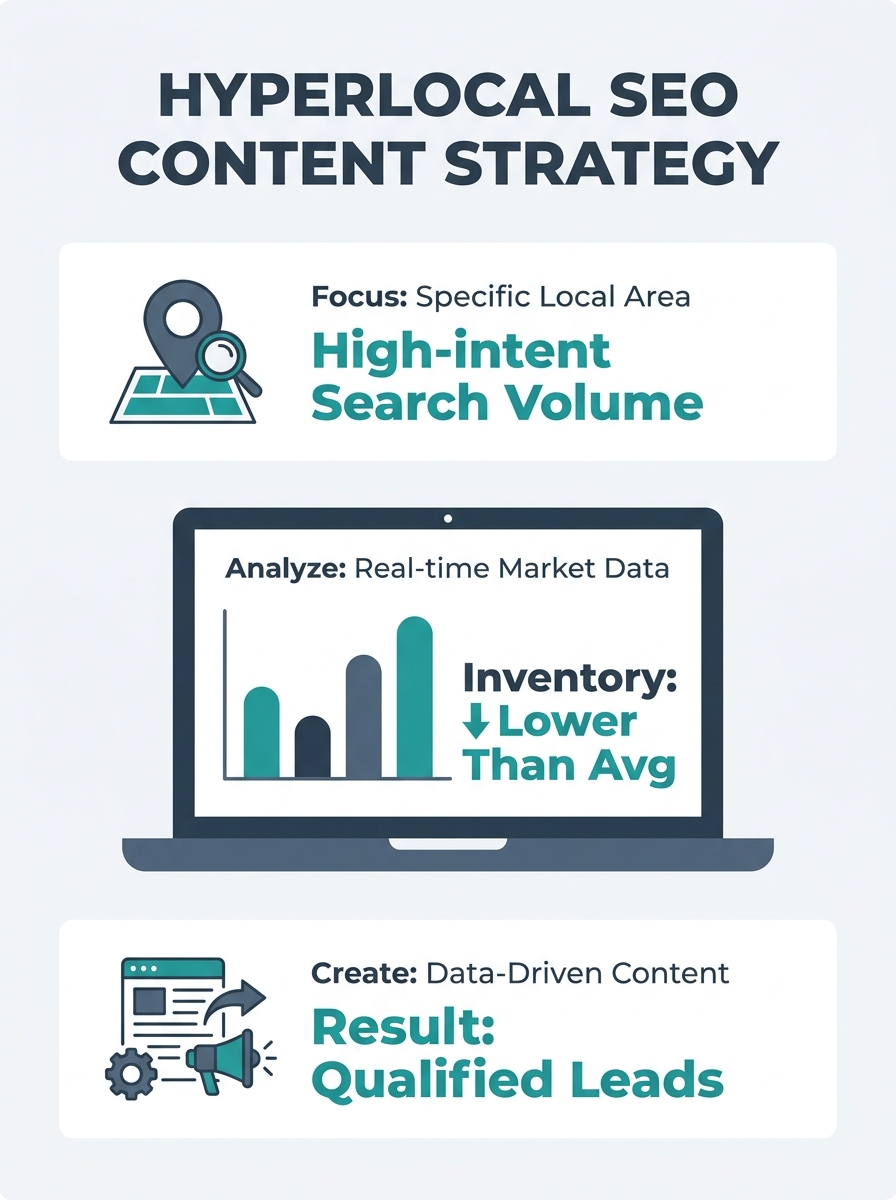
The guide specifies six required components per page, starting with a two-to-three-sentence definition block written in conversational language that AI search engines extract as direct answers. The framework mandates current market data—median sale price, median days on market, and active inventory refreshed quarterly—citing this element as the differentiator that makes pages worth linking to.
Additional required sections include housing stock descriptions (bungalows versus new construction, HOA presence, typical square footage and year built), lifestyle details grounded in local knowledge while avoiding fair housing violations, and a three-to-five-question FAQ answering queries buyers type into search and voice assistants. Each page closes with a single next-step action rather than competing calls-to-action.
Larkin specified one page per neighborhood—not metro-wide or regional pages—covering discrete areas such as Berkeley, Central Park, Old Town Arvada, and The Highlands. The framework recommends building one page weekly to accumulate 10 to 20 pages by Thanksgiving 2026, creating what search engines recognize as a topical authority cluster when pages interlink across adjacent neighborhoods.
Neighborhood Selection Criteria and Competitive Positioning
The guide instructs agents to avoid Denver Metro’s most competitive zip codes where portals dominate first-page rankings. Larkin wrote agents should target the overlap of three factors: neighborhoods where the agent has closed transactions, neighborhoods with sufficient turnover volume, and neighborhoods lacking substantive content beyond portal listings and brokerage template pages.
For turnover assessment, the framework directs agents to MLS closed-sales exports filtered by neighborhood, calculating clusters of homeowners past the eight-year ownership mark. Larkin referenced his prior analysis of Denver homeowner tenure patterns as a lead-generation predictor, applying the same logic to identify neighborhoods entering listing cycles where owners actively search property valuations.
The competitive-gap check involves searching each neighborhood name plus “homes for sale” and scanning first-page results. If portals and template brokerage pages dominate with no locally written content, the framework identifies an SEO opening for agent-owned pages.
Writing Approach and Search Engine Optimization Tactics
Larkin’s framework rejects keyword-density formulas, citing Google’s guidance on helpful content written for people demonstrating firsthand experience. The guide recommends conversational phrasing matching how agents answer client phone calls, structuring content around natural-language questions typed into search engines and voice assistants.
Prescribed heading formats include “What is it like to live in [neighborhood]?” and “How much do homes cost in [neighborhood]?”—strings matching both traditional search queries and ChatGPT prompts. The framework positions MLS access as an unfair advantage over national content farms, instructing agents to export REcolorado closed-sales data and calculate neighborhood-specific medians unavailable to non-licensed publishers.
The guide contrasts owned neighborhood pages with rented portal leads, describing paid channels as “money in, leads out” systems that cease functioning the moment payment stops. Larkin reported one Denver agent canceled a portal subscription on a Friday and recorded zero leads by the following Monday—not reduced volume but complete pipeline stoppage. The framework positions neighborhood pages as assets producing leads at no marginal cost three years after publication, aligned with recent industry reporting on rising lead costs without corresponding quality improvements.
Reading Between the Lines
This playbook arriving from a title company executive rather than a marketing vendor carries different weight—Larkin’s business model depends on closed transactions, not selling SEO services, making the recommendation less conflicted. The 10-to-20-page threshold is specific enough to be actionable and modest enough that a solo agent building one page per week hits the target in four months without hiring writers.
The portal-dependency warning resonates louder in August 2026 than it would have two years ago. With lead-generation failures increasingly tied to mobile and AI search optimization gaps and agents questioning whether to maintain IDX systems that feed competing websites, the case for owned hyperlocal content strengthens beyond SEO theory into pipeline protection.
The framework’s emphasis on fair-housing-compliant local detail—trail access, coffee shops, flood-prone streets—maps directly to NAR buyer research showing neighborhood quality as the top location decision factor. Agents already conduct this verbal walkthrough on buyer tours; the discipline is transcribing that knowledge into search-optimized, AI-citable written blocks that work while the agent sleeps. For teams evaluating website builder platforms and true lead acquisition costs, this framework provides the content blueprint those platforms need to produce long-term ROI beyond template homepages.