

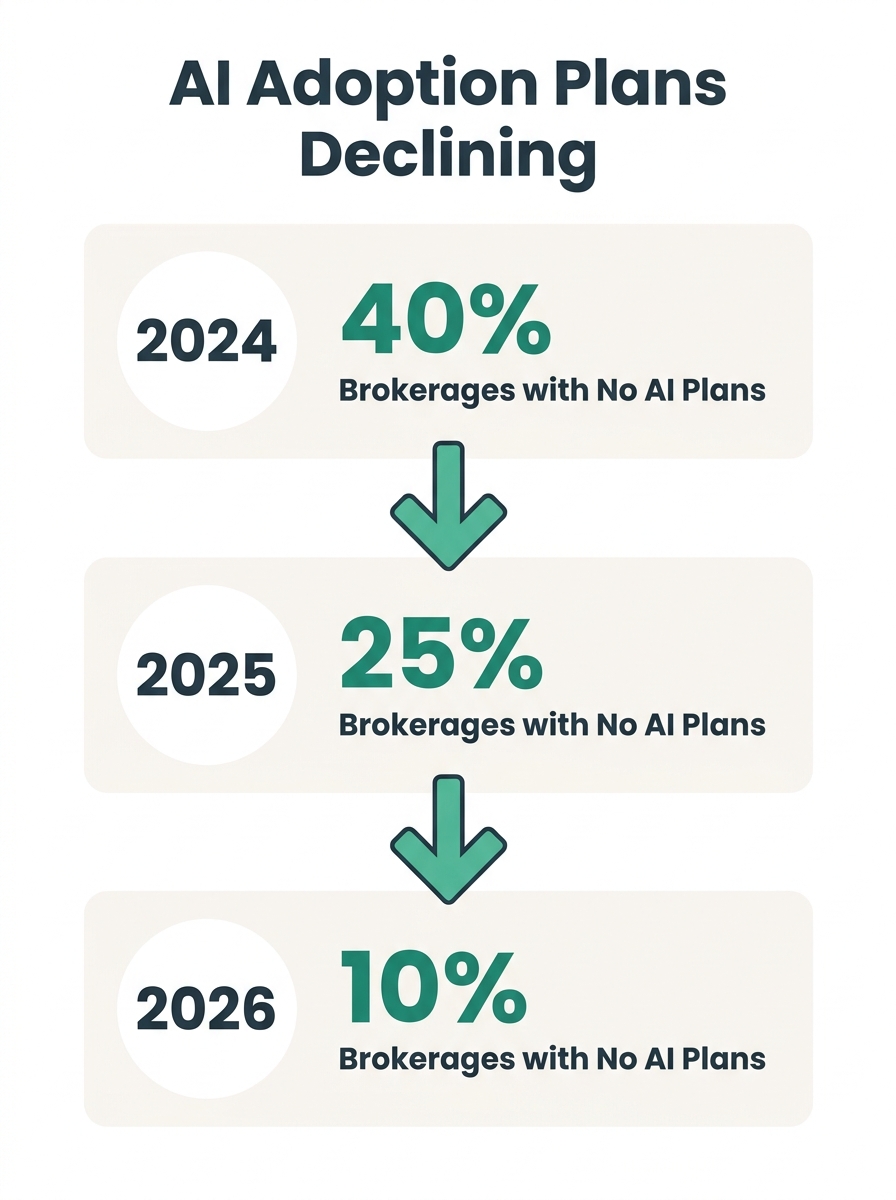
Artificial intelligence adoption among real estate brokerages reached a tipping point in 2026, with only 1.9% reporting no plans to implement AI tools this year, according to the three-year Delta Media Group Real Estate AI & Leadership Survey published August 6. The rapid shift from double-digit resistance in 2024 eliminates what was once a meaningful segment of non-adopters and signals that AI integration has moved from competitive advantage to table-stakes requirement for brokerages competing for agent recruitment and retention.
TL;DR: Nearly all real estate brokerages plan to adopt AI in 2026, with resistance dropping from 10.6% in 2024 to just 1.9% this year, while mid-sized firms now match large brokerages at 100% agent AI usage.
The share of brokerages with no adoption plans fell from 10.6% in 2024 to 4% in 2025, reaching 1.9% in the 2026 survey of more than 100 brokerage leaders. Brokerages reporting zero AI use at any level dropped from 24.8% in 2024 to 3.9% this year, according to the Delta Media Group data.
“Every year we run this survey, the story is less about who is trying AI and more about who still has not,” said Michael Minard, CEO and owner of Delta Media Group. “That second group is nearly gone.”
Mid-Sized Brokerages Eliminate Gap With Largest Firms
Mid-sized brokerages with 101 to 500 agents achieved parity with the industry’s largest firms in 2026, with both segments reporting 100% agent AI usage. The convergence eliminates what was a measurable adoption gap in prior years, when larger brokerages led implementation by double-digit percentages.
The smallest independent brokerages, those with fewer than 10 agents, remain the only segment showing year-over-year inconsistency in adoption rates, the survey found. Every other brokerage size category demonstrated sustained increases across the three-year tracking period.
Brokerage leaders’ perception of AI importance climbed in tandem with adoption rates. Nearly half of respondents (47.6%) rated AI’s importance as an 8 or higher on a 10-point scale in 2026, up from 28.7% in 2025. The shift indicates brokerages are moving beyond pilot programs into strategic dependence on AI for core functions including lead follow-up, marketing automation, and transaction management, capabilities that agents increasingly need to define their marketing voice before deploying.
Platform Consolidation Replaces Point-Solution Approach
Brokerages are favoring unified technology platforms that bundle AI capabilities over standalone tools, according to the survey data. The perceived value of all-in-one marketing platforms incorporating AI and automation reached 7.3 out of 10 in 2026, the highest level recorded in the three-year analysis.
More than half of brokerage leaders (51.5%) rated these integrated platforms an 8 or higher, up from 41.6% in 2025. The preference signals a shift from accumulating individual AI point solutions to consolidating around vendors that deliver AI as part of connected ecosystems.
“Brokerages are not just adopting AI piece by piece anymore,” Minard said. “They are consolidating around partners who can deliver it as part of one connected platform.”
The consolidation trend mirrors broader industry movement toward platforms that handle multiple functions, similar to RealAnalytica’s Atlas Agents launch integrating 30-plus software tools into a single AI-powered workflow system. Brokerages appear to be prioritizing vendor partnerships that reduce technical fragmentation and deliver AI capabilities without requiring agents to manage multiple logins or disconnected systems.
Survey Methodology and Historical Context
Delta Media Group surveyed more than 100 brokerage leaders annually between 2024 and 2026, tracking AI adoption across brokerage size segments and measuring leadership attitudes toward AI importance. The longitudinal design allows year-over-year comparison of adoption velocity and strategic positioning.
The accelerating adoption rate aligns with Gen Z homebuyers’ documented preference for AI-assisted research paired with human agent expertise for transaction completion, creating market pressure for brokerages to equip agents with AI tools that match buyer behavior patterns.
What Happens Next
Brokerages planning digital marketing strategies for 2026 and 2027 face a competitive landscape where AI adoption is no longer a differentiator but a baseline expectation. Agents evaluating brokerage platforms should assess not whether a firm offers AI tools, but which specific workflows those tools automate and whether they integrate with existing marketing systems.
The survey’s finding that only 1.9% of brokerages resist AI adoption suggests that agents who delay learning AI-powered lead nurturing, content generation, and customer communication risk operating at a structural disadvantage. The relevant question shifts from “Should my brokerage adopt AI?” to “Which AI platform best supports my lead-generation workflow and integrates with my sphere-of-influence strategy?”
Delta Media Group indicated it will announce platform developments for its customers, suggesting the survey findings may inform proprietary product strategy in the coming months.