

A Los Angeles luxury agent published a framework July 21 showing artificial intelligence content tools boosted her marketing voice rather than replaced it, after uploading two years of YouTube scripts to train the platform on her communication style, according to HousingWire. Anj Catalano, who specializes in San Fernando Valley and Westside markets for The Agency, reported AI lowered technical barriers to website development and content production while exposing agents who automate without defining perspective.
TL;DR: Luxury agent Anj Catalano uploaded two years of YouTube scripts to AI platforms, discovering the technology boosted authentic voice rather than generating it—a distinction that separates agents who build brands from those running content machines.
Technical Barriers Fell While Voice Requirements Rose
Catalano had carried a list of marketing projects she lacked coding skills to execute: a brand-aligned website, blog campaigns, and client resources. Professional website development quoted at $6,000 to $7,000 would not guarantee the developer could translate her vision, she reported in the HousingWire column.
AI tools removed the technical obstacle. “I could build the website I had imagined, create bespoke imagery instead of stock photography, finally organize years of photos scattered across hard drives,” Catalano wrote. The same platforms that handled visual tasks and site architecture also offered content generation—which initially appeared as a productivity breakthrough.
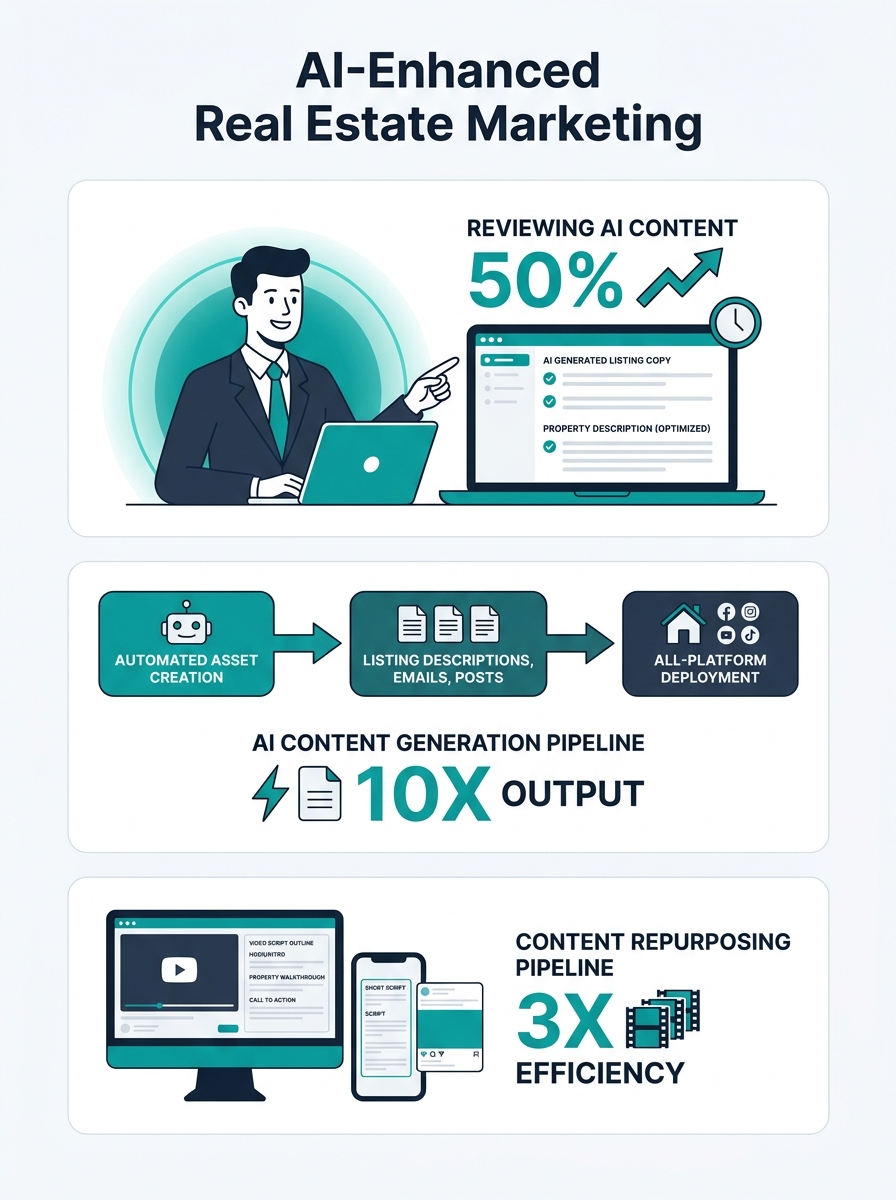
Early AI-written content was “polished, grammatically immaculate, easy to read” but “completely forgettable,” according to Catalano. She identified the same voice patterns across Instagram captions, listing descriptions, and market updates from agents in different markets—identical cadence, tone, and punctuation creating undifferentiated content.
YouTube Scripts Became Training Data for Authentic Output
After upgrading to a professional AI account, Catalano uploaded two years of YouTube scripts that had required “hundreds of hours of thinking and rewriting.” The scripts reflected client conversations, negotiated deals, property walkthroughs, and questions answered repeatedly until she understood her own answers, she reported.
“I wasn’t trying to teach AI what to think. I was giving it enough of my own work to understand how I think,” Catalano wrote. The distinction separated agents training AI on their perspective from those using generic prompts that produce generic results.
The uploaded scripts created a baseline for the AI to match her communication patterns—sentence structure, vocabulary choices, explanation frameworks—without generating the underlying perspective. “Perspective doesn’t come from a prompt. It comes from living. From mistakes. From curiosity. From difficult conversations,” according to the column.
One-third of Gen Z homebuyers already use AI for property research while preferring human agents for transaction execution, according to a Bank of America study, creating demand for agents whose marketing content demonstrates judgment and perspective before the first meeting.
Content Discovery Separated From Trust Formation
Catalano positioned content as a discovery mechanism rather than a trust-building mechanism. “Content may be how people discover me. It is not why they trust me,” she wrote. Trust formation requires perspective and judgment—recognizing a person behind the words rather than automated output.
Every agent now has access to identical AI platforms, eliminating technology as a competitive differentiator. “What none of us have access to is each other’s perspective. That is earned over time,” Catalano reported. AI removed barriers to expressing existing perspective; it did not create perspective where none existed.
The framework parallels real estate agents’ adoption of AI staging tools while maintaining seller approval protocols—technology accelerates execution of decisions agents already made based on market knowledge and client needs.
Catalano’s goal shifted from “she’s good at AI” perception to “I like the way she thinks” response. The metric measures whether content communicates authentic perspective rather than technical proficiency with platforms.
What Happens Next
Real estate agents face a choice between volume-focused content machines and brand-building communication. The 85% of homebuyers now using AI tools during property searches expect to encounter agent content across digital channels, but AI recommendation systems including ChatGPT pull agent suggestions from Zillow rankings that prioritize platform engagement over authentic expertise—making differentiated voice a ranking factor.
Agents who upload existing client communications, email responses, and market commentary as training data will produce AI-assisted content that reflects accumulated expertise. Those relying on generic prompts will generate the “same polished cadence” Catalano identified across competitors. The difference compounds as AI answer engines replace traditional search traffic, prioritizing content that demonstrates individual perspective.
The framework suggests starting with property websites that reflect defined voice and positioning before scaling content production—establishing what automation should boost rather than automating first and discovering bland output later.