

Artificial intelligence recommendation systems including ChatGPT and Google AI Overviews are pulling real estate agent suggestions directly from Zillow’s directory rankings, which prioritize platform engagement and advertising spend over verified market performance, according to a HousingWire analysis published July 20. The AI tools present recommendations as objective research without disclosing that Zillow’s “Find an Agent” directory ranks agents based on review volume, profile completeness, and self-reported sales data rather than independently verified production metrics.
TL;DR: AI systems recommend agents by mirroring Zillow directory rankings that favor platform participation over verified performance, creating a visibility gap agents who built referral-based businesses without optimizing portal presence.
How Zillow’s Directory Ranking System Operates
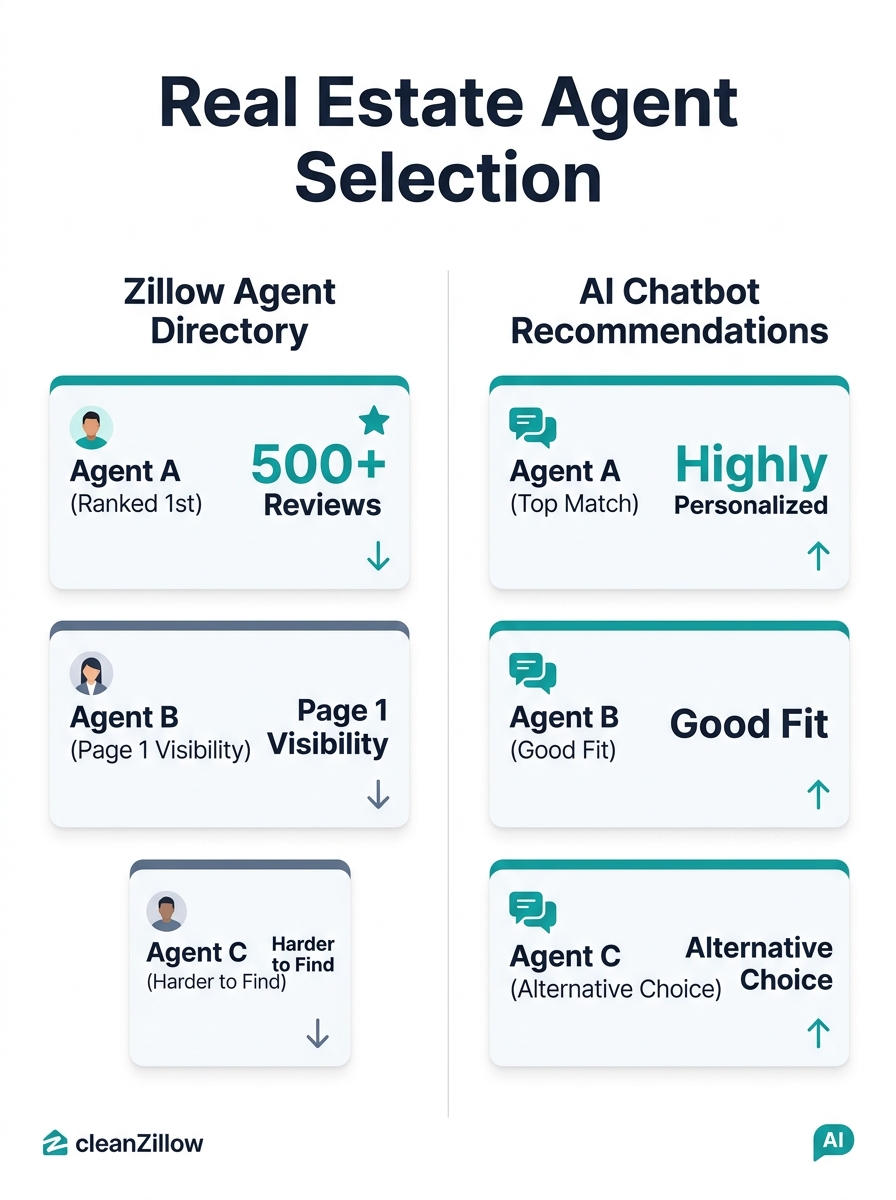
Zillow’s “Find an Agent” search surfaces agents based on star ratings, review counts, and sales data agents attach to profiles through MLS IDs, according to the platform’s published methodology. The ranking signals measure platform engagement rather than independently audited market production. Review counts reward agents who aggressively solicit Zillow-specific reviews; profile completeness rewards agents who treat the platform as a primary marketing channel; self-reported sales reward agents who feed every transaction back into Zillow’s system. Zillow does not publish the full weighting formula for its ranking algorithm.
A top-producing agent who built a referral-based business and never optimized a Zillow presence can rank below a lower-volume agent who works the platform consistently. The directory functions as a ranking of platform participation rather than professional performance, though many high-performing agents rank well because they invest in both production and platform presence. Non-paying agents appear in the directory through MLS records and consumer reviews, but paying Premier Agent advertisers dominate top positions through superior review volume and profile optimization.
The distinction between perceived objectivity and actual methodology remains invisible to consumers using the directory. Buyers and sellers entering a ZIP code see agents ranked with star ratings and sales figures and reasonably assume the top agent is the strongest performer in that market.
AI Systems Inherit Platform Biases Without Correction
When consumers ask AI assistants “who is the top listing agent in this neighborhood” or “recommend me a real estate agent,” the response carries the tone of independent research but draws source material directly from portals that dominate machine-readable web data, according to the HousingWire report. The models do not query MLS production records, audit closings, or verify performance metrics. For residential agent referrals, AI systems pull from Zillow and Homes.com rankings as primary sources.
The same pay-to-play directory structures function as training data for generative AI recommendations. An agent’s visibility in AI-generated results correlates with Zillow directory position, which correlates with platform investment rather than independently verified market leadership. Agents who perform well but decline to participate in portal advertising or review-solicitation programs become systematically invisible to both human consumers and AI recommendation engines.
The assumption that AI-assisted search would analyze real performance data and identify genuinely top agents has not materialized. Instead, AI tools boost existing commercial relationships without disclosing the underlying bias structure. A real estate marketing executive published an AI optimization framework in July designed to help agents win ChatGPT recommendations, acknowledging the need for agents to actively manage visibility across platforms that feed AI training data.
Industry-Wide Pattern Across Consumer Portals
Realtor.com operates a comparable structure, selling agent leads by ZIP code through Connections Plus while presenting a “Find a Realtor” directory built on reviews and self-reported transaction history. Homes.com markets a “Your Listing, Your Lead” model that does not divert listing leads to competitors but still tiers visibility by advertising spend, with paid members sorting above non-members in search results and neighborhood pages.
Agent-matching services vary the bias rather than removing it. HomeLight uses an invitation-only model matching on MLS production data—closed volume, days on market, list-to-sale ratio—but gates participation behind a referral fee of roughly one-third of commission. Redfin’s partner program vets partners on close-rate standards but requires 30-35% of buyer-side commission, making high-performing agents who decline referral fees simply absent from results. UpNest optimizes for agents willing to discount commission most aggressively, surfacing the cheapest agent rather than the most qualified.
No major consumer-facing platform ranks agents based on verified performance independent of whether that agent pays or opts in. What surfaces at the top across every portal is substantially a function of commercial relationships, and no neutral performance-only directory operates at consumer scale for human or machine consultation.
Legal Challenge to Zillow’s Lead Business Structure
A class-action lawsuit filed in September 2025 by Alucard Taylor alleges Zillow deceives consumers about who they are contacting through the platform and conceals referral fees Flex agents pay. Hagens Berman, the firm representing Taylor that also handled the Moehrl commission case, amended the complaint in November 2025 to add RICO claims. The case remains active in Seattle federal court.
The litigation centers on Zillow’s “Contact Agent” routing that sends buyers to agent advertisers rather than listing agents, and Premier Agent’s ZIP-code auction structure. The suit argues consumers believe they are contacting the listing agent when they click contact buttons on listings, but Zillow routes those leads to paying advertisers. The directory ranking structure has received less legal scrutiny despite affecting far more consumer interactions than the contact button.
Reading Between the Lines
The migration of portal ranking bias into AI recommendation systems creates a compounding visibility problem for agents who built businesses on production metrics, referrals, and direct marketing rather than platform optimization. An agent who closed 50 transactions last year through sphere-of-influence marketing but maintains minimal Zillow presence will rank below an agent who closed 20 deals but invested heavily in review solicitation and profile completeness—and that gap now replicates across every AI tool consumers use for agent research.
The practical response requires treating platform optimization as infrastructure rather than optional marketing. Gen Z homebuyers already use AI for initial research while preferring human agents for closing, according to Bank of America data, meaning visibility in AI results increasingly determines whether an agent enters consideration at all. Agents need documented review volume, completed profiles with MLS transaction history, and active presence on the portals AI systems index as authoritative sources.
The alternative—hoping consumers discover agents through word-of-mouth alone—concedes the entire top-of-funnel to competitors who treat Zillow directory position as a lead generation asset. The directory may not measure what consumers think it measures, but it controls what AI tools recommend, and in 2026 that determines which agents get researched before the first phone call happens.