

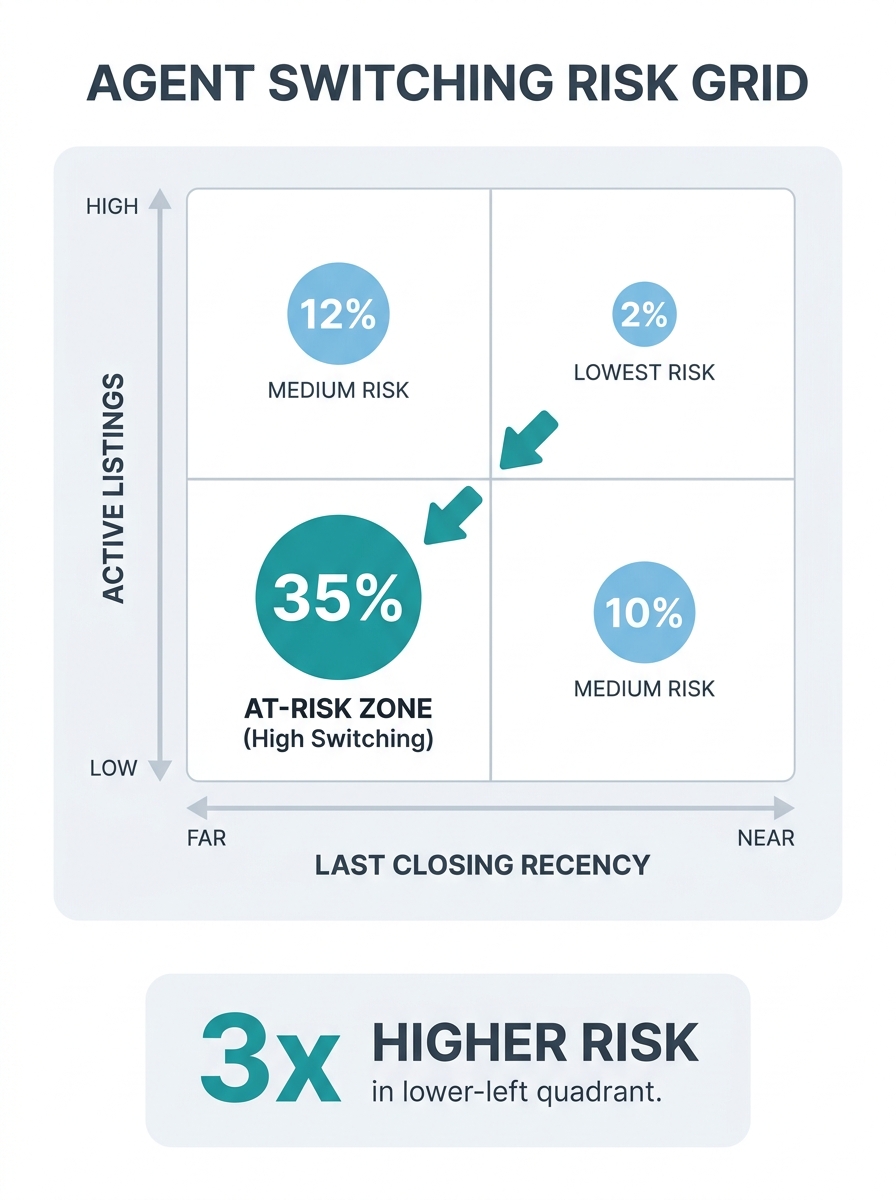
A 12-month forward-looking study tracking more than 625,000 real estate agents found that time since last closing and pipeline depth predict brokerage switching rates six times more reliably than failed listings, according to HousingWire. Agents who closed within three months and carried three or more active listings switched brokerages at a 2.7% rate, while those inactive for six or more months with no listings switched at 15.6%.
TL;DR: A study of 625,000 agents found pipeline inactivity—not failed listings—predicts brokerage switching, with inactive agents switching at rates six times higher than agents with recent closings and active listings.
The Study Design and Methodology
The research captured a single-date snapshot of every agent who closed at least one transaction during a 12-month period across multiple MLS coverage areas, recording only two variables: days since most recent closing and number of active listings at that moment. Researchers then tracked those same agents for 12 months to determine whether their next closing occurred with the same brokerage or a different firm.
The methodology differed from typical agent movement studies by measuring forward risk rather than analyzing agents after they had already switched. The dataset included one-deal and two-deal agents typically excluded from industry research, ensuring the analysis covered the full production spectrum rather than only high-volume producers.
The Pipeline Pattern Holds Across Production Tiers
The switching-rate pattern remained consistent regardless of agent production volume, the study found. Among agents closing 12 or more transactions annually, those with recent closings and three or more active listings switched at 2.3%, while high producers who went six or more months without a closing and had no active listings switched at 17.4%—more than seven times as often.
Mid-tier producers showed switching rates ranging from 3.1% to 13.4%, and lower-volume agents ranged from 4.0% to 14.2%. The condition of an agent’s pipeline predicted movement across every production bracket, challenging the assumption that top producers exhibit greater loyalty. The data instead suggests high producers simply experience empty pipelines less frequently, and when they do their behavior resembles agents at other production levels.
The findings shift the retention question from “Which agents are thinking about leaving?” to “Which agents are becoming free to leave?” according to the research. Active listings, pending transactions, and future commission income all raise the switching cost. As that pipeline shrinks, so does the financial barrier to changing brokerages.
Failed Listings Show Inverse Relationship
Contrary to industry assumptions that canceled or expired listings signal impending agent departures, the study found agents with listing failures switched brokerages less often than agents with no failures. Among agents carrying no active listings, 9.7% of those with no cancellations switched brokerages, compared with 8.0% who experienced two or more cancellations.
The same inverse pattern appeared among agents with three or more active listings, where switching rates fell from 5.3% among those with no cancellations to 1.3% among those with multiple listing failures. Even clusters of cancellations immediately before the observation date showed no meaningful increase in future brokerage movement.
A canceled listing still represents evidence an agent secured business in the first place, the study noted. Failed outcomes reflect activity rather than the greater risk factor: complete inactivity. Brokerages monitoring withdrawal and cancellation patterns as early warning signals may be tracking the wrong metric entirely.
Recruiting and Retention as Mirror Signals
The pipeline-inactivity pattern identifies both agents at risk of leaving a brokerage and agents most likely to be receptive to recruitment offers at competing firms, the study showed. The same signal viewed from opposite sides of the market makes recruiting and retention strategically identical problems rather than separate initiatives.
Brokerages competing for the same pool of local agents can apply the metric both defensively—identifying which of their own agents face increasing switching risk—and offensively, targeting agents at rival firms whose inactive pipelines lower their switching costs. The transparency of MLS data makes both applications feasible for firms willing to monitor pipeline conditions systematically.
For team leaders and broker-owners, the findings suggest proactive engagement tied to pipeline monitoring delivers better retention outcomes than reactive responses to resignation notices. The study’s 12-month observation window means pipeline conditions visible today predict switching behavior that may not manifest for months, creating an early-intervention window.
The Takeaway
Brokerages relying on listing failure rates as retention warning signs are monitoring the wrong metric, this 625,000-agent study demonstrates. Pipeline inactivity—measured as time since last closing combined with current listing inventory—predicts switching at rates six times higher than presence of active listings and recent closings predict retention. Failed listings, widely assumed to signal agent vulnerability, actually correlate with lower switching rates because they still represent business activity.
The actionable insight for teams and brokerages is that retention strategies should trigger on pipeline depletion, not failed outcomes. Agents who closed within the past 90 days and carry three or more listings exhibit single-digit switching risk; those idle for six months with empty pipelines enter double-digit risk territory regardless of production tier. Top producers aren’t inherently more loyal—they simply experience empty pipelines less often, and when they do, their switching behavior mirrors everyone else’s.
The same metric that identifies at-risk agents on your roster also flags receptive recruitment targets at competing brokerages, making pipeline monitoring a dual-purpose competitive tool. For brokers tracking lead response patterns and agent activity as part of their CRM workflows, adding pipeline-depth monitoring to retention dashboards translates existing data into predictive switching risk scores without requiring new data collection.