

A Chicago federal courtroom hearing July 3-4 brought Zillow, Compass, and Midwest Real Estate Data into direct conflict over who controls listing distribution after MRED cut Zillow’s access to 43,000 properties in May following Zillow’s decision to block listings marketed before MLS submission, according to The Real Deal. The preliminary injunction hearing before Federal Judge John J. Tharp Jr. centered on nine Compass listings but carries implications for how brokerages nationwide market inventory and whether portals can dictate listing-submission sequences.
TL;DR: Zillow, Compass, and Chicago’s MRED faced off in federal court July 3-4 over listing control after MRED blocked Zillow’s access to 43,000 listings, with the case testing whether portals can restrict pre-MLS marketing and how agents must sequence property exposure.
The dispute emerged after Zillow implemented a policy barring properties from its platform if brokers marketed them publicly before submitting to the MLS, a move widely interpreted as targeting Compass’ expanding private-listings strategy. MRED responded by terminating Zillow’s data feed access, removing roughly 43,000 Chicago-area listings from the portal. Zillow’s legal argument frames Compass and MRED as attempting to create a “velvet rope” around inventory by encouraging off-MLS marketing channels, while Compass and MRED counter that Zillow is using its traffic reach to dictate broker marketing practices and penalize non-compliance.
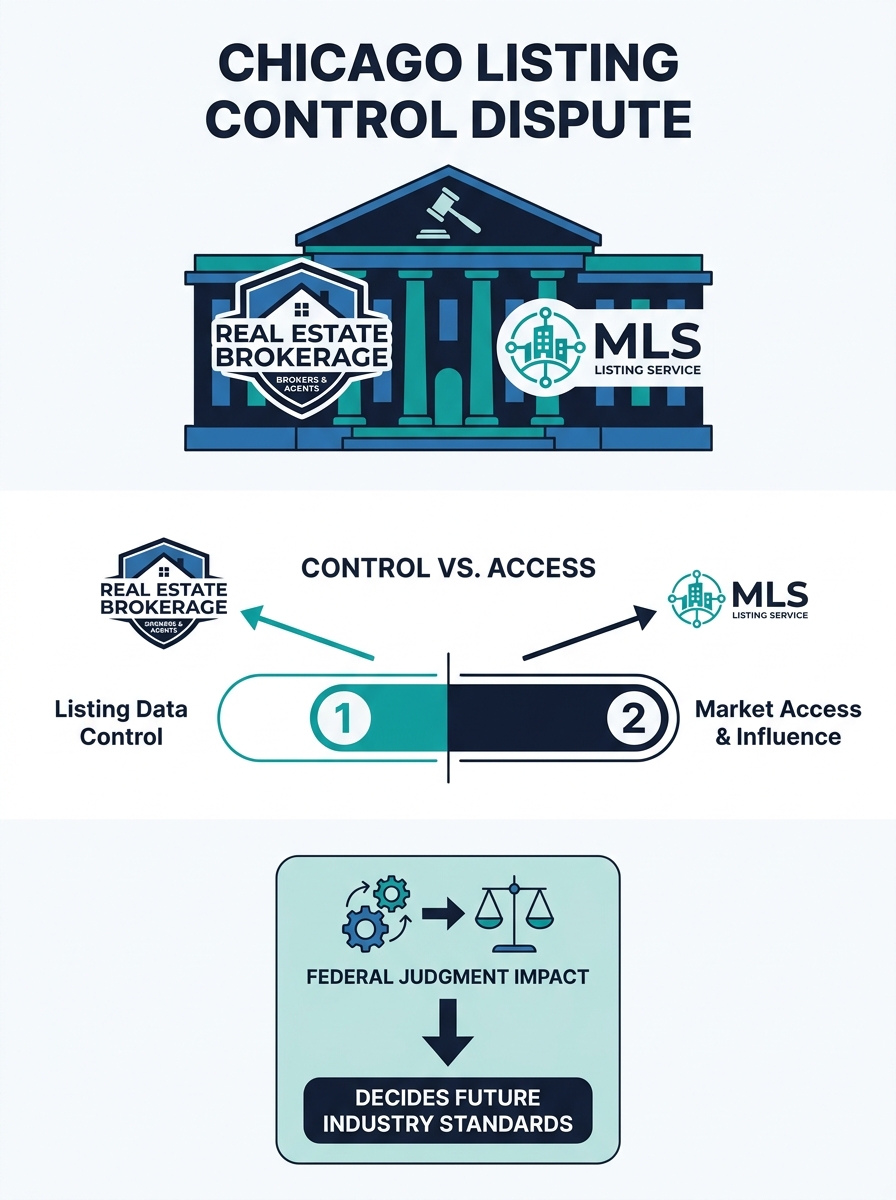
The case functions as a proxy battle over listing-data ownership, portal authority, and whether brokerages can build inventory ecosystems outside portals like Zillow. The outcome will influence how MLSs and brokerages across the country approach private listings and syndication requirements.
Compass Scale Intensifies Scrutiny
Compass closed its $1.6 billion acquisition of Anywhere Real Estate earlier in 2026, creating the nation’s largest residential brokerage with more than 340,000 agents and franchisees under combined brands including @properties, Coldwell Banker Realty, Corcoran, and Sotheby’s International Realty. Since the merger, Compass rolled out fixed transaction fees and an in-house referral program routing buyer inquiries to Compass agents while generating additional company revenue. Those initiatives now face legal challenges, including a proposed Florida class-action lawsuit alleging Compass’ transaction fees are unfair and deceptive, according to the filing. New York’s attorney general is reportedly investigating Compass’ market power and acquisition strategy following the Anywhere deal.
Compass has publicly criticized Zillow’s lead-diversion business model for inserting portals between consumers and listing agents while profiting from lead referrals. However, Compass’ own buyer-referral program directs online inquiries to affiliated agents and collects fees, creating operational parallels to the portal model Compass opposes. As Compass’ footprint expands, the company increasingly confronts questions over listing control, lead distribution, and transaction economics that it previously directed at Zillow.
Agent Marketing Flexibility at Stake
The Zillow-MRED standoff directly impacts real estate agents’ marketing workflows. Zillow’s pre-MLS restriction policy limits brokers’ ability to test private-network marketing before broad syndication, constraining the sequencing options agents use to control exposure and preserve exclusivity for high-end inventory. Agents who market properties through brokerage channels, private networks, or coming-soon campaigns before MLS submission risk losing Zillow visibility entirely under the current policy, reducing lead volume from the platform’s 221 million monthly unique users.
MLS syndication requirements vary by market, but the Chicago case establishes a precedent for whether portals can enforce submission-sequence rules beyond MLS regulations. If courts uphold Zillow’s policy, agents nationwide may face syndication conditions that override local MLS rules and brokerage marketing strategies. Conversely, a ruling favoring MRED and Compass would affirm brokers’ discretion to determine listing-exposure timelines independent of portal requirements, preserving flexibility for coming-soon listings, pocket listings, and off-market campaigns that agents use to differentiate service and control buyer access.
The case also tests how agents can use listing distribution control as a competitive tool. Brokerages investing in proprietary platforms and private networks see listing-sequence control as essential to capturing buyers before properties reach mass-market portals, allowing agents to claim exclusive access and justify premium commission structures. Portal-enforced submission rules undermine that positioning by requiring simultaneous or portal-first exposure.
Commission and Control Dynamics
The Chicago hearing arrives amid ongoing industry recalibration following commission-lawsuit settlements that reshaped buyer-agent compensation disclosure requirements. The Zillow-Compass dispute extends those structural questions to listing control and data ownership. Zillow argues that MRED’s feed termination punishes consumers by restricting inventory visibility, while MRED and Compass contend that Zillow’s policy amounts to unilateral contract enforcement that MLS members never agreed to.
Federal Judge John J. Tharp Jr.’s preliminary injunction ruling will determine whether Zillow must restore blocked listings while litigation proceeds or if MRED can maintain the feed cutoff pending case resolution. The decision carries immediate operational consequences for Chicago-area agents whose listings remain invisible on Zillow and broader strategic implications for how MLSs negotiate syndication terms with portals nationwide. Brokerages watching the case are evaluating whether to expand private-listing programs or align marketing workflows with portal submission requirements to preserve syndication reach.
Brokers Implications
Real estate agents and brokers should prepare for potential shifts in listing-syndication rules depending on how the Chicago court rules on Zillow’s preliminary injunction. If courts uphold portal-enforced submission sequences, agents will need to prioritize MLS-first workflows to maintain Zillow visibility, limiting flexibility for coming-soon campaigns and private-network marketing that many teams use to differentiate service and control buyer access. Brokerages should audit current listing-exposure processes to identify where pre-MLS marketing could trigger syndication restrictions under expanded portal policies.
Agents relying on Zillow leads as a primary traffic source face immediate operational risk if more MLSs adopt MRED’s approach and terminate portal feeds in response to submission-sequence disputes. Diversifying lead generation across multiple portals, direct-site traffic, and referral networks reduces vulnerability to single-platform policy changes. Teams marketing luxury and high-end inventory should evaluate whether pocket-listing and off-market strategies deliver enough premium-positioning value to justify lost portal reach, or if MLS-first submission preserves more total lead volume despite reduced exclusivity perception.
The Compass scrutiny around transaction fees and referral-program economics highlights a broader trend of regulatory attention on how large brokerages monetize individual transactions beyond traditional commission splits. Agents affiliated with consolidating brokerages should review fee structures and understand what portions of transaction revenue flow to corporate entities versus agent compensation, particularly as class-action litigation and state-AG investigations expand. The Chicago case ultimately tests whether data control remains with MLSs and brokerages or shifts toward portals that command consumer attention, a distinction that will shape how agents market listings and capture buyers for years ahead.