

California, Wisconsin, and New York have enacted or advanced disclosure laws requiring real estate agents to label AI-generated listing videos and digitally altered property images, establishing a regulatory framework that separates routine photo enhancements from material alterations that affect buyer perception, according to HousingWire.
TL;DR: Three states now mandate disclosure when AI tools add, remove, or materially change property features in listing media, with enforcement focused on alterations that create false impressions rather than basic photo editing.
California’s Assembly Bill 723 took effect January 1, 2026, requiring brokers and salespersons to disclose digitally altered images and provide access to original, unaltered versions. Wisconsin’s 2025 Act 69, effective in 2027, extends disclosure requirements to reels, animations, and generated video when technology creates false or misleading impressions. New York’s pending bill S9584 would define “digital representations” to include images, video, and immersive media requiring disclosure for material alterations or generated elements.
The laws arrive as agents increasingly deploy AI tools to generate property walkthrough videos from still photographs, create drone-style aerial approaches without capturing actual drone footage, and produce virtually staged interiors. The regulatory question centers not on whether AI was used but whether the technology changed what a reasonable buyer would believe about the property or how the media was captured.
California Sets the Template
Assembly Bill 723 applies when software or AI adds, removes, or changes visible elements including furniture, appliances, flooring, landscaping, façades, floor plans, window views, or neighboring properties. The statute exempts basic edits—lighting, cropping, sharpening, and color correction—as long as they do not change how the property actually looks.
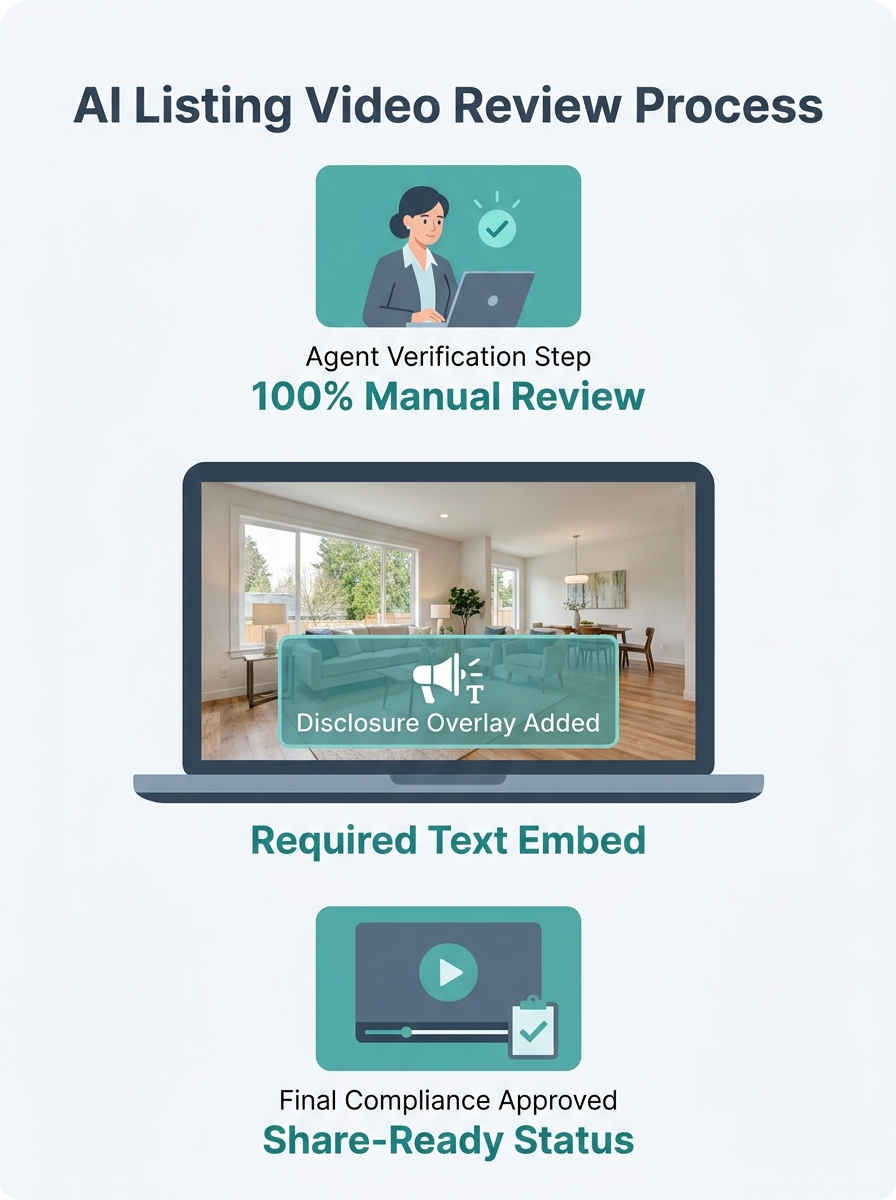
The law requires disclosure to travel with the altered media and mandates that agents maintain access to original versions. A virtually staged room photograph must be labeled near the image itself. An AI-generated listing video must include clear language in the video, caption, or description.
California regulators drew the line at alterations affecting condition, features, surroundings, or the way media was captured. A repaired roof that has not been repaired, a greener lawn that does not exist, a removed utility pole, or an improved view triggers disclosure requirements. So does an AI-generated video that appears to show drone footage or a walkthrough when the source material consisted only of still photography.
Wisconsin and New York Expand the Framework
Wisconsin’s Act 69 broadens the scope beyond static images to include any advertising altered using technology, including AI, that creates a false or misleading impression. The law takes effect in 2027 and explicitly covers reels, animations, and generated video formats that agents now deploy across Instagram, YouTube, and listing portals.
New York regulators have warned that AI-generated listing imagery can produce misleading or exaggerated representations. The pending S9584 bill would codify disclosure requirements for digital representations spanning images, video, and immersive media. The bill defines material alterations to include generated elements that affect how buyers perceive property condition, layout, or features.
The state-by-state approach creates compliance complexity for agents working across jurisdictions, but the professional standard emerging across all three states remains consistent: agents must not let AI create false impressions about property condition or media capture methods.
The Five-Part Disclosure Test
Before publishing AI-assisted listing media, agents should apply a five-part evaluation framework. First, determine whether technology added to, removed, or materially changed anything about the property. Review the final asset as a buyer would. If visible features, condition, layout, or surroundings have been altered, treat it differently from ordinary photo enhancement.
Second, assess whether the video presents movement or perspective that was never actually captured. If it shows aerial-style motion, camera transitions, or a walkthrough created from still images, disclose that directly with language such as “AI-generated video created from property photographs. No drone or walkthrough footage was captured.”
Third, evaluate whether the change affects how a buyer understands the property. Condition, landscaping, views, room size, nearby properties, signs of damage, or features that do not actually exist require careful treatment. If the visual change could influence whether a buyer schedules a showing, writes an offer, or negotiates price, disclose it.
Fourth, confirm that the buyer will actually see the disclosure. Agents have adopted disclosure language including “Virtually staged. Furniture shown is not included,” “Image has been digitally altered. Original photo available on request,” “Video was created from listing photos using AI,” and “Drone-style movement is simulated. No drone footage was captured.” The wording varies by platform, brokerage policy, and state law, but buyers must be able to quickly understand what was real, what was staged, and what was generated.
Fifth, maintain documentation showing what was real and what was changed. Agents should keep original photos, edited versions, generated videos, and disclosure language used with each asset. Even when a specific law does not require that documentation, it serves as professional protection if questions arise later about what was original, what was altered, and how it was disclosed.
What Happens Next
Agents adopting AI staging tools for vacant listings and AI-powered property description generators now face a compliance layer that protects both buyers and brokers. The disclosure framework does not prohibit AI-generated marketing—it requires transparency about what technology changed.
Brokerages should implement pre-publication review protocols for AI-assisted listing media, similar to existing MLS remark review processes. The five-part test translates into checklists that marketing teams can apply before pushing AI-generated videos to YouTube, Instagram, or listing portals. Agents who document original assets, label alterations clearly, and maintain disclosure records position themselves ahead of enforcement actions as additional states adopt similar statutes.
The competitive advantage shifts from producing the most polished AI-generated property tour to producing the most trustworthy one. Agents who disclose AI use plainly and maintain original-asset documentation build buyer trust while expanding their digital marketing toolkit within the evolving regulatory framework.