

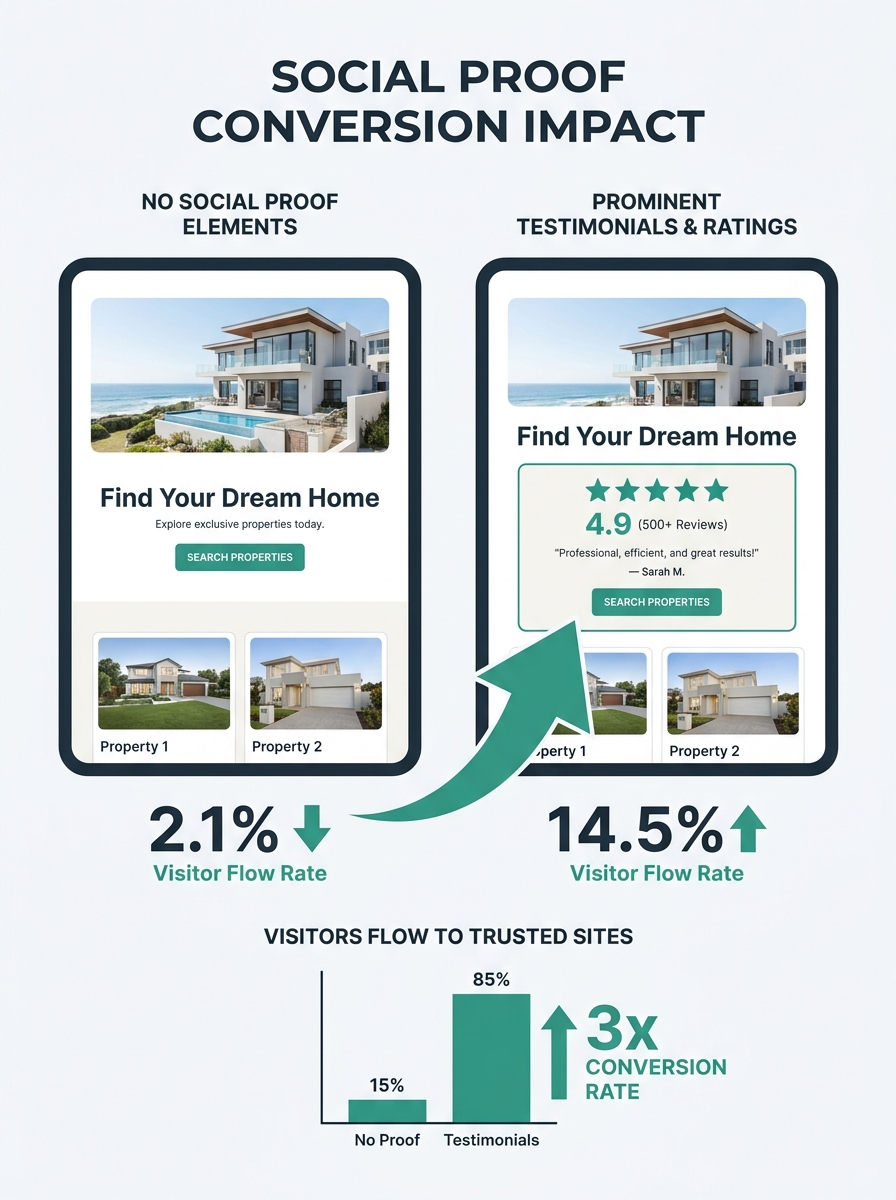
Adding high-quality testimonials to a real estate website increases conversion rates by 34%, turning 1,000 monthly visitors from 100 leads into 134, according to Carrot’s conversion analysis. Sites that skip this step hand those 34 extra leads per month directly to competing agents who display client reviews prominently.
TL;DR: Real estate websites without visible testimonials, reviews, and trust indicators lose up to a third of potential leads to competitors who display social proof. Placing client reviews on your homepage, property pages, and CTA sections creates credibility signals real estate buyers and sellers evaluate before they ever fill out a contact form.
The 34% Conversion Gap Is a Lead Conversion Barrier You Built Yourself
Testimonial-free sites bleed leads because real estate transactions involve the largest financial decisions most people ever make, and visitors assess trustworthiness within seconds of landing on your page. A site without visible real estate social proof creates a lead conversion barrier that pushes prospects toward agents who look more credible online.
The math is straightforward. Carrot’s analysis documents that a site converting at 10% jumps to 13.4% after adding testimonials, a 34% lift with no additional traffic required. For an agent closing 1 in every 15 to 25 leads, that difference translates to roughly one additional deal per month. At an average commission, you’re looking at thousands of dollars walking out the door because your website lacks a few paragraphs of client feedback.
And the compounding effect is significant: that same Carrot analysis showed agents going from $40,000 to $50,000 in monthly wholesale fees after adding testimonials, a $10,000 monthly increase from the same traffic volume.
Tom Ferry’s lead generation team puts it bluntly: “Reviews, photos, and accurate information help you capture home seller leads without paying for every click. Social proof builds trust faster than ads alone,” per their strategy breakdown on lead generation sources.
What Counts as Credibility Signals Real Estate Buyers Actually Trust
Testimonials are the most visible trust indicator, but they’re one piece of a broader proof architecture. An effective website testimonials strategy layers multiple proof types so different visitor segments find the validation they need.
| Social Proof Type | Best Placement | Trust Impact |
|---|---|---|
| Written client testimonials | Homepage, landing pages, service pages | High (direct experience narrative) |
| Google Business Profile reviews | Local search results, GBP listing | High (third-party verified, affects local ranking) |
| Video testimonials | Homepage hero section, about page | Very high (hardest to fake, strongest emotional resonance) |
| Awards and recognitions | Footer, about page, sidebar | Medium (institutional credibility) |
| Transaction volume statistics | Homepage, seller landing pages | Medium-high (quantitative proof of activity) |
Luxury Presence reported that its clients averaged $24 million in annual sales volume in 2024, nearly 10 times the industry standard of $2.5 million. That gap illustrates what happens when agents aggressively display credibility signals real estate consumers respond to. As Luxury Presence’s analysis stated: “The more you share social proof, the more prospects are willing to trust you.”
Celebrity endorsements and award logos play a supporting role. Lockbox’s analysis of real estate social proof notes that trust indicators have historically included “celebrity endorsements, testimonials, or awards.” The digital version of those signals belongs on your website, visible and current.
Placement Determines Whether Client Reviews Conversion Actually Happens
You can collect 50 glowing testimonials and still lose leads if they’re buried on a page nobody visits. The research is consistent: put reviews where traffic already flows.
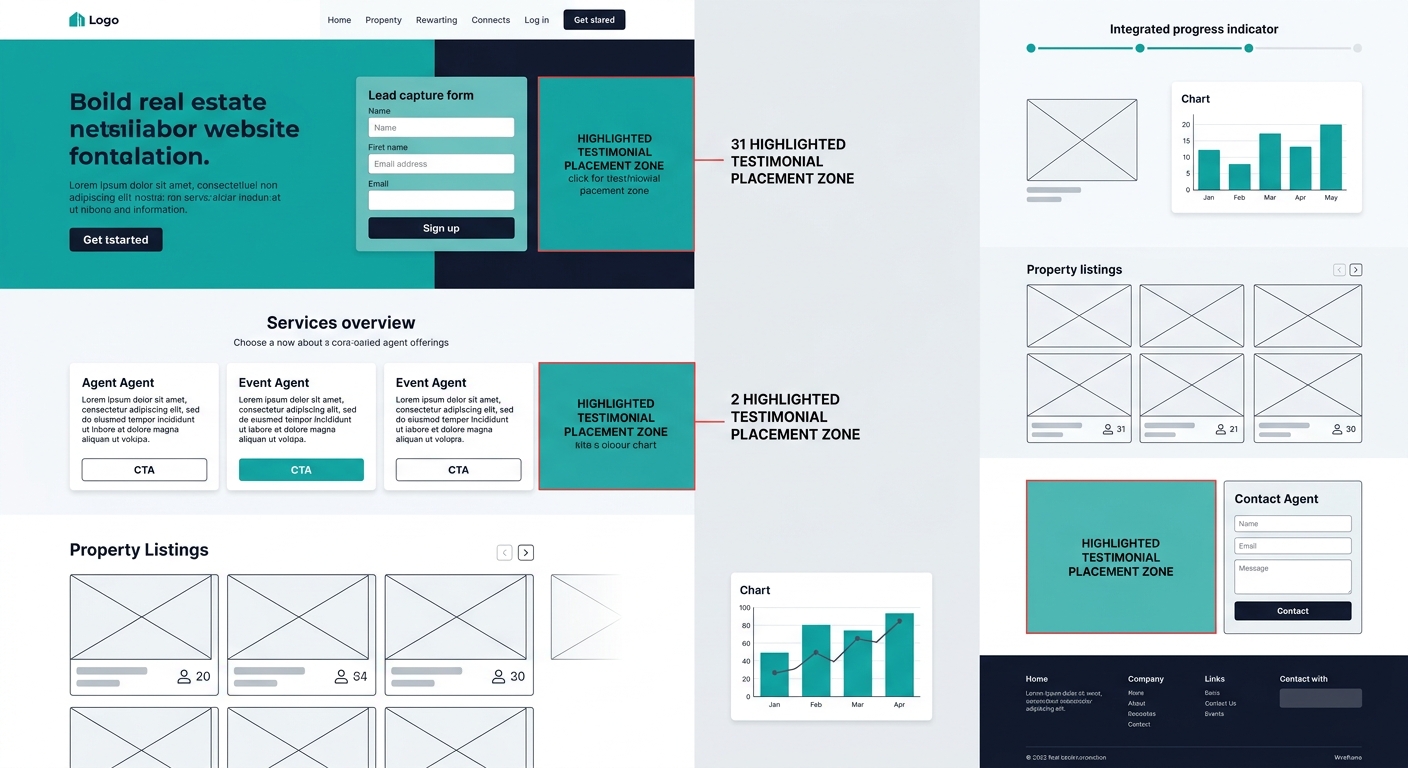
US Realty Training’s guidance is direct: “Place testimonials on high-traffic areas like your homepage, landing pages, and specific service pages,” per their marketing testimonials overview. WiserNotify’s conversion analysis echoes the same prescription, recommending display on “the homepage, property pages, and call-to-action sections” as the three highest-impact placements.
Here’s a placement framework worth testing. Think of it as the Testimonial Proximity Rule: every page that asks a visitor to take action (fill a form, call you, schedule a showing) should have a client review visible within one scroll of that call-to-action button. If a visitor hits your CTA without having seen social proof on the same page, you’ve created friction. And if your CTAs are already underperforming, missing testimonials compound the problem.
The same logic applies to property pages. When someone browses a listing on your site, they’re evaluating both the home and the agent. A short testimonial near the contact form on a listing page connects the property experience to your credibility. We’ve covered how property page element hierarchy affects buyer behavior, and testimonials deserve a spot in that hierarchy right alongside price, photos, and square footage.
Every page that asks a visitor to take action should have a client review visible within one scroll of that call-to-action.
Your Google Business Profile Is the Review Engine That Feeds Everything Else
Google reviews do double duty. They build trust with prospects who find you through search, and they directly affect your local ranking position. HousingWire’s testimonial guide states it plainly: “The more 5-star testimonials you have, specifically on your Google business profile, the higher you will rank on Google when someone searches for a real estate agent in your area.”
This matters because local visibility and website credibility are now intertwined. When Google’s listing ads and organic results compete for the same screen space, agents with 47 five-star reviews outperform agents with 3. The review count becomes either a lead conversion barrier or a lead accelerator, depending on which side of the gap you sit.
iHomeFinder’s lead generation analysis reinforces this point: “Encouraging satisfied clients to leave positive reviews can significantly boost your reputation and attract new leads. Effectively leveraging Google Business Profile results in a steady stream of high-quality leads.”
Tip: Ask every closed client for a Google review within 48 hours of closing. The emotional high point of a successful transaction is the easiest moment to get a detailed, enthusiastic review. Send a direct link to your GBP review page via text, not email. Text open rates run above 90%, compared to roughly 20% for email.
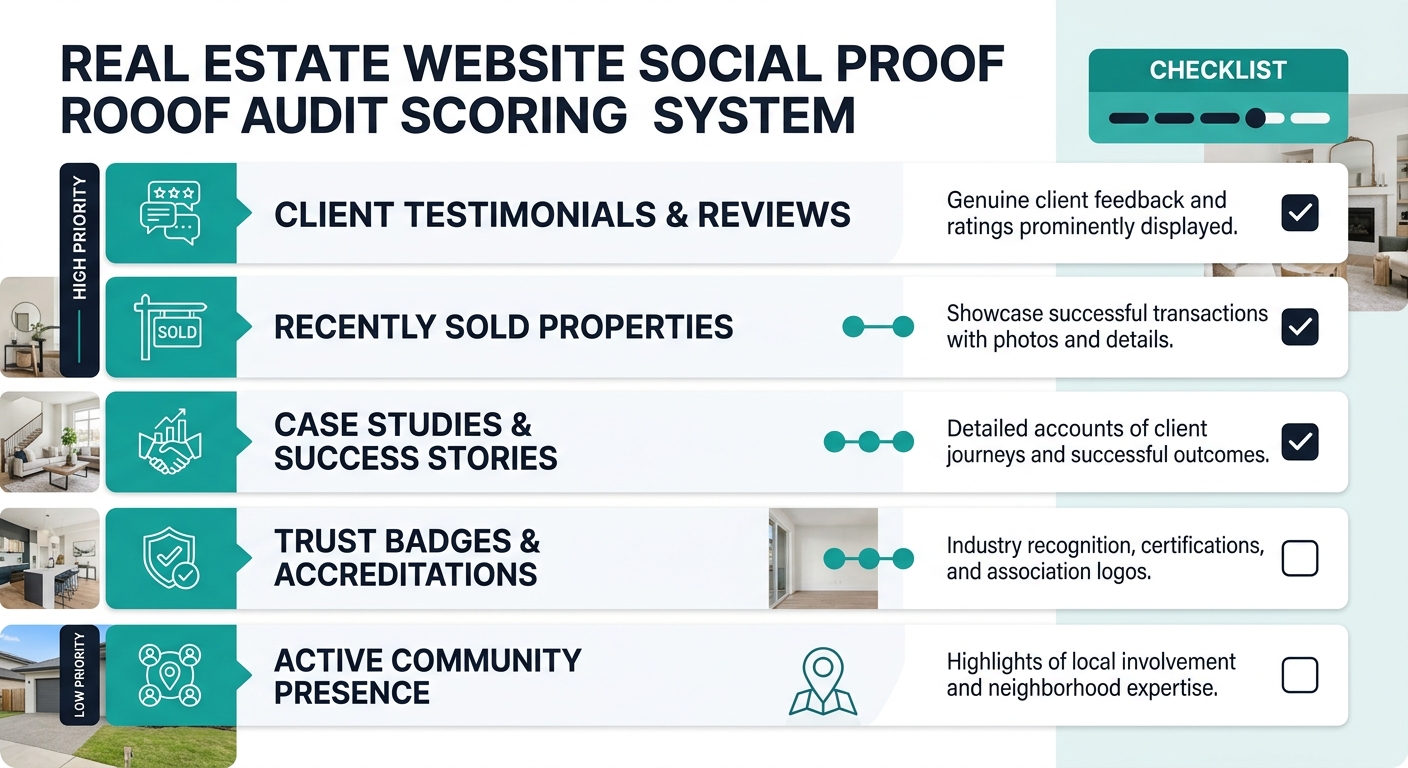
The Five-Point Social Proof Audit
Run this audit on your site right now. Score yourself 0 or 1 on each item:
- Homepage testimonial visibility: Can a visitor see at least one client testimonial without scrolling past the fold? (1 point)
- CTA-adjacent proof: Does every page with a lead capture form display a review within one scroll of that form? (1 point)
- Google review count: Do you have 20 or more Google Business Profile reviews with a 4.5+ average rating? (1 point)
- Recency: Is your most recent displayed testimonial from the past 6 months? Stale reviews signal inactivity. (1 point)
- Specificity: Do your testimonials mention specific outcomes (“sold in 12 days,” “$15K over asking,” “found a home in 3 weeks”) rather than generic praise? (1 point)
A score of 3 or higher puts you ahead of most competing agents in your market. A score of 0 or 1 means your website is actively leaking leads. If you’ve already run a broader website performance audit, add this social proof check to your regular review cycle.
How to Collect Testimonials Without the Awkward Ask
Agents know they should request reviews. They avoid it because the ask feels transactional at a moment that should feel celebratory. Two approaches reduce that friction considerably.
The closing-day photo method works well: take a photo of your clients at closing with keys in hand, in front of their new home, or signing documents. Text them the photo within 24 hours with a message like: “Loved working with you! Would you mind sharing a few words about the experience? Here’s the link.” The photo triggers positive recall, and the text provides a direct path. Keep the ask under 30 words.
The milestone email sequence works for agents with a CRM that supports drip campaigns. Set a trigger for 30 days post-close with a personalized email asking how they’re settling in, followed by a soft review request. At 90 days, send a second request to anyone who didn’t respond. These sequences integrate naturally if your CRM setup already supports automated workflows.
Both methods succeed because they tie the request to a specific positive moment rather than dropping it as a generic ask weeks later. Specificity in the testimonial itself matters, too. Coach your clients by asking targeted questions: “What was your biggest concern before we started working together?” and “What surprised you most about the process?” These prompts produce testimonials with narrative detail that generic five-star ratings can’t match.
What Still Isn’t Settled
The 34% conversion lift from testimonials comes from broad industry data, and individual results will vary based on traffic quality, market competition, and how well the rest of your site performs. Agents in saturated markets where multiple competitors display strong social proof may see diminishing returns from basic text testimonials alone, pushing them toward video reviews or detailed case-study formats for differentiation.
There’s also an open question about review fatigue. As every agent in a market accumulates 50+ Google reviews, the signal value of count alone diminishes. The differentiator shifts toward review quality: specific transaction details, named neighborhoods, dollar amounts, and timelines. Generic five-star reviews reading “Great agent, highly recommend!” carry less weight with sophisticated buyers and sellers who have learned to scan for substance.
What remains clear is the baseline: a real estate website with zero visible social proof is handing leads to competitors who have it. The audit above takes 10 minutes. The fix, for most agents, takes an afternoon of placement changes and a week of outreach to past clients. The cost of doing nothing is measurable in leads lost every month your site runs without the credibility signals real estate consumers now expect as standard.