
Auditing your real estate website’s Core Web Vitals without comparing them against the agents who outrank you in your specific zip code produces data that looks useful but changes nothing. The numbers only mean something relative to your local competition.
TL;DR: A performance audit that checks your site’s speed against Google’s thresholds misses the point. The agents stealing your leads have specific, measurable Core Web Vitals scores you can benchmark against. Test your site, test theirs, and close the gaps that affect conversion, which drops 4.42% for every additional second of load time.
Google Ranks You Against Local Competitors, So Your Audit Should Too
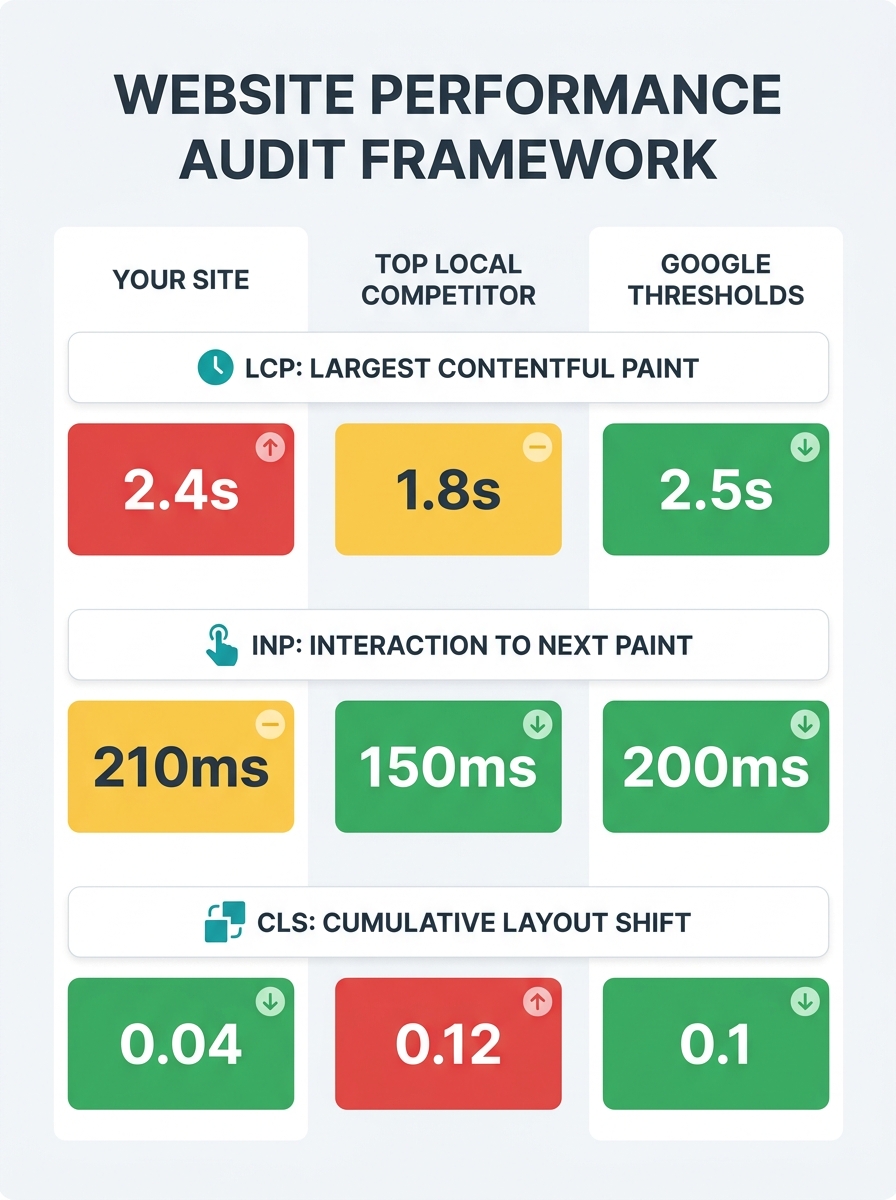
Google’s Core Web Vitals report in Search Console evaluates your pages based on real-world usage data collected over 28 days, sometimes called field data. The three metrics that determine whether your site passes are Largest Contentful Paint (LCP) under 2.5 seconds, Interaction to Next Paint (INP) under 200 milliseconds, and Cumulative Layout Shift (CLS) below 0.1. These thresholds are universal. But ranking is relative.
When a buyer searches “homes for sale in [your neighborhood],” Google doesn’t rank you in a vacuum. It compares your page experience scores against every other agent and portal competing for that same query. A site with an LCP of 3.1 seconds might rank fine in a market where every competitor scores 4+ seconds. That same 3.1-second LCP gets buried in a market where the top three results load in under 2 seconds.
This is why the standard approach to real estate website performance benchmarking, running PageSpeed Insights on your homepage and checking green versus red scores, misses the entire competitive dimension. The audit that moves your business forward has three columns: your score, your top local competitor’s score, and Google’s threshold. Two out of three tell you where you stand. All three tell you what to fix.
According to a December 2025 analysis by CD Studio, sites with poor Core Web Vitals performance rarely appear in AI-generated search responses. As AI Overviews consume more space in search results, and as platforms like Google’s real estate listing pilot continue expanding, agents with slow sites lose visibility in both traditional organic results and AI-cited traffic simultaneously. The agents who explored why their sites underperform competitors found the answer usually wasn’t design. It was load performance on the pages that actually matter: listing detail pages, neighborhood landing pages, and contact forms.
I call this the Three-Column Audit: your site, your top local competitor, Google’s published thresholds. Every metric you measure goes into all three columns. If your LCP is 3.4 seconds, your competitor’s is 1.9 seconds, and Google’s “good” threshold is 2.5 seconds, you know exactly where you stand and what closing the gap is worth.
Info: Run PageSpeed Insights on your homepage AND your heaviest listing page. Many real estate sites pass Core Web Vitals on the homepage but fail on property detail pages loaded with gallery images and embedded virtual tours.
Every Additional Second of Load Time Costs You 4.42% of Conversions
The relationship between website speed and lead conversion in real estate follows a steep, punishing curve. According to Portent’s research, cited across multiple 2026 audit frameworks, each additional second of load time reduces conversion rates by 4.42%. For a real estate site converting at the industry average of 1–3%, losing even a fraction of a percentage point translates directly into missed listing inquiries, skipped showing requests, and abandoned contact forms.
A Deloitte and Google collaborative study found that a 0.1-second improvement in page speed increased retail conversion rates by 8.4%. Real estate isn’t retail, but the behavioral mechanism is identical: faster pages keep visitors engaged long enough to complete the action you want them to take. Vodafone saw an 8% increase in sales after improving LCP. RedBus reported a 7% sales increase after optimizing INP. These are large companies, but the conversion physics apply equally to a three-agent team in suburban Phoenix.
“A $50,000 custom website build can still fail every core technical benchmark if the developer had no SEO brief,” according to luxury real estate marketing directors surveyed in Q1 2026. The spend doesn’t predict the speed. What predicts speed is whether anyone measured it against the sites that are actually winning the local search results.
The mobile dimension makes this worse. Over 69% of home buyers search on mobile devices, and 53% of mobile visitors abandon a site if it takes longer than 3 seconds to load. If your listing pages hit 4 seconds on a 4G connection while your competitor’s pages load in 2.2 seconds, you’re not splitting the market evenly. You’re handing qualified leads to someone who invested in performance instead of features. Agents who’ve audited their mobile conversion gaps consistently find that the biggest problems aren’t on the homepage.
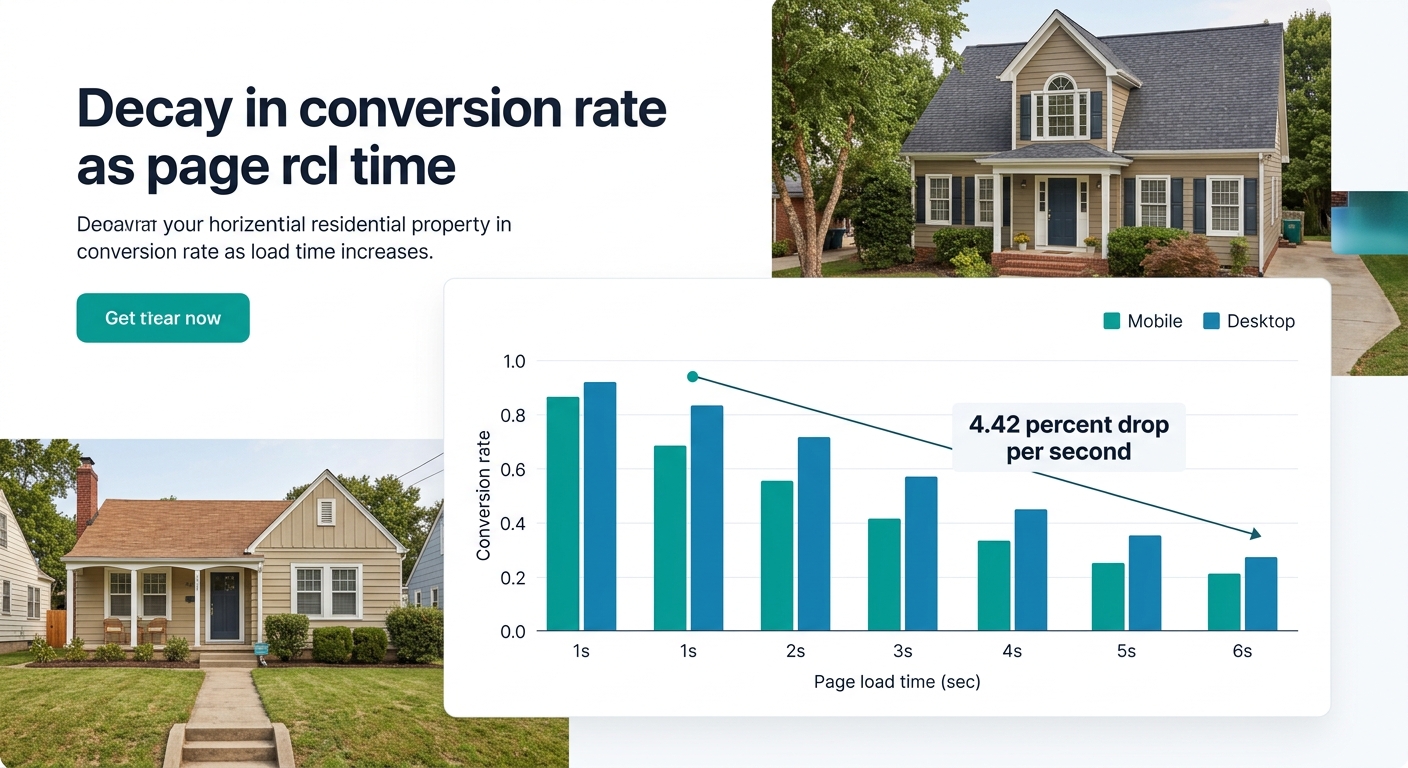
A site with a PageSpeed score below 50 on mobile is a lead leak you can measure in dollars, roughly 4.42% of your conversions gone for every extra second of delay.
IDX Iframes Create a Performance Floor You Can’t Optimize Below
Why do so many real estate sites fail Core Web Vitals despite using modern templates and fast hosting? For a large percentage of agent websites, the answer is the IDX integration method.
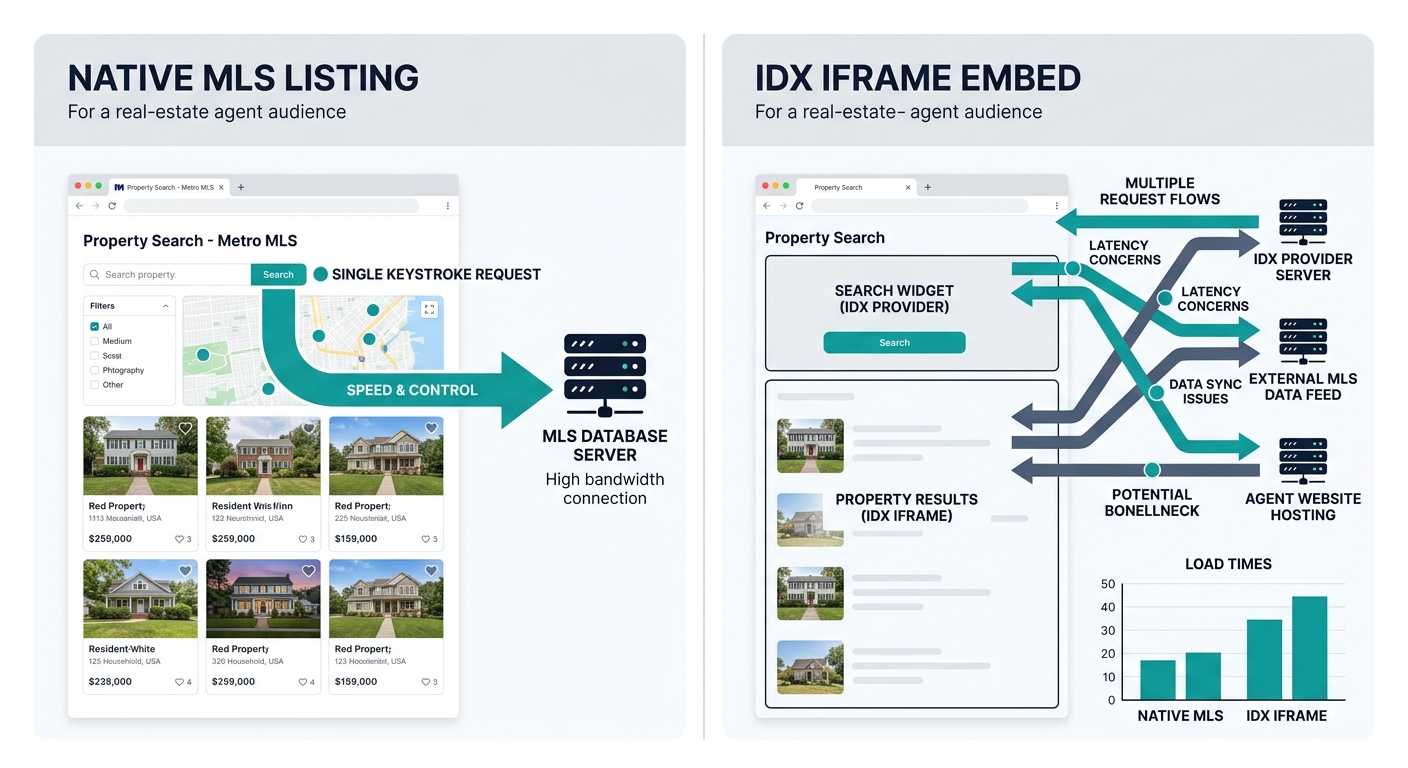
Traditional IDX search widgets and iframe embeds inject third-party content that your server doesn’t control. The browser has to load your page, then load an entirely separate application inside it. That second load carries its own JavaScript, its own CSS, its own image assets. Your LCP score tanks because the largest visual element (often the listing photos inside the IDX frame) loads on someone else’s timeline. Your INP score suffers because click interactions inside the iframe route through the third-party server before responding. Your CLS score breaks because the iframe dimensions shift as content loads asynchronously.
You can benchmark this directly by testing two near-identical pages: one using imported MLS listings as native content, and one using a traditional IDX iframe widget. The performance gap is consistently measurable. Native MLS content renders as part of your page. Iframes render as a page within a page, and Google’s field data measures both layers against you.
“I have audited over 200 real estate websites in the last three years. Luxury sites consistently have the worst Core Web Vitals scores, worse than mid-market, worse than commercial real estate,” an SEO auditor reported in Pro Prank Digital’s 2026 audit guide. The reason tracks back to heavy media assets delivered through third-party embeds rather than optimized native content.
Agents evaluating what they actually need from a website builder should weigh IDX integration method as heavily as design templates. A platform like Pillar property websites that serves listing content natively rather than through iframes gives you a performance floor that’s structurally higher. You start the race closer to the finish line.
And the penalties stack. Each extra form field reduces conversion by 10–15%, according to DM4RE’s 2026 analysis of realtor website mistakes. An agent running IDX widgets alongside multi-field contact forms is stacking two conversion killers on the same page. Agents who’ve investigated why fast sites still lose leads often trace the problem to this exact combination.
The Audit Without a Competitor Column Is Decoration
The claim at the top of this article bears repeating with specifics attached. Average real estate conversion rates sit between 0.4% and 1.2%, according to industry benchmarks. Even a 1% lift in conversion rate can meaningfully change your annual deal count. But you can’t know whether that lift is available to you unless you know where you stand relative to the agents and portals ranking above you for your target searches.
A competitive website audit for agents follows a simple structure. Pick the three queries that matter most to your business: your city name plus “real estate agent,” your top neighborhood plus “homes for sale,” and your own name. Run PageSpeed Insights on the pages that rank (or should rank) for those terms. Run the same test on the pages currently holding positions one through three. Record LCP, INP, and CLS for all of them. The gaps you find are the gaps Google is using to decide ranking order.
This Three-Column Audit format connects directly to search visibility and conversion outcomes. Responding within 5 minutes of a lead inquiry makes you 100x more likely to connect than responding after 30 minutes, according to real estate lead conversion research. But that speed advantage means nothing if the lead never reaches your form because your page loaded too slowly for them to bother filling it out. The full chain matters: page speed to form completion to response time to closed deal. Auditing one link without the others is how agents end up blaming their CRM when the real problem is a 4.8-second LCP on their listing pages.