
Google’s crawler arrives at your real estate website and finds 200 property pages sitting at the same URL depth, built on identical templates, carrying near-duplicate meta descriptions, and linking to nothing else on the site. Every listing looks the same to the algorithm. Your $1.2M waterfront home with drone photography and a custom video walkthrough carries the same structural weight as a studio condo you listed as a favor. The crawler treats them equally because your property page SEO structure gives it no reason to do otherwise.
This is the hierarchy problem, and it explains why agents pour money into listing photography and copywriting only to watch those pages sit at position 40+ in local search. The fix isn’t more content. It’s how you organize the content you already have.
Three architectural approaches solve this problem differently, each with real costs and tradeoffs worth understanding before you rebuild anything.
The Flat Structure: Simple to Build, Impossible to Rank
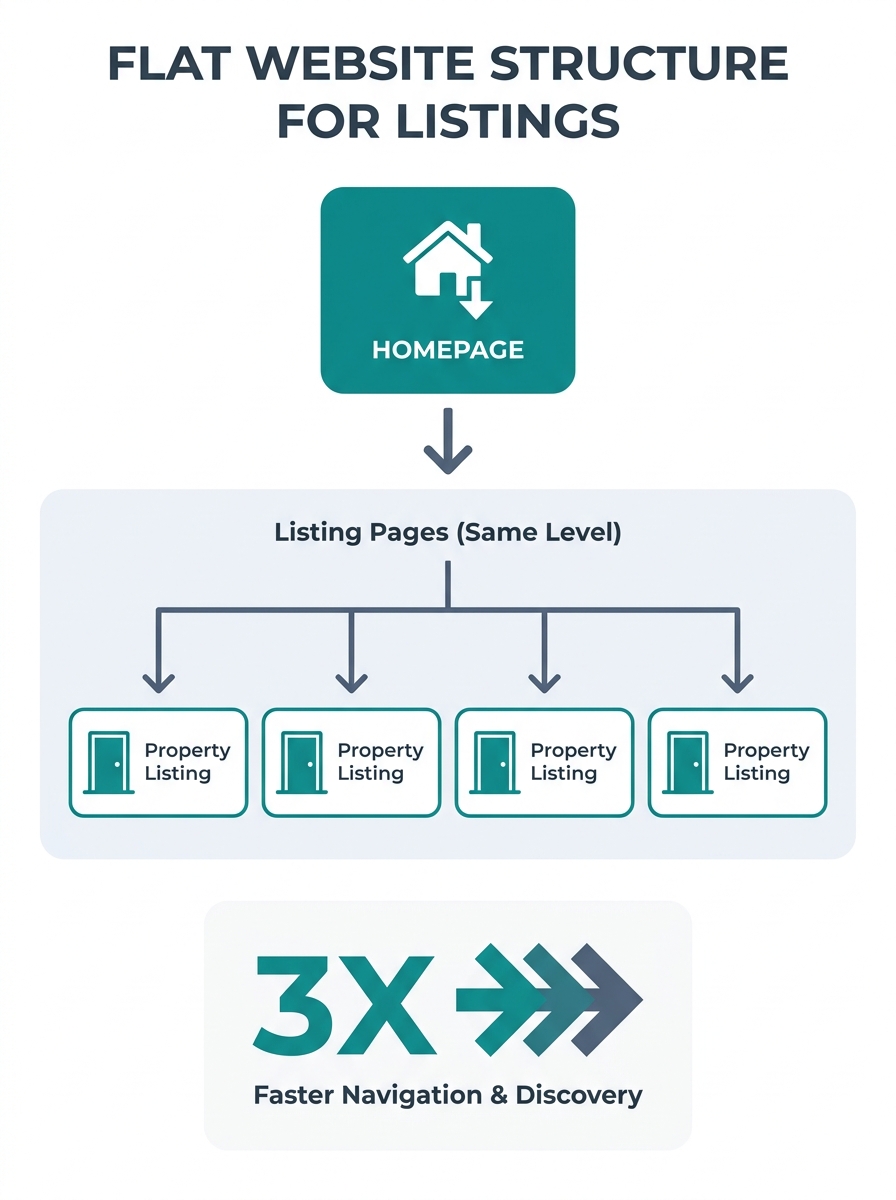
The default setup on most agent websites is flat: every property page lives at a URL like yoursite.com/listing/123-main-st, and none of them connect to each other or to any parent page. IDX feeds generate these pages automatically, and agents rarely touch them after import.
Why agents end up here
It’s the path of least resistance. If you’ve gone through an IDX integration for your site, you know the feed populates listings without manual effort. Pages appear, pages expire, the cycle continues. No one has to think about structure because there isn’t one.
Where it breaks down
Flat structures create three specific ranking problems:
- Crawl budget waste. Google allocates a finite number of pages it will crawl per visit. When every listing page sits at the same priority level, the crawler has no signal about which pages matter. Your flagship listing gets the same crawl frequency as expired pages that haven’t been cleaned up.
- Zero internal link equity. A property page with no inbound links from other pages on your site inherits almost no authority. According to ScaleAcres’ guide on internal linking for real estate, organizing your site into clear categories makes internal linking natural and ensures link equity flows where it matters.
- Duplicate signals. When 200 pages share the same template structure, similar meta descriptions, and thin unique content, Google may consolidate them or simply ignore the majority. Your real estate listing visibility depends on each page communicating distinct value, and flat structures make that nearly impossible at scale.
The flat structure works if you have fewer than 20 active listings and don’t rely on organic search for buyer traffic. For everyone else, it’s a ceiling you’ll hit fast.
The Location-Hub Model: Listings Nested Under Neighborhood Pages
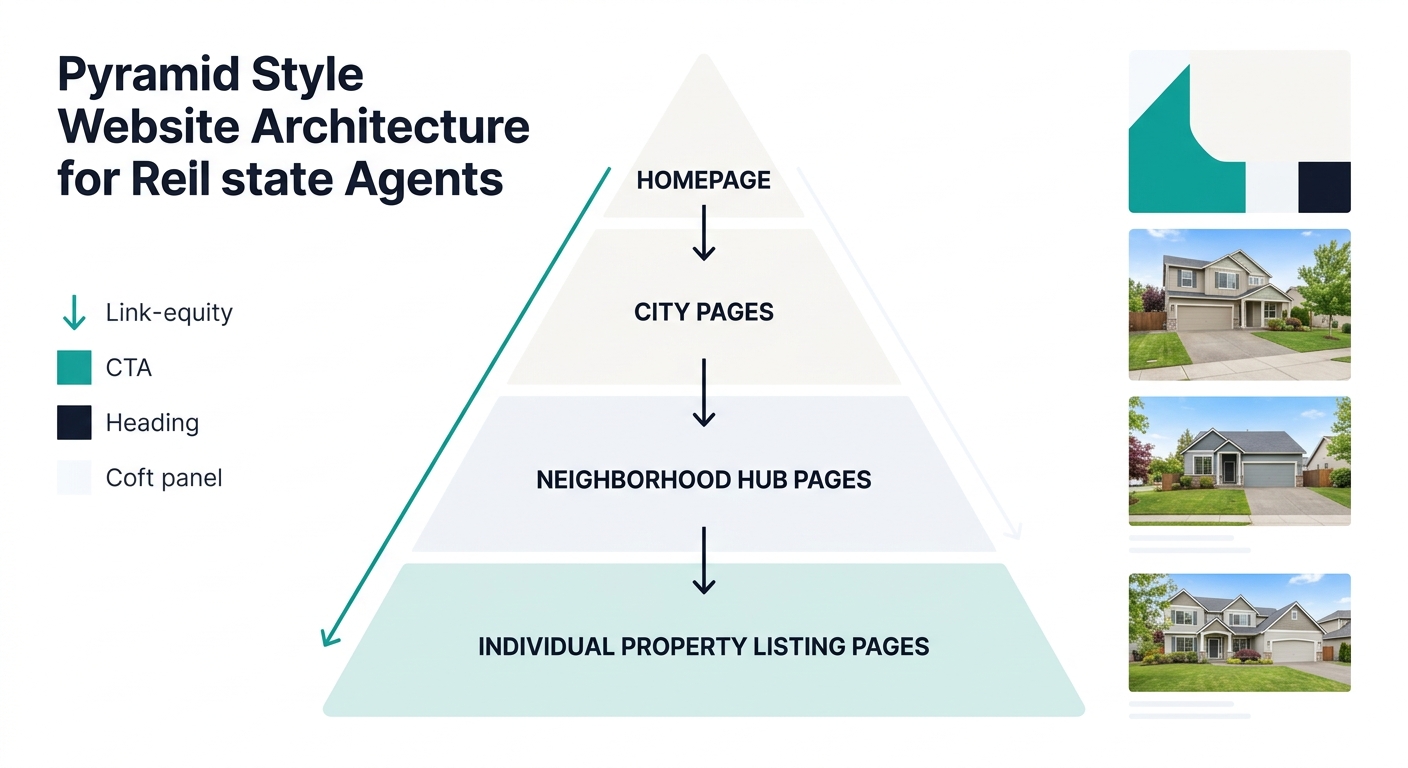
This approach treats geography as the organizing principle. Instead of every listing floating independently, properties are grouped under neighborhood or city pages that act as parent hubs. The URL structure looks like yoursite.com/austin-tx/zilker/123-main-st, and each neighborhood page links down to its active listings while also linking sideways to adjacent neighborhoods.
How the hierarchy works
Think of it as a pyramid. Your homepage links to city-level pages. City pages link to neighborhood pages. Neighborhood pages link to individual property listings. Each layer passes authority downward, and the listings at the bottom inherit the relevance signals that their parent pages have accumulated over time.
This is where building neighborhood content hubs pays compound dividends. A well-written Zilker neighborhood page that ranks for “homes in Zilker Austin” passes local relevance to every property listed beneath it. When a buyer searches “3 bedroom house Zilker,” Google already associates your site with that area.
Your flagship listing doesn’t need to rank on its own authority. It needs to inherit authority from the neighborhood page above it.
The tradeoffs you should know about
The location-hub model is the strongest approach for local search ranking for listings, but it comes with real maintenance costs:
- Each neighborhood page needs unique, substantive content. Copying the same paragraph across 15 neighborhood pages with only the city name swapped will get those pages ignored or filtered by Google. As one SEO guide for real estate puts it bluntly: “Do not copy the same content across pages. Each location must feel unique.”
- You need to actively manage internal linking for property pages as listings come and go. When a property sells, the link from the neighborhood page should update. Broken internal links erode the authority chain you’ve built.
- Building this structure takes upfront time. You’re writing 10-30 neighborhood pages before you see ranking improvements, and each one needs local keywords, embedded maps, and genuine area knowledge.
Agents who already produce area-specific content will find this model a natural extension of what they’re doing. Agents who hate writing will find it painful. The results, though, are the most durable of the three options. Pages you build today will still pass authority to listings you add two years from now.
Dedicated Single-Property Pages for Priority Listings
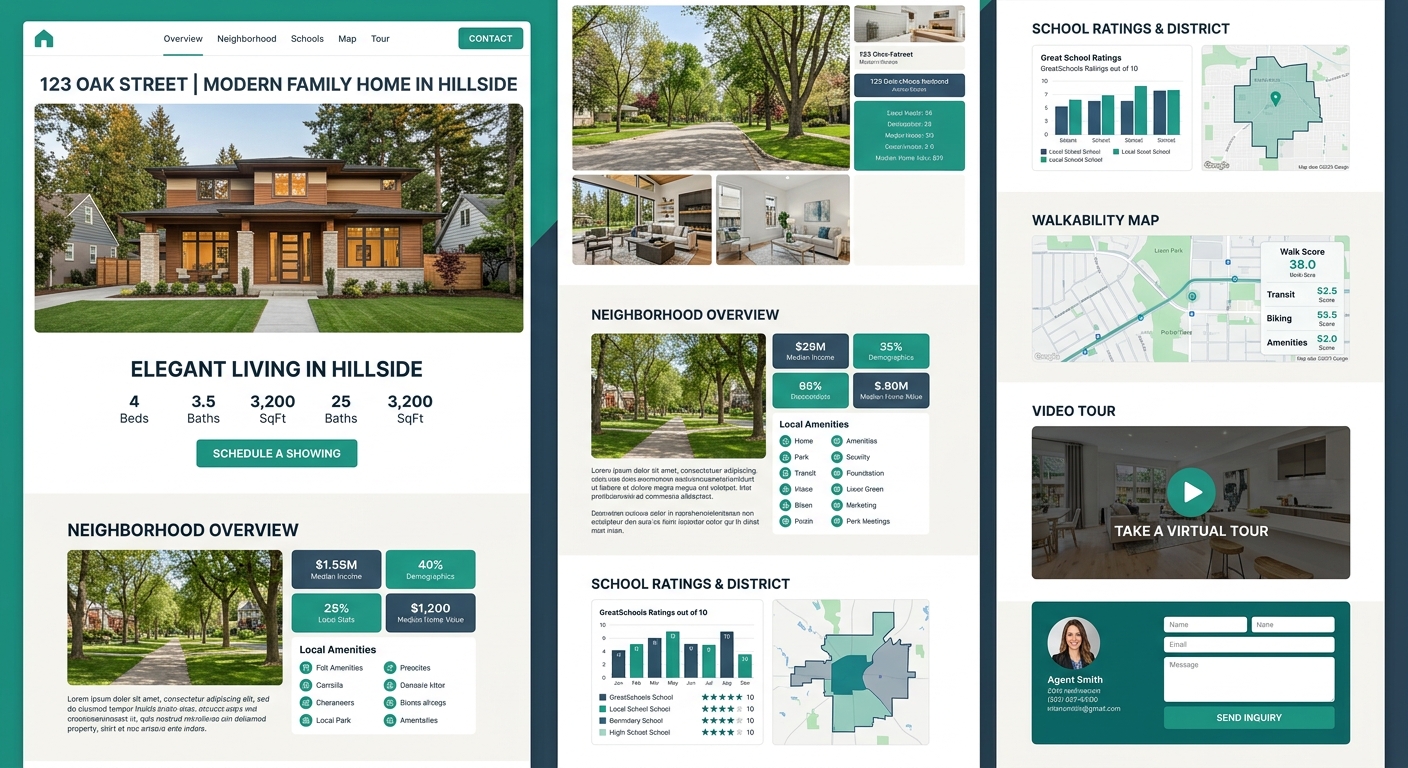
The third option is selective rather than systematic. Instead of restructuring your entire site, you identify your highest-value listings and build them dedicated pages that function almost as standalone microsites within your domain. These pages get custom URLs, unique content blocks (think neighborhood context, school data, walkability analysis), embedded video, and deliberate internal links from your blog posts, neighborhood pages, and homepage.
When this makes sense
If you carry a small number of premium listings at any given time, the math favors depth over breadth. A dedicated page for a $2M property can include 800+ words of unique content, pull in schema markup for price and location, and earn links from your social channels and email campaigns. That concentrated effort pushes a single page up in search results far faster than spreading the same energy across 50 template listings.
BrightLocal’s research on local real estate SEO emphasizes tailoring each page’s meta titles and descriptions to include local search terms, making individual listings more discoverable for specific location queries. Dedicated pages give you the space to do this properly.
This approach also pairs well with your broader website architecture strategy, because these priority pages can serve as anchor points that link out to your neighborhood hubs and related listings, strengthening the overall site structure even if you haven’t built a full pyramid.
The tradeoffs you should know about
Dedicated pages take real production effort per listing. You’re writing unique copy, sourcing or creating visuals, and building internal links manually. That’s fine for five listings a quarter. It’s unsustainable for fifty.
There’s also a lifespan problem. When the property sells, you have a page with accumulated authority and nowhere to send it. Smart agents redirect sold-listing URLs to the parent neighborhood page, transferring that equity back up the chain. Agents who don’t think about redirects end up with 404 errors that waste everything they built.
And if you only apply this treatment to select listings, your remaining inventory still sits in whatever default structure your site uses. The hierarchy problem persists for your mid-tier properties.
Tip: When a dedicated listing page accumulates backlinks and authority, always 301-redirect the URL to the neighborhood parent page after the sale closes. That link equity doesn’t have to die with the listing.
How To Choose Between These Three
The honest answer depends on your inventory volume, your willingness to produce content, and how much of your lead flow comes from organic search versus paid channels or referrals.
If you run fewer than 20 active listings and organic search is a secondary lead source, the flat structure won’t kill you. Focus your energy elsewhere. But understand that you’re leaving local search ranking potential on the table.
If you cover a defined geographic area and want compounding organic traffic over time, the location-hub model is the strongest choice. It requires the most upfront work and ongoing maintenance, but it’s the only approach that makes every future listing automatically stronger by inheriting established neighborhood authority. Agents who build property websites on Pillar get a structural advantage here because the platform is designed around this kind of organized, SEO-conscious architecture.
If you carry a handful of high-value listings and need them to rank quickly, dedicated single-property pages give you the most control per listing. Combine this with the location-hub model for everything else, and you’ve got the best of both approaches running simultaneously.
Most agents who take property page SEO structure seriously end up with a hybrid: location hubs as the foundation, dedicated pages for their top three to five listings at any given time, and proper redirects when properties close. The combination ensures that link equity from internal linking for property pages never evaporates. Authority you build today circulates through your site for years. The agents who figure this out stop competing with Zillow for generic terms and start owning the neighborhood-level searches where actual buyers make decisions.